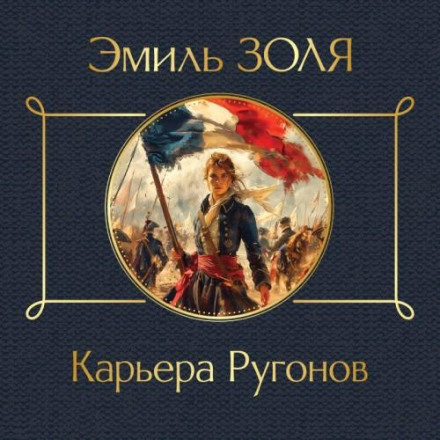
The Fortune of the Rougons
15 hrs. 21 min.
Émile Zola (1840–1902) was one of the pillars of world realistic literature—the leader of the literary movement of naturalism, a passionate publicist and human-rights advocate, and a keen researcher of everyday life.
His best-known work is the monumental twenty-volume cycle “Rougon-Macquart,” opening before the reader an endless panorama of human vices and virtues in the settings of the Second Empire—an encyclopedia of life in Paris and the French provinces based on several generations of one family, which bore the strangest offspring.
“The Career of the Rougons” is Émile Zola’s first novel from the Rougon-Macquart cycle, first published in 1871. Zola’s plan was to show in the series how heredity and environment affected members of one family during the years of the Second Empire—the period of Napoleon III’s dictatorship.
In the first novel of the series, Zola tells the beginning of the histories of the Rougon and Macquart families, revealing the origins of nearly all the main members, focusing primarily on Pierre Rougon and his half-brother Antoine Macquart. They take part in an adventure involving the seizure of power in the city and opposition to republican insurgents.
His best-known work is the monumental twenty-volume cycle “Rougon-Macquart,” opening before the reader an endless panorama of human vices and virtues in the settings of the Second Empire—an encyclopedia of life in Paris and the French provinces based on several generations of one family, which bore the strangest offspring.
“The Career of the Rougons” is Émile Zola’s first novel from the Rougon-Macquart cycle, first published in 1871. Zola’s plan was to show in the series how heredity and environment affected members of one family during the years of the Second Empire—the period of Napoleon III’s dictatorship.
In the first novel of the series, Zola tells the beginning of the histories of the Rougon and Macquart families, revealing the origins of nearly all the main members, focusing primarily on Pierre Rougon and his half-brother Antoine Macquart. They take part in an adventure involving the seizure of power in the city and opposition to republican insurgents.
1.
The Fortune of the Rougons
(narrated by
Alexey Dyakov)
1.
The Fortune of the Rougons
(narrated by
Konstantin Dneprovsky)
1.
The Fortune of the Rougons
2.
La Curée (The Kill)
(narrated by
Inna Sytnik)
2.
La Curée (The Kill)
(narrated by
Konstantin Dneprovsky)
3.
The Belly of Paris
(narrated by
Larisa Tretyakova)
3.
The Belly of Paris
(narrated by
Konstantin Dneprovsky)
3.
The Belly of Paris
(narrated by
Pavel Lomakin)
3.
The Belly of Paris
(narrated by
Vsevolod Kuznetsov)
4.
The Conquest of Plassans
(narrated by
Konstantin Dneprovsky)
5.
The Sin of Father Mouret
(narrated by
Arkady Bukhmin)
5.
The Sin of Father Mouret
(narrated by
Alina Ray)
5.
The Sin of Abbé Mouret
(narrated by
Konstantin Dneprovsky)
6.
His Excellency Eugene Rougon
(narrated by
Valery Tolkov)
7.
L'Assommoir
(narrated by
Veronika Oboyanka)
7.
The Trap
(narrated by
Margarita Ivanova)
8.
A Love Episode
(narrated by
Oleg Martyanov)
8.
A Love Episode
(narrated by
Natalya Frolova)
9.
Nana
(narrated by
Nikolay Orlovsky)
9.
Nana
(narrated by
Natalya Pervina)
9.
Nana
(narrated by
Irina Vorobyova)
10.
Pot Luck
(narrated by
Natalya Domeretskaya)
11.
The Ladies' Paradise
(narrated by
Olga Zyuzina)
11.
The Ladies' Paradise
(narrated by
Yuliya Tarkhova)
11.
The Ladies' Paradise
(narrated by
Veronika Oboyanka)
12.
The Joy of Life
(narrated by
Yuliya Tarkhova)
12.
The Joys of Life
(narrated by
Sergey Kazakov)
13.
Germinal
(narrated by
Yury Zaborovsky)
13.
Germinal
(narrated by
Natalya Pervina)
13.
Germinal
(narrated by
Konstantin Dneprovsky)
13.
Germinal
(narrated by
Arkady Bukhmin)
14.
The Masterpiece
(narrated by
Tatyana Telegina)
14.
The Masterpiece
(narrated by
Olga Andreeva)
14.
The Masterpiece
(narrated by
Ivan Zabelin)
15.
Earth
(narrated by
Valery Tolkov)
16.
The Dream
(narrated by
Irina Efremova, Olga Evdokimova)
17.
The Beast Within
(narrated by
Arkady Bukhmin)
17.
The Beast Within
(narrated by
Valery Tolkov)
18.
Money
(narrated by
Yury Zaborovsky)
18.
Money
(narrated by
Yaroslav Lukashev)
18.
Money
(narrated by
Olga Andreeva)
18.
Money
(narrated by
Konstantin Dneprovsky)
19.
The Debacle
(narrated by
Ilya Akintyev)
20.
Doctor Pascal
(narrated by
Vladislav Pogiba)
La Bête humaine
(narrated by
Roman Popov)
The Dream
(narrated by
Olga Evdokimova)
