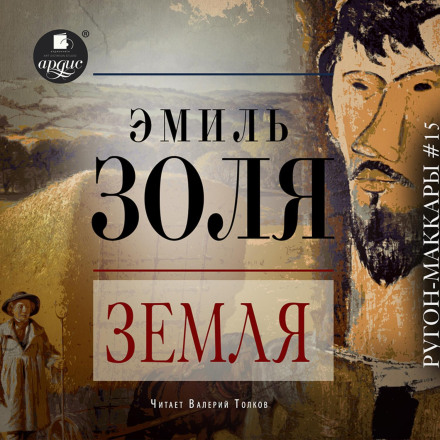
Earth
18 hrs. 53 min.
"The Soil" is Émile Zola’s fifteenth novel in the "Rougon-Macquart" cycle, dedicated to members of one family who lived during the Second Empire—Napoleon III’s dictatorship period—written in 1887 and perhaps one of the most provocative. It is a rather dark recollection of peasant life in the second half of the 19th century: small landowners hungering for profit, gripped by a passion for the land that drives them to crime. The book is packed with details that were meant to shock readers of that era—when animal breeding alternated with human activity, marked by a pace and brutality often reaching rape. When "The Soil" appeared, it sparked fierce disputes, an example of which was the "Manifesto of the Five," an article published in the newspaper "Figaro" by five young writers who advised Zola to consult Dr. Charcot, a famous French neurologist, to cure painful obsessive ideas.
1.
The Fortune of the Rougons
(narrated by
Alexey Dyakov)
1.
The Fortune of the Rougons
(narrated by
Konstantin Dneprovsky)
1.
The Fortune of the Rougons
(narrated by
Elena Shemet)
2.
La Curée (The Kill)
(narrated by
Inna Sytnik)
2.
La Curée (The Kill)
(narrated by
Konstantin Dneprovsky)
3.
The Belly of Paris
(narrated by
Larisa Tretyakova)
3.
The Belly of Paris
(narrated by
Konstantin Dneprovsky)
3.
The Belly of Paris
(narrated by
Pavel Lomakin)
3.
The Belly of Paris
(narrated by
Vsevolod Kuznetsov)
4.
The Conquest of Plassans
(narrated by
Konstantin Dneprovsky)
5.
The Sin of Father Mouret
(narrated by
Arkady Bukhmin)
5.
The Sin of Father Mouret
(narrated by
Alina Ray)
5.
The Sin of Abbé Mouret
(narrated by
Konstantin Dneprovsky)
6.
His Excellency Eugene Rougon
(narrated by
Valery Tolkov)
7.
L'Assommoir
(narrated by
Veronika Oboyanka)
7.
The Trap
(narrated by
Margarita Ivanova)
8.
A Love Episode
(narrated by
Oleg Martyanov)
8.
A Love Episode
(narrated by
Natalya Frolova)
9.
Nana
(narrated by
Nikolay Orlovsky)
9.
Nana
(narrated by
Natalya Pervina)
9.
Nana
(narrated by
Irina Vorobyova)
10.
Pot Luck
(narrated by
Natalya Domeretskaya)
11.
The Ladies' Paradise
(narrated by
Olga Zyuzina)
11.
The Ladies' Paradise
(narrated by
Yuliya Tarkhova)
11.
The Ladies' Paradise
(narrated by
Veronika Oboyanka)
12.
The Joy of Life
(narrated by
Yuliya Tarkhova)
12.
The Joys of Life
(narrated by
Sergey Kazakov)
13.
Germinal
(narrated by
Yury Zaborovsky)
13.
Germinal
(narrated by
Natalya Pervina)
13.
Germinal
(narrated by
Konstantin Dneprovsky)
13.
Germinal
(narrated by
Arkady Bukhmin)
14.
The Masterpiece
(narrated by
Tatyana Telegina)
14.
The Masterpiece
(narrated by
Olga Andreeva)
14.
The Masterpiece
(narrated by
Ivan Zabelin)
15.
Earth
16.
The Dream
(narrated by
Irina Efremova, Olga Evdokimova)
17.
The Beast Within
(narrated by
Arkady Bukhmin)
17.
The Beast Within
(narrated by
Valery Tolkov)
18.
Money
(narrated by
Yury Zaborovsky)
18.
Money
(narrated by
Yaroslav Lukashev)
18.
Money
(narrated by
Olga Andreeva)
18.
Money
(narrated by
Konstantin Dneprovsky)
19.
The Debacle
(narrated by
Ilya Akintyev)
20.
Doctor Pascal
(narrated by
Vladislav Pogiba)
La Bête humaine
(narrated by
Roman Popov)
The Dream
(narrated by
Olga Evdokimova)
