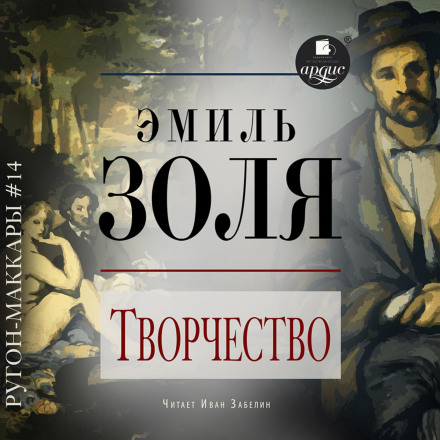
The Masterpiece
15 hrs. 7 min.
“Creativity” is the fourteenth novel by Émile Zola in the “Rougon-Macquart” cycle, devoted to members of one family who lived during the Second Empire—the period of Napoleon III’s dictatorship. First published as a separate book in 1886. At the age of eight, Claude Lantier was brought to Plassan by an elderly gentleman captivated by the quality of his drawings (see the novel “The Trap”). He also appears in another novel in the cycle, “The Belly of Paris.” In “Creativity,” Lantier—who resembles the Impressionist Paul Cézanne— is the childhood friend of the writer Pierre Sandoz, to whom Zola passed many of his own traits.
Together with Sandoz and other artists and sculptors, Claude struggles to introduce a new form of painting, far from the neoclassical canon popular at official exhibitions. If some of the artists eventually manage to win, Lantier goes from failure to failure, remaining misunderstood by the public and often by his own friends.
Together with Sandoz and other artists and sculptors, Claude struggles to introduce a new form of painting, far from the neoclassical canon popular at official exhibitions. If some of the artists eventually manage to win, Lantier goes from failure to failure, remaining misunderstood by the public and often by his own friends.
1.
The Fortune of the Rougons
(narrated by
Alexey Dyakov)
1.
The Fortune of the Rougons
(narrated by
Konstantin Dneprovsky)
1.
The Fortune of the Rougons
(narrated by
Elena Shemet)
2.
La Curée (The Kill)
(narrated by
Inna Sytnik)
2.
La Curée (The Kill)
(narrated by
Konstantin Dneprovsky)
3.
The Belly of Paris
(narrated by
Larisa Tretyakova)
3.
The Belly of Paris
(narrated by
Konstantin Dneprovsky)
3.
The Belly of Paris
(narrated by
Pavel Lomakin)
3.
The Belly of Paris
(narrated by
Vsevolod Kuznetsov)
4.
The Conquest of Plassans
(narrated by
Konstantin Dneprovsky)
5.
The Sin of Father Mouret
(narrated by
Arkady Bukhmin)
5.
The Sin of Father Mouret
(narrated by
Alina Ray)
5.
The Sin of Abbé Mouret
(narrated by
Konstantin Dneprovsky)
6.
His Excellency Eugene Rougon
(narrated by
Valery Tolkov)
7.
L'Assommoir
(narrated by
Veronika Oboyanka)
7.
The Trap
(narrated by
Margarita Ivanova)
8.
A Love Episode
(narrated by
Oleg Martyanov)
8.
A Love Episode
(narrated by
Natalya Frolova)
9.
Nana
(narrated by
Nikolay Orlovsky)
9.
Nana
(narrated by
Natalya Pervina)
9.
Nana
(narrated by
Irina Vorobyova)
10.
Pot Luck
(narrated by
Natalya Domeretskaya)
11.
The Ladies' Paradise
(narrated by
Olga Zyuzina)
11.
The Ladies' Paradise
(narrated by
Yuliya Tarkhova)
11.
The Ladies' Paradise
(narrated by
Veronika Oboyanka)
12.
The Joy of Life
(narrated by
Yuliya Tarkhova)
12.
The Joys of Life
(narrated by
Sergey Kazakov)
13.
Germinal
(narrated by
Yury Zaborovsky)
13.
Germinal
(narrated by
Natalya Pervina)
13.
Germinal
(narrated by
Konstantin Dneprovsky)
13.
Germinal
(narrated by
Arkady Bukhmin)
14.
The Masterpiece
(narrated by
Tatyana Telegina)
14.
The Masterpiece
(narrated by
Olga Andreeva)
14.
The Masterpiece
15.
Earth
(narrated by
Valery Tolkov)
16.
The Dream
(narrated by
Irina Efremova, Olga Evdokimova)
17.
The Beast Within
(narrated by
Arkady Bukhmin)
17.
The Beast Within
(narrated by
Valery Tolkov)
18.
Money
(narrated by
Yury Zaborovsky)
18.
Money
(narrated by
Yaroslav Lukashev)
18.
Money
(narrated by
Olga Andreeva)
18.
Money
(narrated by
Konstantin Dneprovsky)
19.
The Debacle
(narrated by
Ilya Akintyev)
20.
Doctor Pascal
(narrated by
Vladislav Pogiba)
La Bête humaine
(narrated by
Roman Popov)
The Dream
(narrated by
Olga Evdokimova)
100%
55:10
Творчество - 0 -
1:04:11
Творчество - 1 -
1:20:37
Творчество - 2 -
1:05:26
Творчество - 3 -
1:02:03
Творчество - 4 -
1:09:49
Творчество - 5 -
1:22:03
Творчество - 6 -
1:12:03
Творчество - 7 -
1:40:23
Творчество - 8 -
1:51:17
Творчество - 9 -
1:23:45
Творчество - 10 -
1:01:11
Творчество - 11 -
