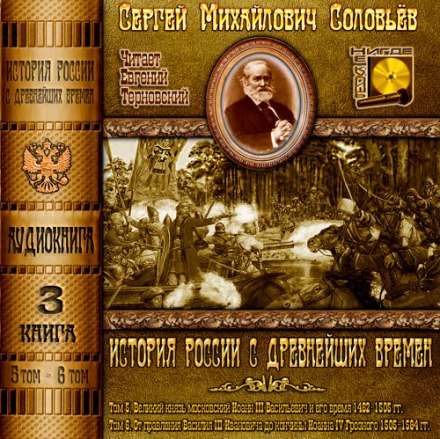
History of Russia from Ancient Times, Volumes 5–6
51 hrs. 27 min.
Language
Russian
Author
Sergey Solovyov
Author
Sergey Solovyov
Narrator
Evgeny Ternovsky
Narrator
Evgeny Ternovsky
Volume 5. Grand Prince of Moscow Ivan III Vasilyevich and his time, 1462–1505.
Volume 6. From the reign of Vasily III Ivanovich to the death of Ivan IV the Terrible, 1505–1584.
Volume 5. Contents
Book content 3
First section
Chapter 01. Novgorod the Great
The significance of Ivan III and his character.— The state of Novgorod the Great.— The Lithuanian side.— The Boretskys.— Clashes with the Grand Prince.— The cautious behavior of the Grand Prince and the metropolitan.— The election of the ruler.— Veche feuds.— A treaty with Casimir of Lithuania.— The war of Novgorod with Moscow.— Peace in the old way.— The consecration of the ruler Feofil.— Novgorod’s lack of armaments; those who were wronged appeal to the grand-princely court.— Peaceful arrival of Ivan to Novgorod for the administration of justice. Court.— Petitioners go to Moscow.— The ruler and the master.— Ivan wants to be master in Novgorod.— A new war.— Novgorod brought on par with Moscow.— Movements in Novgorod in favor of old ways.— Executions and resettlements.— The annexation of Vyatka.— Quarrels of Pskovites with grand-princely officials.— The Moscow Grand Prince administers in Ryazan.— The annexation of Tver to Moscow; the final annexation of Yaroslavl and Rostov.
Chapter 02. Sophia Paleolog
Annexation of the appanage of Vereya to Moscow.— Ivan III’s attitude toward his kinsmen brothers.— Ivan’s second marriage to Sophia Paleolog.— The significance of Sophia.— The struggle between Ivan’s son and grandson.— The fate of the leading nobles.
Chapter 03. The East
Subjugation of Kazan.— Conquest of Perm.— The Yugra princes pay tribute to Moscow; the establishment of Russians on the Pechora; crossing beyond the Ural Mountains.— Raids by Khan Akhmat of the Golden Horde.— Ivan’s behavior during the second raid by Akhmat.— A message to him from Vassian, Archbishop of Rostov.— Akhmat’s retreat from Ugra.— Akhmat’s death in the steppe.— The Crimean Horde.— Ivan’s alliance with the Crimean Khan Mengli-Girey; Crimean forces finish off the Golden Horde.— First contacts of Russia with Turkey.— Relations with the Tyumen people, the Nogais, Horesan, and Georgia.
Chapter 04. Lithuania
The favorable position of the Moscow Grand Prince relative to the Lithuanian prince.— Casimir of Lithuania’s hostility toward Ivan.— Ivan allied with the Crimean Khan against Lithuania.— Transfer of minor border princes from Lithuanian subjection to Moscow.— The death of King Casimir.— Offensive movement from Moscow toward Lithuania.— Courtship of Casimir’s son, Grand Prince Alexander, for Elena, Ivan’s daughter.— Peace and marriage.— Troubles regarding Elena.— Transfer of the princes of Belsky, Chernigov, and Seversk from Alexander to Ivan.— Renewed war.— Victories of the Russians at Vèdroshe and near Mstislavl.— Alexander seeks peace.— Mediation by the King of Hungary.— Truce.— Elena’s relations with her father.— Wars with Livonian Germans.— War with the Swedes in alliance with Denmark.— Relations with the Austrian court and Venice.
Chapter 05. Internal state of Russian society in the time of Ivan III
Death and will of Ivan III.— Agreement of Ivan’s sons while their father was alive.— Ivan III’s title.— The form of address of nobles and servants to the Grand Prince.— Seals.— The Grand-Princely treasury.— Wealth of appanage princes.— Grand-princely revenues.— The Grand Prince’s way of life.— Comparative position of the Grand Princes of Moscow and Lithuania.— Princes and boyars in Moscow.— Cross-swearing records.— New court ranks.— The court of the Grand Princess.— Wealth of prince-boyars.— Feeding allowances.— Estates.— Forces in the North-Eastern and South-Western Russia.— Orders (administrative departments).— Cities in South-Western Russia.— Magdeburg law.— The appearance of a Russian city.— Fires.— Rural population.— Yuryev Day.— Rural population in Lithuanian possessions.— Misfortunes.— Trade.— Arts.— Posts.— The Church.— The heresy of Judaizers.— Joseph Volotsky.— Measures to improve the morals of the clergy.— Concerns for literacy.— God-based life in monasteries.— Teachings.— Material condition of the clergy.— Question: should monasteries own populated estates? Connection between the Russian Church and the Eastern Church.— Condition of Orthodox clergy in Lithuanian possessions.— The Sudebnik of Ivan III and the Sudebnik of Casimir of Lithuania.— Popular law.— Public morality.— Literature.
Second section
Chapter 01. Pskov
War with Kazan.— War with Lithuania.— Glinsky.— Death of King Alexander.— Glinsky arms himself against his successor Sigismund and enters into service with the Moscow Grand Prince.— Eternal peace between Vasily and Sigismund.— Hostility between Vasily and Crimea.— Livonian affairs.— Fall of Pskov.
Chapter 02. Smolensk
Renewal of war with Lithuania.— Capture of Smolensk.— Betrayal by Glinsky.— Defeat of the Russians at Orsha.— Sigismund does not take advantage of victory.— Sigismund incites the Crimeans to attack Russian possessions.— Alliance of Vasily with Albrecht of Brandenburg.— Mediation by Emperor Maximilian.— Embassy of Gerberstein.— Alliance of Kazan and Crimea against Moscow.— Invasion by Magmet-Girey.— Truce with Lithuania.— Wars with Kazan.— Relations with Crimea, Sweden, Hanseatic cities, Denmark, Rome, and Turkey.— Annexation of Ryazan, the Principality of Seversk, and the appanage of Volotsk.
Chapter 03. Internal affairs
Relations of the Grand Prince with his brothers.— Divorce of Vasily and a new marriage.— Illness and death of Vasily.— The character of the deceased.— His way of life, family relations.— Relations with nobles.— Title, revenues of the Grand Princes of Moscow and Lithuania.— Customs of the Moscow court.— Composition of the court.— Troops.— Orders.— Charters of grant.— Nobility and troops in Western Russia.— Cossacks.— Cities.— Rural population.— Properties of the land according to foreign descriptions.— Industries.— Trade.— Arts.— Church events.— Joseph Volotsky and Maxim Grek.— Vassian Kosoy.— Everyday life of monasteries.— Relations with Eastern churches.— Condition of the West-Russian Church.— Legislation.— Popular law.— Morals and customs.— Literature.
First section
Chapter 01. Novgorod the Great
The significance of Ivan III and his character.— The state of Novgorod the Great.— The Lithuanian side.— The Boretskys.— Clashes with the Grand Prince.— The cautious behavior of the Grand Prince and the metropolitan.— The election of the ruler.— Veche feuds.— A treaty with Casimir of Lithuania.— The war of Novgorod with Moscow.— Peace in the old way.— The consecration of the ruler Feofil.— Novgorod’s lack of armaments; those who were wronged appeal to the grand-princely court.— Peaceful arrival of Ivan to Novgorod for the administration of justice. Court.— Petitioners go to Moscow.— The ruler and the master.— Ivan wants to be master in Novgorod.— A new war.— Novgorod brought on par with Moscow.— Movements in Novgorod in favor of old ways.— Executions and resettlements.— The annexation of Vyatka.— Quarrels of Pskovites with grand-princely officials.— The Moscow Grand Prince administers in Ryazan.— The annexation of Tver to Moscow; the final annexation of Yaroslavl and Rostov.
Chapter 02. Sophia Paleolog
Annexation of the appanage of Vereya to Moscow.— Ivan III’s attitude toward his kinsmen brothers.— Ivan’s second marriage to Sophia Paleolog.— The significance of Sophia.— The struggle between Ivan’s son and grandson.— The fate of the leading nobles.
Chapter 03. The East
Subjugation of Kazan.— Conquest of Perm.— The Yugra princes pay tribute to Moscow; the establishment of Russians on the Pechora; crossing beyond the Ural Mountains.— Raids by Khan Akhmat of the Golden Horde.— Ivan’s behavior during the second raid by Akhmat.— A message to him from Vassian, Archbishop of Rostov.— Akhmat’s retreat from Ugra.— Akhmat’s death in the steppe.— The Crimean Horde.— Ivan’s alliance with the Crimean Khan Mengli-Girey; Crimean forces finish off the Golden Horde.— First contacts of Russia with Turkey.— Relations with the Tyumen people, the Nogais, Horesan, and Georgia.
Chapter 04. Lithuania
The favorable position of the Moscow Grand Prince relative to the Lithuanian prince.— Casimir of Lithuania’s hostility toward Ivan.— Ivan allied with the Crimean Khan against Lithuania.— Transfer of minor border princes from Lithuanian subjection to Moscow.— The death of King Casimir.— Offensive movement from Moscow toward Lithuania.— Courtship of Casimir’s son, Grand Prince Alexander, for Elena, Ivan’s daughter.— Peace and marriage.— Troubles regarding Elena.— Transfer of the princes of Belsky, Chernigov, and Seversk from Alexander to Ivan.— Renewed war.— Victories of the Russians at Vèdroshe and near Mstislavl.— Alexander seeks peace.— Mediation by the King of Hungary.— Truce.— Elena’s relations with her father.— Wars with Livonian Germans.— War with the Swedes in alliance with Denmark.— Relations with the Austrian court and Venice.
Chapter 05. Internal state of Russian society in the time of Ivan III
Death and will of Ivan III.— Agreement of Ivan’s sons while their father was alive.— Ivan III’s title.— The form of address of nobles and servants to the Grand Prince.— Seals.— The Grand-Princely treasury.— Wealth of appanage princes.— Grand-princely revenues.— The Grand Prince’s way of life.— Comparative position of the Grand Princes of Moscow and Lithuania.— Princes and boyars in Moscow.— Cross-swearing records.— New court ranks.— The court of the Grand Princess.— Wealth of prince-boyars.— Feeding allowances.— Estates.— Forces in the North-Eastern and South-Western Russia.— Orders (administrative departments).— Cities in South-Western Russia.— Magdeburg law.— The appearance of a Russian city.— Fires.— Rural population.— Yuryev Day.— Rural population in Lithuanian possessions.— Misfortunes.— Trade.— Arts.— Posts.— The Church.— The heresy of Judaizers.— Joseph Volotsky.— Measures to improve the morals of the clergy.— Concerns for literacy.— God-based life in monasteries.— Teachings.— Material condition of the clergy.— Question: should monasteries own populated estates? Connection between the Russian Church and the Eastern Church.— Condition of Orthodox clergy in Lithuanian possessions.— The Sudebnik of Ivan III and the Sudebnik of Casimir of Lithuania.— Popular law.— Public morality.— Literature.
Second section
Chapter 01. Pskov
War with Kazan.— War with Lithuania.— Glinsky.— Death of King Alexander.— Glinsky arms himself against his successor Sigismund and enters into service with the Moscow Grand Prince.— Eternal peace between Vasily and Sigismund.— Hostility between Vasily and Crimea.— Livonian affairs.— Fall of Pskov.
Chapter 02. Smolensk
Renewal of war with Lithuania.— Capture of Smolensk.— Betrayal by Glinsky.— Defeat of the Russians at Orsha.— Sigismund does not take advantage of victory.— Sigismund incites the Crimeans to attack Russian possessions.— Alliance of Vasily with Albrecht of Brandenburg.— Mediation by Emperor Maximilian.— Embassy of Gerberstein.— Alliance of Kazan and Crimea against Moscow.— Invasion by Magmet-Girey.— Truce with Lithuania.— Wars with Kazan.— Relations with Crimea, Sweden, Hanseatic cities, Denmark, Rome, and Turkey.— Annexation of Ryazan, the Principality of Seversk, and the appanage of Volotsk.
Chapter 03. Internal affairs
Relations of the Grand Prince with his brothers.— Divorce of Vasily and a new marriage.— Illness and death of Vasily.— The character of the deceased.— His way of life, family relations.— Relations with nobles.— Title, revenues of the Grand Princes of Moscow and Lithuania.— Customs of the Moscow court.— Composition of the court.— Troops.— Orders.— Charters of grant.— Nobility and troops in Western Russia.— Cossacks.— Cities.— Rural population.— Properties of the land according to foreign descriptions.— Industries.— Trade.— Arts.— Church events.— Joseph Volotsky and Maxim Grek.— Vassian Kosoy.— Everyday life of monasteries.— Relations with Eastern churches.— Condition of the West-Russian Church.— Legislation.— Popular law.— Morals and customs.— Literature.
Volume 6. From the reign of Vasily III Ivanovich to the death of Ivan IV the Terrible, 1505–1584.
Volume 6. Contents
Chapter 01. The reign of the Grand Princess Elena
Elena’s right to rule.— Turmoil.— The imprisonment of the appanage prince Yuri.— The triumph of Telepnev-Obolensky and Glinsky’s imprisonment.— The flight of nobles to Lithuania.— The flight of the appanage prince Andrey from Staritsa, his arrival in Moscow, and his imprisonment.— The Lithuanian war, negotiations and truce.— Crimean affairs.— Machinations by Belsky in Constantinople.— The Girays’ involvement in Kazan affairs.— Peace treaty with Sweden and relations with other states.— Building of cities; calling settlers from abroad.— Measures against counterfeit and clipped money.— Children of boyars living in the Duma.— The Onega charter; the charter for Vladimir beavers (i.e., fur-trappers).— The power of Telepnev-Obolensky.— Elena’s death.
Chapter 02. Boyar rule
The character of Prince Vasily Shuisky.— The death of Telepnev-Obolensky.— Shuisky’s quarrel with Belsky and the latter’s imprisonment; execution of clerk Mishurin.— The reign of Ivan Shuisky.— Deposing the metropolitan Daniel and elevating Joasaph.— Release of Ivan Belsky; his reign and that of the metropolitan Joasaph.— Release of Prince Vladimir Andreevich Staritsky.— The triumph of the Shuiskys.— The death of Belsky.— Deposing the metropolitan Joasaph and elevating Makary.— The reign of Andrey Shuisky.— Removal of the ruler’s favorite—Vorontsov.— The upbringing of Ivan and the formation of his character.— The death of Andrey Shuisky.— Exiles and disgraces (opalas).— Acceptance of the royal title and Ivan’s marriage to Anastasia Romanovna.— Fires in Moscow.— Accusations against the Glinskys for sorcery; the people’s uprising against them.— Sylvester and Adashev.— Summoning elected representatives and the king’s speech from the Lobnoye Mesto (Place of the Annunciation).— Significance of the boyar rule.— Lithuanian, Crimean, and Kazan affairs during this reign.— Misfortunes caused by external and internal enemies.— Lip charters.— New news about the children of boyars living in the Duma.— The flight of Pyotr Friazin.
Chapter 03. Kazan, Astrakhan, Livonia
An unsuccessful campaign against Kazan in 1550.— Foundation of Sviyazhsk; subjugation of surrounding tribes and Kazan itself.— Hatred in Kazan toward Tsar Shig-Alei, the vassal of Moscow.— The Kazan people’s request to appoint for them a Moscow boyar as viceroy instead of Shig-Alei.— The ruler agrees, but the Kazan people do not let boyars into the city.— Campaign against Kazan in 1552.— Invasion by the Crimean Khan.— Siege and capture of Kazan.— The tsar’s return to Moscow.— Significance of taking Kazan.— Struggle with five Kazan peoples.— Moscow’s attitude toward Nogais.— Conquest of Astrakhan.— Attitude toward peoples of the Caucasus region.— Struggle against Crimea.— War and peace with Sweden.— Livonian War.— Relations with Sweden, Denmark, and Lithuania.— The beginning of relations with England.
Chapter 04. The Oprichnina
Causes of displeasure between the tsar and Sylvester.— The illness of Ivan and the behavior of some nobles during it.— Travel to the Kirillov Monastery.— Maxim Grek.— Vassian Toporkov.— The flight of Prince Semyon Rostovsky.— Reviewing the evidence regarding Sylvester’s and Adashev’s removal.— Executions.— Moral corruption of Ivan.— Exile of the princes Kurlatev and Boratyinsky.— Stipendiary records.— Kurbsky’s flight to Lithuania and his correspondence with Ivan.— The impression made by Kurbsky’s departure on the tsar.— Ivan’s departure from Moscow.— Establishment of the oprichnina.— Metropolitan Philip.— The death of Prince Vladimir Andreevich.— Novgorod executions.— The secret traitorous investigation.— Ivan’s spiritual testament of 1572.— Grand Prince Simeon.
Chapter 05. Polotsk
Russian successes in Livonia; its fragmentation.— The idea of Ivan marrying the sister of the Polish king.— Capture of Polotsk.— Negotiations for peace with Lithuania.— A cathedral in Moscow concerning these negotiations.— Renewed military actions.— Cessation because of the king’s illness.— The idea of electing Ivan as his successor.— The king makes the Danish prince Magnus a vassal king of Livonia.— Relations with Sweden.— Magnus’s unsuccessful actions against Reval.— Importance of the Baltic shores for Russia according to the opinions of its enemies.— Crimean affairs.— Unsuccessful campaign of the Turkish troops toward Astrakhan.— Invasion by the Crimean Khan and burning of Moscow.— The second invasion and repelling it by Prince Vorotynsky.
Chapter 06. Stephen Báthory
The condition of Poland and Lithuania under the last Jagiellon.— The death of Sigismund-August and the question of electing a new king.— Negotiations with John on this matter.— Election of Henry of Anjou.— His flight from Poland.— New elections.— Election of Stephen Báthory.— John’s relations with Sweden and war in Estonia and Livonia.— Báthory’s offensive movement.— Causes of his successes.— Báthory’s capture of Polotsk, Sokol, and other fortresses; Swedes attacking from the other side.— The second campaign of Báthory.— Negotiations.— Báthory’s third campaign and the siege of Pskov.— Jesuit Possevin.— The Truce of Zapolye.— The tsar’s conversation with Possevin about faith.— Truce with Sweden.— Negotiations with England about an alliance.— Relations with the emperor and Denmark.— Uprisings among the Cheremis.
Chapter 07. The Stroganovs and Yermak
First contacts with Siberia.— The precariousness of its dependence on Moscow.— First reports about the Stroganovs.— Grigory Stroganov receives lands on the Kama and builds small towns.— The Stroganovs obtain the right to establish settlements beyond the Ural Mountains.— Strengthening of Cossacks on the Don.— Hostile clashes of the Cossacks with the state.— Cossack ataman Yermak among the Stroganovs and sent by them across the Ural Mountains.— The tsar’s anger at the Stroganovs for this.— Yermak’s successful actions in Siberia.— He informs Ivan about them.— Dispatching royal voivodes to accept Siberian cities from the Cossacks.— Ivan’s premature decline, its causes.— Tsar’s marriages.— The killing of a son.— Ivan’s illness and death.— Explaining his character and activities.
Comments on volumes 5 and 6
Elena’s right to rule.— Turmoil.— The imprisonment of the appanage prince Yuri.— The triumph of Telepnev-Obolensky and Glinsky’s imprisonment.— The flight of nobles to Lithuania.— The flight of the appanage prince Andrey from Staritsa, his arrival in Moscow, and his imprisonment.— The Lithuanian war, negotiations and truce.— Crimean affairs.— Machinations by Belsky in Constantinople.— The Girays’ involvement in Kazan affairs.— Peace treaty with Sweden and relations with other states.— Building of cities; calling settlers from abroad.— Measures against counterfeit and clipped money.— Children of boyars living in the Duma.— The Onega charter; the charter for Vladimir beavers (i.e., fur-trappers).— The power of Telepnev-Obolensky.— Elena’s death.
Chapter 02. Boyar rule
The character of Prince Vasily Shuisky.— The death of Telepnev-Obolensky.— Shuisky’s quarrel with Belsky and the latter’s imprisonment; execution of clerk Mishurin.— The reign of Ivan Shuisky.— Deposing the metropolitan Daniel and elevating Joasaph.— Release of Ivan Belsky; his reign and that of the metropolitan Joasaph.— Release of Prince Vladimir Andreevich Staritsky.— The triumph of the Shuiskys.— The death of Belsky.— Deposing the metropolitan Joasaph and elevating Makary.— The reign of Andrey Shuisky.— Removal of the ruler’s favorite—Vorontsov.— The upbringing of Ivan and the formation of his character.— The death of Andrey Shuisky.— Exiles and disgraces (opalas).— Acceptance of the royal title and Ivan’s marriage to Anastasia Romanovna.— Fires in Moscow.— Accusations against the Glinskys for sorcery; the people’s uprising against them.— Sylvester and Adashev.— Summoning elected representatives and the king’s speech from the Lobnoye Mesto (Place of the Annunciation).— Significance of the boyar rule.— Lithuanian, Crimean, and Kazan affairs during this reign.— Misfortunes caused by external and internal enemies.— Lip charters.— New news about the children of boyars living in the Duma.— The flight of Pyotr Friazin.
Chapter 03. Kazan, Astrakhan, Livonia
An unsuccessful campaign against Kazan in 1550.— Foundation of Sviyazhsk; subjugation of surrounding tribes and Kazan itself.— Hatred in Kazan toward Tsar Shig-Alei, the vassal of Moscow.— The Kazan people’s request to appoint for them a Moscow boyar as viceroy instead of Shig-Alei.— The ruler agrees, but the Kazan people do not let boyars into the city.— Campaign against Kazan in 1552.— Invasion by the Crimean Khan.— Siege and capture of Kazan.— The tsar’s return to Moscow.— Significance of taking Kazan.— Struggle with five Kazan peoples.— Moscow’s attitude toward Nogais.— Conquest of Astrakhan.— Attitude toward peoples of the Caucasus region.— Struggle against Crimea.— War and peace with Sweden.— Livonian War.— Relations with Sweden, Denmark, and Lithuania.— The beginning of relations with England.
Chapter 04. The Oprichnina
Causes of displeasure between the tsar and Sylvester.— The illness of Ivan and the behavior of some nobles during it.— Travel to the Kirillov Monastery.— Maxim Grek.— Vassian Toporkov.— The flight of Prince Semyon Rostovsky.— Reviewing the evidence regarding Sylvester’s and Adashev’s removal.— Executions.— Moral corruption of Ivan.— Exile of the princes Kurlatev and Boratyinsky.— Stipendiary records.— Kurbsky’s flight to Lithuania and his correspondence with Ivan.— The impression made by Kurbsky’s departure on the tsar.— Ivan’s departure from Moscow.— Establishment of the oprichnina.— Metropolitan Philip.— The death of Prince Vladimir Andreevich.— Novgorod executions.— The secret traitorous investigation.— Ivan’s spiritual testament of 1572.— Grand Prince Simeon.
Chapter 05. Polotsk
Russian successes in Livonia; its fragmentation.— The idea of Ivan marrying the sister of the Polish king.— Capture of Polotsk.— Negotiations for peace with Lithuania.— A cathedral in Moscow concerning these negotiations.— Renewed military actions.— Cessation because of the king’s illness.— The idea of electing Ivan as his successor.— The king makes the Danish prince Magnus a vassal king of Livonia.— Relations with Sweden.— Magnus’s unsuccessful actions against Reval.— Importance of the Baltic shores for Russia according to the opinions of its enemies.— Crimean affairs.— Unsuccessful campaign of the Turkish troops toward Astrakhan.— Invasion by the Crimean Khan and burning of Moscow.— The second invasion and repelling it by Prince Vorotynsky.
Chapter 06. Stephen Báthory
The condition of Poland and Lithuania under the last Jagiellon.— The death of Sigismund-August and the question of electing a new king.— Negotiations with John on this matter.— Election of Henry of Anjou.— His flight from Poland.— New elections.— Election of Stephen Báthory.— John’s relations with Sweden and war in Estonia and Livonia.— Báthory’s offensive movement.— Causes of his successes.— Báthory’s capture of Polotsk, Sokol, and other fortresses; Swedes attacking from the other side.— The second campaign of Báthory.— Negotiations.— Báthory’s third campaign and the siege of Pskov.— Jesuit Possevin.— The Truce of Zapolye.— The tsar’s conversation with Possevin about faith.— Truce with Sweden.— Negotiations with England about an alliance.— Relations with the emperor and Denmark.— Uprisings among the Cheremis.
Chapter 07. The Stroganovs and Yermak
First contacts with Siberia.— The precariousness of its dependence on Moscow.— First reports about the Stroganovs.— Grigory Stroganov receives lands on the Kama and builds small towns.— The Stroganovs obtain the right to establish settlements beyond the Ural Mountains.— Strengthening of Cossacks on the Don.— Hostile clashes of the Cossacks with the state.— Cossack ataman Yermak among the Stroganovs and sent by them across the Ural Mountains.— The tsar’s anger at the Stroganovs for this.— Yermak’s successful actions in Siberia.— He informs Ivan about them.— Dispatching royal voivodes to accept Siberian cities from the Cossacks.— Ivan’s premature decline, its causes.— Tsar’s marriages.— The killing of a son.— Ivan’s illness and death.— Explaining his character and activities.
Comments on volumes 5 and 6
1.
History of Russia from Ancient Times. Volumes 1, 2
(narrated by
Evgeny Ternovsky)
2.
History of Russia from the Earliest Times. Volumes 3, 4
(narrated by
Evgeny Ternovsky)
3.
History of Russia from the Earliest Times. Volume 3
(narrated by
Leontina Brotskaya)
3.
History of Russia from Ancient Times, Volumes 5–6
4.
History of Russia from Ancient Times. Volumes 7, 8
(narrated by
Evgeny Ternovsky)
5.
History of Russia from Ancient Times. Volumes 9, 10
(narrated by
Evgeny Ternovsky)
6.
History of Russia from the Earliest Times. Volumes 11, 12
(narrated by
Vyacheslav Gerasimov)
7.
History of Russia from Ancient Times. Volumes 13, 14
(narrated by
Evgeny Ternovsky)
8.
History of Russia from Ancient Times. Volumes 15, 16
(narrated by
Ilya Prudovsky)
9.
History of Russia from the Earliest Times. Volumes 17, 18
(narrated by
Yury Zaborovsky)
10.
History of Russia from the Earliest Times. Volumes 19, 20
(narrated by
Ilya Prudovsky)
11.
History of Russia from Ancient Times. Volumes 21, 22
(narrated by
Vyacheslav Gerasimov)
12.
History of Russia from the Earliest Times. Volume 12
(narrated by
Leontina Brotskaya)
12.
History of Russia from Ancient Times. Volumes 23, 24
(narrated by
Evgeny Ternovsky)
13.
History of Russia from the Earliest Times. Volume 13. From the Reign of Feodor Alekseyevich to the Moscow Uprising of 1682
(narrated by
Leontina Brotskaya)
13.
History of Russia from Ancient Times. Volumes 25, 26
(narrated by
Valeria Lebedeva)
14.
History of Russia from the Earliest Times. Volume 14. From the Reign of Tsarevna Sophia to the Beginning of the Reign of Peter I Alexeyevich. 1682–1703.
(narrated by
Leontina Brotskaya)
14.
History of Russia from Ancient Times. Volumes 27, 28
(narrated by
Yury Zaborovsky)
15.
History of Russia from the Earliest Times. Volume 15
(narrated by
Leontina Brotskaya)
15.
History of Russia from Ancient Times. Volume 29
(narrated by
Valeria Lebedeva)
19.
History of Russia from the Earliest Times. Volume 19. From the Reign of Empress Catherine I Alexeyevna to the Reign of Empress Anna Ioannovna
(narrated by
Leontina Brotskaya)
20.
History of Russia from the Earliest Times. Volume 20. The Reign of Empress Anna Ioannovna
(narrated by
Leontina Brotskaya)
21.
History of Russia from the Earliest Times. Volume 21. The Reign of Empress Elisabeth Petrovna. 1740–1744.
(narrated by
Leontina Brotskaya)
22.
History of Russia from the Earliest Times. Volume 22. The Reign of Empress Elisabeth Petrovna. 1745–1748.
(narrated by
Leontina Brotskaya)
23.
History of Russia from the Earliest Times. Volume 23. The Reign of Empress Elisabeth Petrovna
(narrated by
Leontina Brotskaya)
24.
History of Russia from the Earliest Times. Volume 24
(narrated by
Leontina Brotskaya)
25.
History of Russia from the Earliest Times. Volume 25
(narrated by
Leontina Brotskaya)
100%
01:35
00_001
08:12
05_01_01_001
08:08
05_01_01_002
08:04
05_01_01_003
02:30
05_01_01_004
08:05
05_01_01_005
08:14
05_01_01_006
08:03
05_01_01_007
00:40
05_01_01_008
08:01
05_01_01_009
08:15
05_01_01_010
08:05
05_01_01_011
00:43
05_01_01_012
08:07
05_01_01_013
08:07
05_01_01_014
08:03
05_01_01_015
01:17
05_01_01_016
08:10
05_01_01_017
08:13
05_01_01_018
08:08
05_01_01_019
01:01
05_01_01_020
08:01
05_01_01_021
08:02
05_01_01_022
08:04
05_01_01_023
01:56
05_01_01_024
08:07
05_01_01_025
08:02
05_01_01_026
08:26
05_01_01_027
00:05
05_01_01_028
08:03
05_01_02_001
08:12
05_01_02_002
08:09
05_01_02_003
05:00
05_01_02_004
08:03
05_01_02_005
08:06
05_01_02_006
08:05
05_01_02_007
04:28
05_01_02_008
08:04
05_01_02_009
08:09
05_01_02_010
08:15
05_01_02_011
05:04
05_01_02_012
08:17
05_01_03_001
08:17
05_01_03_002
07:09
05_01_03_003
08:01
05_01_03_004
08:16
05_01_03_005
07:20
05_01_03_006
08:04
05_01_03_007
08:09
05_01_03_008
04:51
05_01_03_009
08:03
05_01_03_010
08:01
05_01_03_011
08:20
05_01_03_012
00:11
05_01_03_013
08:04
05_01_03_014
08:05
05_01_03_015
08:04
05_01_03_016
00:53
05_01_03_017
08:09
05_01_04_001
08:10
05_01_04_002
08:03
05_01_04_003
02:08
05_01_04_004
08:14
05_01_04_005
08:11
05_01_04_006
08:04
05_01_04_007
02:27
05_01_04_008
08:25
05_01_04_009
08:13
05_01_04_010
08:05
05_01_04_011
01:39
05_01_04_012
08:12
05_01_04_013
08:08
05_01_04_014
08:15
05_01_04_015
02:10
05_01_04_016
08:15
05_01_04_017
08:05
05_01_04_018
08:03
05_01_04_019
04:13
05_01_04_020
08:10
05_01_04_021
08:02
05_01_04_022
08:04
05_01_04_023
01:27
05_01_04_024
08:05
05_01_04_025
08:09
05_01_04_026
08:10
05_01_04_027
01:30
05_01_04_028
08:09
05_01_04_029
08:04
05_01_04_030
08:08
05_01_04_031
03:20
05_01_04_032
08:10
05_01_04_033
08:17
05_01_04_034
08:07
05_01_04_035
00:21
05_01_04_036
08:02
05_01_05_001
08:04
05_01_05_002
08:06
05_01_05_003
03:29
05_01_05_004
08:05
05_01_05_005
08:12
05_01_05_006
08:11
05_01_05_007
03:48
05_01_05_008
08:09
05_01_05_009
08:21
05_01_05_010
08:15
05_01_05_011
02:23
05_01_05_012
08:05
05_01_05_013
08:04
05_01_05_014
08:19
05_01_05_015
02:52
05_01_05_016
08:01
05_01_05_017
08:14
05_01_05_018
08:06
05_01_05_019
03:07
05_01_05_020
08:07
05_01_05_021
08:02
05_01_05_022
08:04
05_01_05_023
03:12
05_01_05_024
08:10
05_01_05_025
08:17
05_01_05_026
08:12
05_01_05_027
02:38
05_01_05_028
08:26
05_01_05_029
08:02
05_01_05_030
08:05
05_01_05_031
02:20
05_01_05_032
08:04
05_01_05_033
08:03
05_01_05_034
08:18
05_01_05_035
02:13
05_01_05_036
08:07
05_01_05_037
08:22
05_01_05_038
08:11
05_01_05_039
03:17
05_01_05_040
08:03
05_01_05_041
08:02
05_01_05_042
08:01
05_01_05_043
02:54
05_01_05_044
08:01
05_01_05_045
08:02
05_01_05_046
08:01
05_01_05_047
03:16
05_01_05_048
09:05
05_01_05_049
08:23
05_01_05_050
08:06
05_01_05_051
01:28
05_01_05_052
08:09
05_02_01_001
08:04
05_02_01_002
07:38
05_02_01_003
08:01
05_02_01_004
08:09
05_02_01_005
06:52
05_02_01_006
08:02
05_02_01_007
08:02
05_02_01_008
07:43
05_02_01_009
08:07
05_02_01_010
08:11
05_02_01_011
08:04
05_02_01_012
00:06
05_02_01_013
08:11
05_02_02_001
08:04
05_02_02_002
08:07
05_02_02_003
03:26
05_02_02_004
08:03
05_02_02_005
08:08
05_02_02_006
08:02
05_02_02_007
02:27
05_02_02_008
08:09
05_02_02_009
08:03
05_02_02_010
08:05
05_02_02_011
02:31
05_02_02_012
08:01
05_02_02_013
08:07
05_02_02_014
08:04
05_02_02_015
02:36
05_02_02_016
08:02
05_02_02_017
08:02
05_02_02_018
08:23
05_02_02_019
03:41
05_02_02_020
08:03
05_02_02_021
08:02
05_02_02_022
08:09
05_02_02_023
04:43
05_02_02_024
08:02
05_02_02_025
08:02
05_02_02_026
08:03
05_02_02_027
04:07
05_02_02_028
08:02
05_02_03_001
08:10
05_02_03_002
08:08
05_02_03_003
03:01
05_02_03_004
08:05
05_02_03_005
08:06
05_02_03_006
08:09
05_02_03_007
03:32
05_02_03_008
08:03
05_02_03_009
08:02
05_02_03_010
08:07
05_02_03_011
03:39
05_02_03_012
08:15
05_02_03_013
08:05
05_02_03_014
08:08
05_02_03_015
03:36
05_02_03_016
08:06
05_02_03_017
08:12
05_02_03_018
08:25
05_02_03_019
02:48
05_02_03_020
08:13
05_02_03_021
08:02
05_02_03_022
08:02
05_02_03_023
03:01
05_02_03_024
08:05
05_02_03_025
08:08
05_02_03_026
08:02
05_02_03_027
03:38
05_02_03_028
08:01
05_02_03_029
08:03
05_02_03_030
08:02
05_02_03_031
03:29
05_02_03_032
08:03
05_02_03_033
08:14
05_02_03_034
08:03
05_02_03_035
03:34
05_02_03_036
08:07
05_02_03_037
08:02
05_02_03_038
08:02
05_02_03_039
02:31
05_02_03_040
08:03
05_02_03_041
08:10
05_02_03_042
08:04
05_02_03_043
03:23
05_02_03_044
08:07
05_02_03_045
08:04
05_02_03_046
08:03
05_02_03_047
04:20
05_02_03_048
08:03
06_01_001
08:10
06_01_002
08:07
06_01_003
05:26
06_01_004
08:10
06_01_005
08:02
06_01_006
08:09
06_01_007
05:21
06_01_008
08:03
06_01_009
08:19
06_01_010
08:12
06_01_011
05:19
06_01_012
08:02
06_01_013
08:04
06_01_014
08:05
06_01_015
03:47
06_01_016
08:03
06_02_001
08:15
06_02_002
08:07
06_02_003
05:01
06_02_004
08:02
06_02_005
08:07
06_02_006
08:04
06_02_007
05:25
06_02_008
08:05
06_02_009
08:19
06_02_010
08:05
06_02_011
05:18
06_02_012
08:05
06_02_013
08:03
06_02_014
08:04
06_02_015
04:32
06_02_016
08:19
06_02_017
08:02
06_02_018
08:04
06_02_019
04:28
06_02_020
08:03
06_03_001
08:04
06_03_002
08:06
06_03_003
02:32
06_03_004
08:04
06_03_005
08:26
06_03_006
08:03
06_03_007
01:56
06_03_008
08:02
06_03_009
08:04
06_03_010
08:05
06_03_011
02:21
06_03_012
08:09
06_03_013
08:16
06_03_014
08:13
06_03_015
02:00
06_03_016
08:02
06_03_017
08:09
06_03_018
08:24
06_03_019
01:47
06_03_020
08:04
06_03_021
08:06
06_03_022
08:02
06_03_023
02:24
06_03_024
08:09
06_03_025
08:08
06_03_026
08:05
06_03_027
01:49
06_03_028
08:03
06_03_029
08:17
06_03_030
08:02
06_03_031
02:09
06_03_032
08:03
06_03_033
08:05
06_03_034
08:06
06_03_035
02:20
06_03_036
08:17
06_03_037
08:05
06_03_038
08:09
06_03_039
01:52
06_03_040
08:09
06_03_041
08:16
06_03_042
08:11
06_03_043
02:12
06_03_044
08:16
06_04_001
08:05
06_04_002
08:13
06_04_003
04:53
06_04_004
08:01
06_04_005
08:04
06_04_006
08:16
06_04_007
03:24
06_04_008
08:08
06_04_009
08:05
06_04_010
08:04
06_04_011
04:46
06_04_012
08:20
06_04_013
08:03
06_04_014
08:03
06_04_015
04:02
06_04_016
08:09
06_04_017
08:10
06_04_018
08:09
06_04_019
04:08
06_04_020
08:05
06_04_021
08:17
06_04_022
08:07
06_04_023
03:48
06_04_024
08:04
06_04_025
08:22
06_04_026
08:19
06_04_027
03:07
06_04_028
08:19
06_05_001
08:04
06_05_002
08:08
06_05_003
02:05
06_05_004
08:05
06_05_005
08:05
06_05_006
08:10
06_05_007
02:25
06_05_008
08:01
06_05_009
08:13
06_05_010
08:17
06_05_011
02:06
06_05_012
08:02
06_05_013
08:03
06_05_014
08:05
06_05_015
02:32
06_05_016
08:01
06_05_017
08:12
06_05_018
08:09
06_05_019
03:28
06_05_020
08:06
06_05_021
08:02
06_05_022
08:05
06_05_023
02:38
06_05_024
08:03
06_05_025
08:25
06_05_026
08:09
06_05_027
01:37
06_05_028
08:10
06_06_001
08:05
06_06_002
08:16
06_06_003
02:19
06_06_004
08:19
06_06_005
08:09
06_06_006
08:03
06_06_007
02:00
06_06_008
08:03
06_06_009
08:07
06_06_010
08:05
06_06_011
02:16
06_06_012
08:13
06_06_013
08:03
06_06_014
08:12
06_06_015
02:40
06_06_016
08:03
06_06_017
08:01
06_06_018
08:02
06_06_019
02:16
06_06_020
08:10
06_06_021
08:06
06_06_022
08:04
06_06_023
02:47
06_06_024
08:08
06_06_025
08:36
06_06_026
08:08
06_06_027
02:21
06_06_028
08:02
06_06_029
08:02
06_06_030
08:08
06_06_031
01:29
06_06_032
08:23
06_06_033
08:09
06_06_034
08:07
06_06_035
01:37
06_06_036
08:07
06_06_037
08:04
06_06_038
08:11
06_06_039
03:59
06_06_040
08:32
06_06_041
08:06
06_06_042
08:04
06_06_043
02:18
06_06_044
08:03
06_06_045
08:17
06_06_046
08:02
06_06_047
03:01
06_06_048
08:02
06_07_001
08:09
06_07_002
08:04
06_07_003
01:09
06_07_004
08:10
06_07_005
08:09
06_07_006
08:15
06_07_007
01:08
06_07_008
08:16
06_07_009
08:04
06_07_010
08:02
06_07_011
01:42
06_07_012
08:03
06_07_013
08:08
06_07_014
07:54
06_07_015
08:09
06_07_016
08:16
06_07_017
08:09
06_07_018
01:01
06_07_019
08:19
06_07_020
08:04
06_07_021
08:27
06_07_022
08:05
06_07_023
02:37
06_07_024
02:52
06_07_025
07:10
06_Ком_001
05:43
06_Ком_002
06:10
06_Ком_003
04:13
06_Ком_004
06:16
06_Ком_005
03:02
06_Ком_006
06:58
06_Ком_007
03:02
06_Ком_008
08:08
06_Ком_009
04:53
06_Ком_010
