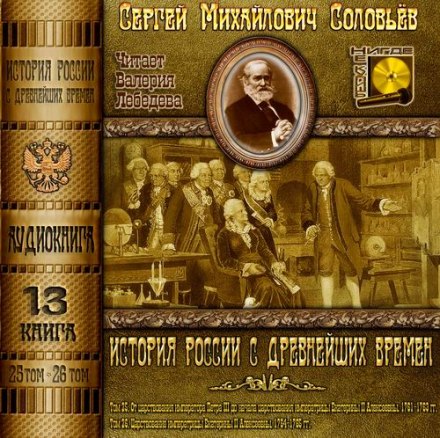
History of Russia from Ancient Times. Volumes 25, 26
38 hrs. 52 min.
Language
Russian
Author
Sergey Solovyov
Author
Sergey Solovyov
Narrator
Valeria Lebedeva
Narrator
Valeria Lebedeva
Volume 25. From the reign of Emperor Peter III to the beginning of the reign of Empress Catherine II Alexeyevna. 1761–1763.
Volume 26. Reign of Empress Catherine II Alexeyevna. 1764–1765.
Volume 25. Contents
Comments on Volumes 25 and 26
Chapter 01. Reign of Emperor Peter III Feodorovich 25 December 1761 — 28 June 1762
Mercies of the new ruler. — Return of exiles. — New Prosecutor General Glebov. — New council. — Holstein princes and other influential people. — First orders in the Senate. — Manifesto on the freedom of the nobility. — Destruction of the Secret Chancellery. — Court department in the Senate; division of the Justice — and the Estate Colleges and the Court order into departments. — Decision in the case of church estates. — Decree on the return of fugitive dissenters (Old Believers). — Peasant unrest. — State of finances. — Military preparations. — Peace and alliance with Prussia. — Clashes with Denmark. — Relations with Austria, France, England, Sweden, Poland, and Turkey. — Displeasure in Russia over the change in foreign policy. — Difficult position of Chancellor Vorontsov and Iv. Iv. Shuvalov. — Displeasure of the closest persons. — Displeasure of the clergy and the troops. — Signs of disorder in the government machine. — General dissatisfaction due to Peter III’s behavior. — Fears of Prussian ministers regarding this dissatisfaction. — Correspondence of Frederick II with Peter III on this matter. — Rumyantsev and the overseas army. — Ivan Antonovich. — Grave situation of Empress Catherine. — N. I. Panin; Hetman Razumovsky. — Movements in the Guards. — Princess Dashkova. — Orlovs. — Acceleration of the movement in favor of Catherine. — Proclamation of her as Empress and Autocrat on 28 June. — Her campaign to Peterhof. — Unsuccessful attempts by Peter III; he refuses the throne.
Chapter 02. Reign of Empress Catherine II Alexeyevna 1762
Awards to participants in the event of 28 June. — Return of Count Bestuzhev-Ryumin and Prince Shakhovskoy. — Solemn acquittal of Bestuzhev. — Adadurov and Elagin. — Fate of Gudovich, Volkov, and Melnunov. — Position of Iv. Iv. Shuvalov. — The Vorontsovs. — Minikh. — Catherine in the Senate. — Death of Peter III. — The idea of a monument to Catherine. — Financial measures. — Measures against bribery, against monopolies. — Peasant unrest. — The case of church estates. — The case of establishing the Imperial Council. — Preparations for the coronation. — Correspondence of Teplov with Panin. — The empress arrives in Moscow. — Coronation. — The case of Guryov and Khrushchov. — Care for improving the conditions of both capitals. — Abolition of sheriffs/investigators. — Continued peasant unrest. — Commission on church estates. — Summoning foreign colonists. — Efforts to return Russian refugees. — End of the case of the Imperial Council. — General character of Russia’s foreign policy at the beginning of Catherine II’s reign. — Relations with Prussia, Denmark, Sweden, Poland, Courland, Turkey, Austria, France, and England.
Chapter 03. Continuation of the reign of Empress Catherine II Alexeyevna 1763
Resignation of old nobles. — Troubles for Iv. Iv. Shuvalov regarding university administration; his departure abroad. — Departure abroad of the chancellor, Count Vorontsov. — N. I. Panin—senior member of the Foreign Collegium. — The empress’s orders regarding this collegium. — Zakhar Chernyshev and Rumyantsev. — Volkov—Orenburg governor. — Telleben was taken abroad. — Clash between Bestuzhev and Panin. — The case of Arseny Matseyevich. — Catherine’s journey to Rostov. — The case of Khitrovo. — Return of the court to St. Petersburg. — Division of the Senate into departments. — Abuses in the provinces. — End of the case of Irkutsk investigator Krylov. — Fall of Prosecutor General Glebov. — Reports by Prince Vyazemsky on the state of the eastern provinces. — Disturbances among the merchants. — Limiting torture and confiscation. — Unsuccessful outcome of the Commission on the Rights of the Nobility. — The case of the dissenters (Old Believers). — Peasant unrest. — Peter Iv. Panin’s opinion on peasant escapes. — Audit/revision. — New ranks. — Orders regarding salt. — Measures regarding trade. — Foundation of the Foundling Home. — Establishment of the Medical Collegium. — Fires. — Russian settlements in the East. — Foreign settlements. — Fall of Khorvat. — Cases of the Kyrgyz and Kalmyk. — Movement in Little Russia to establish hereditary hetmanship. — Question of electing the Polish king after the death of Augustus III. — Correspondence on this issue with foreign powers.
Chapter 01. Reign of Emperor Peter III Feodorovich 25 December 1761 — 28 June 1762
Mercies of the new ruler. — Return of exiles. — New Prosecutor General Glebov. — New council. — Holstein princes and other influential people. — First orders in the Senate. — Manifesto on the freedom of the nobility. — Destruction of the Secret Chancellery. — Court department in the Senate; division of the Justice — and the Estate Colleges and the Court order into departments. — Decision in the case of church estates. — Decree on the return of fugitive dissenters (Old Believers). — Peasant unrest. — State of finances. — Military preparations. — Peace and alliance with Prussia. — Clashes with Denmark. — Relations with Austria, France, England, Sweden, Poland, and Turkey. — Displeasure in Russia over the change in foreign policy. — Difficult position of Chancellor Vorontsov and Iv. Iv. Shuvalov. — Displeasure of the closest persons. — Displeasure of the clergy and the troops. — Signs of disorder in the government machine. — General dissatisfaction due to Peter III’s behavior. — Fears of Prussian ministers regarding this dissatisfaction. — Correspondence of Frederick II with Peter III on this matter. — Rumyantsev and the overseas army. — Ivan Antonovich. — Grave situation of Empress Catherine. — N. I. Panin; Hetman Razumovsky. — Movements in the Guards. — Princess Dashkova. — Orlovs. — Acceleration of the movement in favor of Catherine. — Proclamation of her as Empress and Autocrat on 28 June. — Her campaign to Peterhof. — Unsuccessful attempts by Peter III; he refuses the throne.
Chapter 02. Reign of Empress Catherine II Alexeyevna 1762
Awards to participants in the event of 28 June. — Return of Count Bestuzhev-Ryumin and Prince Shakhovskoy. — Solemn acquittal of Bestuzhev. — Adadurov and Elagin. — Fate of Gudovich, Volkov, and Melnunov. — Position of Iv. Iv. Shuvalov. — The Vorontsovs. — Minikh. — Catherine in the Senate. — Death of Peter III. — The idea of a monument to Catherine. — Financial measures. — Measures against bribery, against monopolies. — Peasant unrest. — The case of church estates. — The case of establishing the Imperial Council. — Preparations for the coronation. — Correspondence of Teplov with Panin. — The empress arrives in Moscow. — Coronation. — The case of Guryov and Khrushchov. — Care for improving the conditions of both capitals. — Abolition of sheriffs/investigators. — Continued peasant unrest. — Commission on church estates. — Summoning foreign colonists. — Efforts to return Russian refugees. — End of the case of the Imperial Council. — General character of Russia’s foreign policy at the beginning of Catherine II’s reign. — Relations with Prussia, Denmark, Sweden, Poland, Courland, Turkey, Austria, France, and England.
Chapter 03. Continuation of the reign of Empress Catherine II Alexeyevna 1763
Resignation of old nobles. — Troubles for Iv. Iv. Shuvalov regarding university administration; his departure abroad. — Departure abroad of the chancellor, Count Vorontsov. — N. I. Panin—senior member of the Foreign Collegium. — The empress’s orders regarding this collegium. — Zakhar Chernyshev and Rumyantsev. — Volkov—Orenburg governor. — Telleben was taken abroad. — Clash between Bestuzhev and Panin. — The case of Arseny Matseyevich. — Catherine’s journey to Rostov. — The case of Khitrovo. — Return of the court to St. Petersburg. — Division of the Senate into departments. — Abuses in the provinces. — End of the case of Irkutsk investigator Krylov. — Fall of Prosecutor General Glebov. — Reports by Prince Vyazemsky on the state of the eastern provinces. — Disturbances among the merchants. — Limiting torture and confiscation. — Unsuccessful outcome of the Commission on the Rights of the Nobility. — The case of the dissenters (Old Believers). — Peasant unrest. — Peter Iv. Panin’s opinion on peasant escapes. — Audit/revision. — New ranks. — Orders regarding salt. — Measures regarding trade. — Foundation of the Foundling Home. — Establishment of the Medical Collegium. — Fires. — Russian settlements in the East. — Foreign settlements. — Fall of Khorvat. — Cases of the Kyrgyz and Kalmyk. — Movement in Little Russia to establish hereditary hetmanship. — Question of electing the Polish king after the death of Augustus III. — Correspondence on this issue with foreign powers.
Volume 26. Reign of Empress Catherine II Alexeyevna. 1764–1765.
Volume 26. Contents
Chapter 01. Continuation of the reign of Empress Catherine II Alexeyevna. 1764
Senate concerns about a monument to the empress. — The plot of Mirovich. — Catherine’s trip to the Baltic regions. — The Schlisselburg incident. — Trial of Mirovich and his execution. — Prince Vyazemsky appointed to carry out the duties of Prosecutor General. — Instruction written for him by the empress. — Dispute in the Senate regarding the post of general recluitter for petitions (general-reketmeyster). — Resolution of the question of confiscated estates. — Financial orders. — The first Russian ship in the Mediterranean Sea. — Concerns about trade. — Serfs among merchants. — Runaways. — Share-farmers/half-farmers (polovniki). — Unsuccessful outcome of the audit/revision. — Instruction to governors. — Pensions. — End of the commission on church estates. — Dissenters. — Teplov’s note on disorders in Little Russia. — Final abolition of hetmanship. — Rumyantsev—chairman of the Little Russian Collegium. — Instruction to him by the empress. — Transformation of New Serbia. — Sloboda-Ukraine Governorate. — State of the eastern ukraina. — The case of the Kamchatka expedition. — Polish affairs. — Violence at local sejms (sjemiks). — The Czartoryskis demand the entry of Russian troops into Poland. — Convening sejm. — Beginning of transformations. — Radziwill and Branicki flee from Russian troops. — Election of Stanisław Poniatowski as king. — The new king asks the empress to allow reforms in the Polish constitution. — Catherine does not agree. — Failure of the dissenters’ case. — Russia’s alliance with Prussia. — Frederick II makes it clear that one must not allow reforms in Poland. — Displeasure of Russia with Austria regarding Polish matters. — Tense relations between Russia and France. — Efforts of the Russian court to keep the Porte from interfering in Polish affairs. — The animosity of the Crimean Khan toward Russia. — Consul Nikiphorov in Crimea. — Change in French policy toward Sweden. — Intensification of its struggle there with Russia. — Continuation of friendship between Russia and Denmark. — Baron Korff’s project on a “Northern Alliance.” — Unsuccessful negotiations with England about an alliance.
Chapter 02. Continuation of the reign of Empress Catherine II Alexeyevna. 1765
Sins/“guilty” buyouts (redemption payments). — Maintenance of the army. — The empress’s dissatisfaction with the navy and works at the Baltic port. — The Reval harbor. — Catherine’s journey along the Ladoga Canal. — The canal from Sias to Volkhov. — Senate activity on the question of juvenile criminals and the concealment of villains. — The empress’s firmness in limiting torture. — Catherine’s memorandum regarding the Volynsky case. — News in the Senate. — Disorders in the colleges. — Sad news about Russian trade in Constantinople. — Introduction of potatoes. — Activity of the Novgorod governor Sievers. — Commission on state boundary surveying. — Question of the arrangement of barracks. — Events in provincial administration. — Slowness of the audit. — Commission on factory peasants. — Serfs among merchants. — Mail service. — Abolition of fees for appointing clergy. — Determination of pay for religious rites/requests. — Schism (raskol). — The case of Pyskorsky abbot Iust. — Clash between the Voronezh bishop and Don Cossacks. — Rumyantsev’s activity in Little Russia. — Clash of foreign colonists with former Russian settlers. — Self-styled claimants (impostors). — General view on Russia’s relations with Poland. — The dissenters’ case and Poland’s clash with Prussia. — Relations of Russia with other European states in 1765.
Chapter 03. Continuation in Russia from the founding of Moscow University to the death of Lomonosov. 1755–1765
Influence of French literature under Elizabeth and Catherine II. — Intellectual movement in France in the period described. Relations of Russian people to Western enlightenment under Elizabeth. — Correspondence between Voltaire and Iv. Iv. Shuvalov under Elizabeth. — Catherine II’s relations with Voltaire, D’Alembert, Diderot. — Catherine’s correspondence with Geoffrin. — Education of the Grand Duke. — Poroshin, his “Notes,” his fate. — Lomonosov’s and Trediakovsky’s last activity. — Müller. — Schlözer. — Moscow University. — Kazan gymnasium. — Corps units. — Sending students of theological schools abroad. — Private education. — Reminder from the Synod about religious and moral upbringing. — Krishinin. — New educational institutions under Catherine II; Betsky. — Literature. — Theater. — Art.
Additions to Volume 26
Senate concerns about a monument to the empress. — The plot of Mirovich. — Catherine’s trip to the Baltic regions. — The Schlisselburg incident. — Trial of Mirovich and his execution. — Prince Vyazemsky appointed to carry out the duties of Prosecutor General. — Instruction written for him by the empress. — Dispute in the Senate regarding the post of general recluitter for petitions (general-reketmeyster). — Resolution of the question of confiscated estates. — Financial orders. — The first Russian ship in the Mediterranean Sea. — Concerns about trade. — Serfs among merchants. — Runaways. — Share-farmers/half-farmers (polovniki). — Unsuccessful outcome of the audit/revision. — Instruction to governors. — Pensions. — End of the commission on church estates. — Dissenters. — Teplov’s note on disorders in Little Russia. — Final abolition of hetmanship. — Rumyantsev—chairman of the Little Russian Collegium. — Instruction to him by the empress. — Transformation of New Serbia. — Sloboda-Ukraine Governorate. — State of the eastern ukraina. — The case of the Kamchatka expedition. — Polish affairs. — Violence at local sejms (sjemiks). — The Czartoryskis demand the entry of Russian troops into Poland. — Convening sejm. — Beginning of transformations. — Radziwill and Branicki flee from Russian troops. — Election of Stanisław Poniatowski as king. — The new king asks the empress to allow reforms in the Polish constitution. — Catherine does not agree. — Failure of the dissenters’ case. — Russia’s alliance with Prussia. — Frederick II makes it clear that one must not allow reforms in Poland. — Displeasure of Russia with Austria regarding Polish matters. — Tense relations between Russia and France. — Efforts of the Russian court to keep the Porte from interfering in Polish affairs. — The animosity of the Crimean Khan toward Russia. — Consul Nikiphorov in Crimea. — Change in French policy toward Sweden. — Intensification of its struggle there with Russia. — Continuation of friendship between Russia and Denmark. — Baron Korff’s project on a “Northern Alliance.” — Unsuccessful negotiations with England about an alliance.
Chapter 02. Continuation of the reign of Empress Catherine II Alexeyevna. 1765
Sins/“guilty” buyouts (redemption payments). — Maintenance of the army. — The empress’s dissatisfaction with the navy and works at the Baltic port. — The Reval harbor. — Catherine’s journey along the Ladoga Canal. — The canal from Sias to Volkhov. — Senate activity on the question of juvenile criminals and the concealment of villains. — The empress’s firmness in limiting torture. — Catherine’s memorandum regarding the Volynsky case. — News in the Senate. — Disorders in the colleges. — Sad news about Russian trade in Constantinople. — Introduction of potatoes. — Activity of the Novgorod governor Sievers. — Commission on state boundary surveying. — Question of the arrangement of barracks. — Events in provincial administration. — Slowness of the audit. — Commission on factory peasants. — Serfs among merchants. — Mail service. — Abolition of fees for appointing clergy. — Determination of pay for religious rites/requests. — Schism (raskol). — The case of Pyskorsky abbot Iust. — Clash between the Voronezh bishop and Don Cossacks. — Rumyantsev’s activity in Little Russia. — Clash of foreign colonists with former Russian settlers. — Self-styled claimants (impostors). — General view on Russia’s relations with Poland. — The dissenters’ case and Poland’s clash with Prussia. — Relations of Russia with other European states in 1765.
Chapter 03. Continuation in Russia from the founding of Moscow University to the death of Lomonosov. 1755–1765
Influence of French literature under Elizabeth and Catherine II. — Intellectual movement in France in the period described. Relations of Russian people to Western enlightenment under Elizabeth. — Correspondence between Voltaire and Iv. Iv. Shuvalov under Elizabeth. — Catherine II’s relations with Voltaire, D’Alembert, Diderot. — Catherine’s correspondence with Geoffrin. — Education of the Grand Duke. — Poroshin, his “Notes,” his fate. — Lomonosov’s and Trediakovsky’s last activity. — Müller. — Schlözer. — Moscow University. — Kazan gymnasium. — Corps units. — Sending students of theological schools abroad. — Private education. — Reminder from the Synod about religious and moral upbringing. — Krishinin. — New educational institutions under Catherine II; Betsky. — Literature. — Theater. — Art.
Additions to Volume 26
1.
History of Russia from Ancient Times. Volumes 1, 2
(narrated by
Evgeny Ternovsky)
2.
History of Russia from the Earliest Times. Volumes 3, 4
(narrated by
Evgeny Ternovsky)
3.
History of Russia from the Earliest Times. Volume 3
(narrated by
Leontina Brotskaya)
3.
History of Russia from Ancient Times, Volumes 5–6
(narrated by
Evgeny Ternovsky)
4.
History of Russia from Ancient Times. Volumes 7, 8
(narrated by
Evgeny Ternovsky)
5.
History of Russia from Ancient Times. Volumes 9, 10
(narrated by
Evgeny Ternovsky)
6.
History of Russia from the Earliest Times. Volumes 11, 12
(narrated by
Vyacheslav Gerasimov)
7.
History of Russia from Ancient Times. Volumes 13, 14
(narrated by
Evgeny Ternovsky)
8.
History of Russia from Ancient Times. Volumes 15, 16
(narrated by
Ilya Prudovsky)
9.
History of Russia from the Earliest Times. Volumes 17, 18
(narrated by
Yury Zaborovsky)
10.
History of Russia from the Earliest Times. Volumes 19, 20
(narrated by
Ilya Prudovsky)
11.
History of Russia from Ancient Times. Volumes 21, 22
(narrated by
Vyacheslav Gerasimov)
12.
History of Russia from the Earliest Times. Volume 12
(narrated by
Leontina Brotskaya)
12.
History of Russia from Ancient Times. Volumes 23, 24
(narrated by
Evgeny Ternovsky)
13.
History of Russia from the Earliest Times. Volume 13. From the Reign of Feodor Alekseyevich to the Moscow Uprising of 1682
(narrated by
Leontina Brotskaya)
13.
History of Russia from Ancient Times. Volumes 25, 26
14.
History of Russia from the Earliest Times. Volume 14. From the Reign of Tsarevna Sophia to the Beginning of the Reign of Peter I Alexeyevich. 1682–1703.
(narrated by
Leontina Brotskaya)
14.
History of Russia from Ancient Times. Volumes 27, 28
(narrated by
Yury Zaborovsky)
15.
History of Russia from the Earliest Times. Volume 15
(narrated by
Leontina Brotskaya)
15.
History of Russia from Ancient Times. Volume 29
(narrated by
Valeria Lebedeva)
19.
History of Russia from the Earliest Times. Volume 19. From the Reign of Empress Catherine I Alexeyevna to the Reign of Empress Anna Ioannovna
(narrated by
Leontina Brotskaya)
20.
History of Russia from the Earliest Times. Volume 20. The Reign of Empress Anna Ioannovna
(narrated by
Leontina Brotskaya)
21.
History of Russia from the Earliest Times. Volume 21. The Reign of Empress Elisabeth Petrovna. 1740–1744.
(narrated by
Leontina Brotskaya)
22.
History of Russia from the Earliest Times. Volume 22. The Reign of Empress Elisabeth Petrovna. 1745–1748.
(narrated by
Leontina Brotskaya)
23.
History of Russia from the Earliest Times. Volume 23. The Reign of Empress Elisabeth Petrovna
(narrated by
Leontina Brotskaya)
24.
History of Russia from the Earliest Times. Volume 24
(narrated by
Leontina Brotskaya)
25.
History of Russia from the Earliest Times. Volume 25
(narrated by
Leontina Brotskaya)
100%
08:32
25_00_Ком_001
08:12
25_00_Ком_002
08:36
25_00_Ком_003
08:19
25_00_Ком_004
08:12
25_00_Ком_005
08:22
25_00_Ком_006
08:21
25_00_Ком_007
08:02
25_00_Ком_008
09:11
25_00_Ком_009
08:24
25_00_Ком_010
08:26
25_00_Ком_011
08:17
25_00_Ком_012
08:39
25_00_Ком_013
08:13
25_00_Ком_014
03:48
25_00_Ком_015
09:21
25_01_001
08:21
25_01_002
08:53
25_01_003
08:54
25_01_004
08:43
25_01_005
09:52
25_01_006
08:25
25_01_007
08:29
25_01_008
08:05
25_01_009
08:03
25_01_010
08:36
25_01_011
08:44
25_01_012
08:13
25_01_013
09:15
25_01_014
08:46
25_01_015
08:09
25_01_016
08:03
25_01_017
09:04
25_01_018
08:13
25_01_019
08:40
25_01_020
10:28
25_01_021
08:52
25_01_022
08:16
25_01_023
08:46
25_01_024
09:21
25_01_025
09:53
25_01_026
09:41
25_01_027
10:11
25_01_028
08:14
25_01_029
08:15
25_01_030
09:00
25_01_031
08:29
25_01_032
08:02
25_01_033
08:13
25_01_034
09:25
25_01_035
09:30
25_01_036
08:26
25_01_037
08:12
25_01_038
08:07
25_01_039
08:25
25_01_040
09:14
25_01_041
08:12
25_01_042
08:06
25_01_043
10:12
25_01_044
08:46
25_01_045
08:37
25_01_046
00:19
25_01_047
01:42
25_01_Сод
08:14
25_02_001
08:49
25_02_002
09:34
25_02_003
08:25
25_02_004
08:09
25_02_005
08:37
25_02_006
10:41
25_02_007
09:39
25_02_008
08:15
25_02_009
08:32
25_02_010
09:40
25_02_011
08:03
25_02_012
08:34
25_02_013
09:08
25_02_014
08:12
25_02_015
09:36
25_02_016
08:29
25_02_017
08:45
25_02_018
08:30
25_02_019
08:11
25_02_020
08:59
25_02_021
08:15
25_02_022
10:02
25_02_023
08:16
25_02_024
08:44
25_02_025
08:31
25_02_026
09:55
25_02_027
08:04
25_02_028
08:16
25_02_029
08:22
25_02_030
08:08
25_02_031
08:36
25_02_032
09:24
25_02_033
08:22
25_02_034
08:32
25_02_035
09:34
25_02_036
08:52
25_02_037
08:04
25_02_038
08:22
25_02_039
09:20
25_02_040
07:33
25_02_041
09:06
25_03_001
09:09
25_03_002
10:09
25_03_003
08:21
25_03_004
08:58
25_03_005
08:18
25_03_006
08:35
25_03_007
09:37
25_03_008
10:25
25_03_009
09:07
25_03_010
08:11
25_03_011
09:08
25_03_012
08:48
25_03_013
08:57
25_03_014
08:11
25_03_015
08:30
25_03_016
08:15
25_03_017
08:50
25_03_018
08:11
25_03_019
08:47
25_03_020
08:02
25_03_021
08:17
25_03_022
08:23
25_03_023
10:52
25_03_024
09:19
25_03_025
08:15
25_03_026
08:25
25_03_027
08:03
25_03_028
08:25
25_03_029
09:07
25_03_030
08:09
25_03_031
08:58
25_03_032
09:35
25_03_033
08:26
25_03_034
08:42
25_03_035
08:41
25_03_036
08:02
25_03_037
09:21
25_03_038
08:46
25_03_039
08:26
25_03_040
08:11
25_03_041
09:18
25_03_042
09:11
25_03_043
08:11
25_03_044
08:23
25_03_045
09:14
25_03_046
01:31
25_03_047
08:03
26_01_001
08:29
26_01_002
11:41
26_01_003
09:07
26_01_004
09:33
26_01_005
08:30
26_01_006
10:15
26_01_007
08:30
26_01_008
09:26
26_01_009
10:48
26_01_010
09:26
26_01_011
08:05
26_01_012
09:05
26_01_013
08:33
26_01_014
08:02
26_01_015
10:17
26_01_016
09:07
26_01_017
08:28
26_01_018
08:04
26_01_019
08:02
26_01_020
08:07
26_01_021
09:04
26_01_022
08:07
26_01_023
09:08
26_01_024
08:02
26_01_025
08:49
26_01_026
08:11
26_01_027
08:27
26_01_028
09:17
26_01_029
08:28
26_01_030
09:17
26_01_031
09:06
26_01_032
08:26
26_01_033
10:17
26_01_034
09:22
26_01_035
08:32
26_01_036
10:59
26_01_037
10:13
26_01_038
08:16
26_01_039
11:16
26_01_040
08:21
26_01_041
08:03
26_01_042
09:12
26_02_001
11:38
26_02_002
09:12
26_02_003
08:10
26_02_004
10:29
26_02_005
08:47
26_02_006
08:23
26_02_007
08:46
26_02_008
09:35
26_02_009
09:05
26_02_010
09:13
26_02_011
08:31
26_02_012
09:54
26_02_013
08:35
26_02_014
08:09
26_02_015
08:37
26_02_016
08:34
26_02_017
09:31
26_02_018
08:50
26_02_019
09:35
26_02_020
08:16
26_02_021
11:01
26_02_022
08:52
26_02_023
08:08
26_02_024
08:47
26_02_025
01:23
26_02_026
08:21
26_03_001
08:44
26_03_002
08:25
26_03_003
08:17
26_03_004
08:46
26_03_005
09:23
26_03_006
08:02
26_03_007
09:50
26_03_008
08:44
26_03_009
08:42
26_03_010
09:42
26_03_011
10:52
26_03_012
08:29
26_03_013
09:12
26_03_014
08:15
26_03_015
08:29
26_03_016
08:01
26_03_017
08:20
26_03_018
08:09
26_03_019
11:02
26_03_020
08:21
26_03_021
08:35
26_03_022
08:31
26_03_023
08:57
26_03_024
08:20
26_03_025
08:53
26_03_026
09:19
26_03_027
08:01
26_03_028
08:42
26_03_029
09:02
26_03_030
08:41
26_03_031
09:18
26_03_032
08:14
26_03_033
08:08
26_03_034
10:28
26_03_035
08:38
26_03_036
08:30
26_03_037
08:17
26_03_038
08:07
26_03_039
08:58
26_03_040
08:03
26_03_041
08:46
26_03_042
10:35
26_03_043
08:58
26_03_044
08:28
26_03_045
08:40
26_03_046
08:05
26_03_047
08:32
26_03_048
03:33
26_03_049
07:01
26_04_Доп_001
