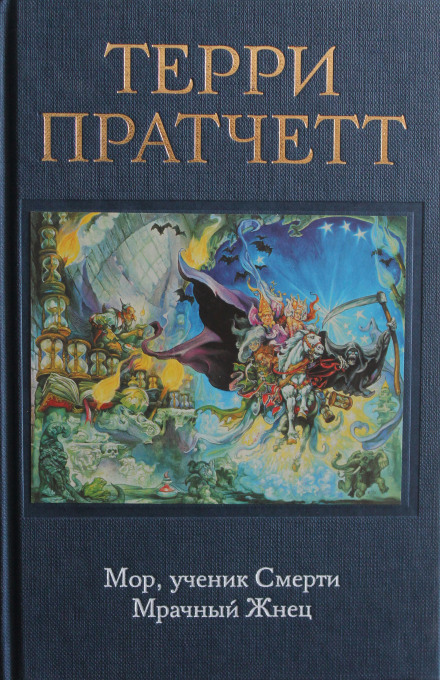
Mort
8 hrs. 33 min.
Language
Russian
Author
Terry Pratchett
Author
Terry Pratchett
Narrator
Alexander Klyukvin
Narrator
Alexander Klyukvin
A young man named Mоr was beginning to get bored on his father’s farm. But then, unexpectedly, luck smiled on him. He is hired to work as an apprentice—and it turns out that his employer is none other than Death himself. By shifting part of his own responsibilities onto the student, Death— for the first time in all his existence—takes a day off. Meanwhile, Mor grows more and more like his master, but Death’s next assignment forces him to challenge his mentor.
In this room, lit by bright flames of candles, there are life-measurers. Shelf after shelf holds squat hourglasses—one glass vessel for each living person. They work without ceasing, requiring no winding: they keep pouring and pouring their fine sand from the future into the past. Each falling grain adds an inconspicuous silky sound to the overall whistling, so that it seems the room is filled with the sound of a sea tide.
And here is the owner of this strange room—he walks slowly and majestically along the shelves. His look is troubled. His name is Death.
But not just Death as some abstract, general idea. The sphere of activity of this official, to tell the truth, is not a sphere at all, but rather a plane. This plane’s sphere of activity includes the Flat World. As the name suggests, this world is completely flat and rests (more precisely, rides) on the backs of four huge elephants. The disk is encircled by a waterfall whose foaming cascades fall into space like an endless avalanche.
Scientists calculated that the odds of a real existence of such openly absurd a world are one in a million.
However, wizards calculated that the chance of “one in a million” comes up in nine cases out of ten.
In this room, lit by bright flames of candles, there are life-measurers. Shelf after shelf holds squat hourglasses—one glass vessel for each living person. They work without ceasing, requiring no winding: they keep pouring and pouring their fine sand from the future into the past. Each falling grain adds an inconspicuous silky sound to the overall whistling, so that it seems the room is filled with the sound of a sea tide.
And here is the owner of this strange room—he walks slowly and majestically along the shelves. His look is troubled. His name is Death.
But not just Death as some abstract, general idea. The sphere of activity of this official, to tell the truth, is not a sphere at all, but rather a plane. This plane’s sphere of activity includes the Flat World. As the name suggests, this world is completely flat and rests (more precisely, rides) on the backs of four huge elephants. The disk is encircled by a waterfall whose foaming cascades fall into space like an endless avalanche.
Scientists calculated that the odds of a real existence of such openly absurd a world are one in a million.
However, wizards calculated that the chance of “one in a million” comes up in nine cases out of ten.
1.
The Colour of Magic
(narrated by
Alexander Klyukvin)
2.
The Light Fantastic
(narrated by
Alexander Klyukvin)
3.
Feet of Clay
(narrated by
Alexander Klyukvin)
3.
Equal Rites
(narrated by
Alexander Klyukvin)
4.
Eric
(narrated by
Alexander Klyukvin)
5.
Interesting Times
(narrated by
Abr Kapitan)
6.
Interesting Times
(narrated by
Alexander Klyukvin)
6.
Night Watch
(narrated by
Alexander Klyukvin)
6.
The Last Continent
(narrated by
Epifan Ukh, Vita Kovaleva, Lisa)
7.
The Last Hero
(narrated by
Abr Kapitan)
8.
Unseen Academicals
(narrated by
Elena Polonetskaya)
8.
Snuff
(narrated by
Alexander Klyukvin)
9.
Equal Rites
(narrated by
Alexander Klyukvin)
10.
Witches Abroad
(narrated by
Alexey Sergeyev)
10.
Wyrd Sisters
(narrated by
Alexander Klyukvin)
11.
Witches Abroad
(narrated by
DrLutz)
11.
Witches Abroad
(narrated by
Alexander Klyukvin)
12.
Lords and Ladies
(narrated by
DrLutz)
12.
Lords and Ladies
(narrated by
Alexander Klyukvin)
13.
Maskerade
(narrated by
Alexander Klyukvin)
14.
Carpe Jugulum
(narrated by
Nelly)
14.
Carpe Jugulum
(narrated by
Alexander Klyukvin)
15.
The Wee Free Men
(narrated by
Abr Kapitan, Nelly)
15.
The Wee Free Men
(narrated by
Dellini)
16.
A Hat Full of Sky
(narrated by
Abr Kapitan, Nelly)
17.
Wintersmith
(narrated by
Ivan Litvinov)
17.
Wintersmith
(narrated by
Abr Kapitan, Nelly)
18.
Midnight Dress
(narrated by
Abr Kapitan, Nelly)
19.
The Shepherd's Crown
(narrated by
Max Potyomkin)
20.
Mort
(narrated by
Mikhail Makushev)
20.
Mort
21.
Reaper Man
(narrated by
Alexander Klyukvin)
22.
Soul Music
(narrated by
Max Potyomkin)
22.
Soul Music
(narrated by
Alexander Klyukvin)
23.
Hogfather
(narrated by
Alexander Klyukvin)
23.
Hogfather
(narrated by
Max Potyomkin)
24.
Thief of Time
(narrated by
Sergey Kirsanov)
25.
Guards! Guards!
(narrated by
Alexander Klyukvin)
26.
Jingo
(narrated by
Alexander Klyukvin)
27.
Feet of Clay
(narrated by
Ignatyev Dmitry (digig))
28.
Only You Can Save Mankind
(narrated by
Max Potyomkin)
28.
The Patriot
(narrated by
Alexander Klyukvin)
29.
The Fifth Elephant
(narrated by
Alexander Klyukvin)
29.
The Fifth Elephant
(narrated by
Max Potyomkin)
30.
Night Watch
(narrated by
Max Potyomkin)
31.
Thud!
(narrated by
Max Potyomkin)
31.
Thud!
(narrated by
Alexander Klyukvin)
32.
Snuff
(narrated by
Max Potyomkin)
33.
Going Postal
(narrated by
Sergey Tsaregorodtsev)
33.
Going Postal
(narrated by
Albert Kramer)
34.
Making Money
(narrated by
Sergey Tsaregorodtsev)
35.
Raising Steam
(narrated by
Sergey Tsaregorodtsev)
36.
Pyramids
(narrated by
Ilya Dementyev)
37.
Moving Pictures
(narrated by
Mikhail Makushev, Irina Shornova)
38.
Small Gods
(narrated by
DrLutz)
39.
The Truth
(narrated by
Oleg Buldakov)
Making Money
(narrated by
Alexander Aravushkin)
Going Postal
(narrated by
Alexander Aravushkin)
Going Postal
(narrated by
Alexander Klyukvin)
Stories from the Discworld
(narrated by
Mikhail Makushev)
Raising Steam
(narrated by
Alexander Aravushkin)
Tales from the Discworld
(narrated by
Vladislav Kopp)
0.
Monstrous Regiment
(narrated by
Max Potyomkin)
100%
1:36:18
01_Mor. Uchenik Smerti
1:26:28
02_Mor. Uchenik Smerti
1:20:41
03_Mor. Uchenik Smerti
1:41:10
04_Mor. Uchenik Smerti
1:43:05
05_Mor. Uchenik Smerti
45:23
06_Mor. Uchenik Smerti
