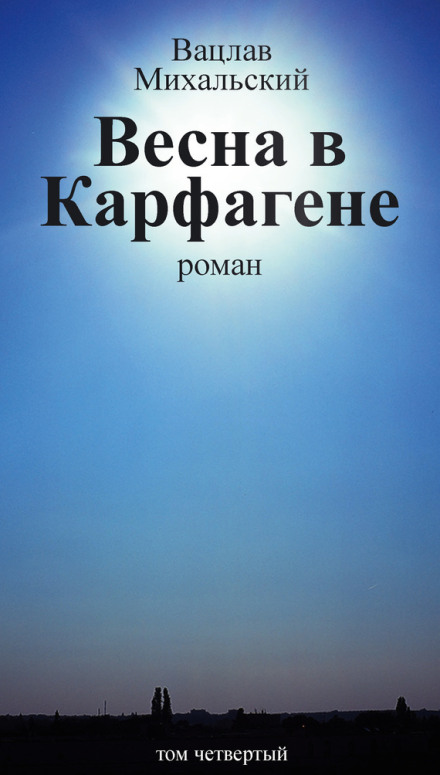
Spring in Carthage
10 hrs. 34 min.
Language
Russian
Author
Vatslav Mikhalsky
Author
Vatslav Mikhalsky
Narrator
Irina Vorobyova
Narrator
Irina Vorobyova
For the first time in Russian literature, in the pages of the epic novel by Vaclav Michalski “Spring and Carthage,” Moscow and Carthage—Russia and Tunisia—Russians, Arabs, and French—appeared side by side. They became intertwined in the fates of the novel’s main heroines, Maria and Alexandra, daughters of the admiral of the Russian Imperial Fleet. What happens to their mother, the countess turned into a cleaning woman—her new life—is no less tragic in its force and contrast than the fate of her daughters. In “Spring in Carthage” there is both novelty of material and a strong intrigue, vivid and lively characters, and descriptions of historical events of the 20th century unknown to the broad public.
At one time Valentin Kataev wrote: “Vaclav Michalski immediately drew the attention of readers and critics with the freshness of his remarkable talent. He has a steady eye and a sharp analytical mind. He handles the word excellently and knows its value. The driving force of his work is imagination… The female images in Michalski’s prose are always believable and unique.” These words from an outstanding master can very well be applied to Vaclav Michalski’s new book.
At one time Valentin Kataev wrote: “Vaclav Michalski immediately drew the attention of readers and critics with the freshness of his remarkable talent. He has a steady eye and a sharp analytical mind. He handles the word excellently and knows its value. The driving force of his work is imagination… The female images in Michalski’s prose are always believable and unique.” These words from an outstanding master can very well be applied to Vaclav Michalski’s new book.
1.
Spring in Carthage
2.
For the Lonely, Everywhere Is a Desert
(narrated by
Irina Vorobyova)
3.
Two Are Needed for Joy
(narrated by
Lyudmila Kungurova)
4.
Temple of Harmony
(narrated by
Lyudmila Kungurova)
5.
Forgiveness Sunday
(narrated by
Lyudmila Kungurova)
6.
The River of Time: Ave Maria
(narrated by
Lyudmila Kungurova)
100%
21:09
vesna-v-karfagene-0001
20:43
vesna-v-karfagene-0002
24:18
vesna-v-karfagene-0003
18:23
vesna-v-karfagene-0004
15:47
vesna-v-karfagene-0005
16:36
vesna-v-karfagene-0006
14:54
vesna-v-karfagene-0007
26:18
vesna-v-karfagene-0008
18:54
vesna-v-karfagene-0009
25:40
vesna-v-karfagene-0010
15:35
vesna-v-karfagene-0011
24:40
vesna-v-karfagene-0012
19:57
vesna-v-karfagene-0013
25:05
vesna-v-karfagene-0014
12:05
vesna-v-karfagene-0015
19:09
vesna-v-karfagene-0016
26:23
vesna-v-karfagene-0017
20:18
vesna-v-karfagene-0018
22:24
vesna-v-karfagene-0019
13:25
vesna-v-karfagene-0020
18:42
vesna-v-karfagene-0021
21:27
vesna-v-karfagene-0022
24:26
vesna-v-karfagene-0023
27:36
vesna-v-karfagene-0024
26:58
vesna-v-karfagene-0025
24:30
vesna-v-karfagene-0026
25:14
vesna-v-karfagene-0027
15:24
vesna-v-karfagene-0028
22:48
vesna-v-karfagene-0029
25:55
vesna-v-karfagene-0030
