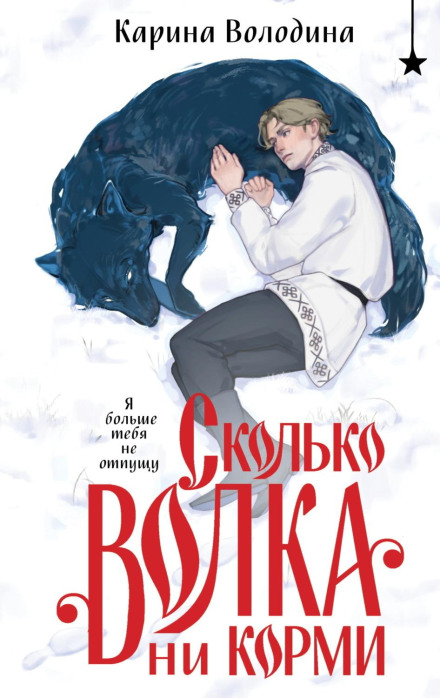
No Matter How Much You Feed the Wolf
19 hrs. 33 min.
Language
Russian
Author
Karina Volodina
Author
Karina Volodina
Narrator
Miroslav Velesov
Narrator
Miroslav Velesov
Ravan always felt that his destiny was to become a wolf. He performed countless rituals and tried every method, but nothing worked. The community has long grown disappointed in him; they watch him with suspicion and no longer believe in his hidden wolf nature. But Ravan doesn’t lose hope. Rumor has it that in the forest there live the lutes—creatures that are half-human, half-wolf. Maybe they can help him gain the ability he desires: to transform into a wolf. But how can he find them?
Baya has always been sure: there’s no need to talk to people unless you have to, and don’t let them see you in human form—otherwise you’ll get into trouble. Yet one boy caught her interest: he was performing a funny, ridiculous ritual in the night forest, which made her laugh. “In the forest you’ll find everything you’re looking for,” the lutes say.
However, life among wolves turns out to be far from a fairy tale...
1. The main hero is not “the chosen one,” although he is obsessively desperate to be. 2. A story about how not to lose yourself amid the whirlpool of your own fears and ambitions—how to tell your personal desires apart from what society has imposed on you. 3. All the inhabitants of the magical forest—from werewolves to the Master (a forest spirit/leshy)—are deeply tied to Slavic mythology, and they are not just a set of magical creatures for atmosphere; they form a cohesive organism essential to both the mood and the plot. 4. Humor, charismatic secondary characters, and the protagonists’ ability to laugh at themselves—even in the most serious situations. 5. The narration language is simple, but stylized, with elements of archaic vocabulary that create a dark, mysterious atmosphere of a mighty Slavic forest.
Baya has always been sure: there’s no need to talk to people unless you have to, and don’t let them see you in human form—otherwise you’ll get into trouble. Yet one boy caught her interest: he was performing a funny, ridiculous ritual in the night forest, which made her laugh. “In the forest you’ll find everything you’re looking for,” the lutes say.
However, life among wolves turns out to be far from a fairy tale...
1. The main hero is not “the chosen one,” although he is obsessively desperate to be. 2. A story about how not to lose yourself amid the whirlpool of your own fears and ambitions—how to tell your personal desires apart from what society has imposed on you. 3. All the inhabitants of the magical forest—from werewolves to the Master (a forest spirit/leshy)—are deeply tied to Slavic mythology, and they are not just a set of magical creatures for atmosphere; they form a cohesive organism essential to both the mood and the plot. 4. Humor, charismatic secondary characters, and the protagonists’ ability to laugh at themselves—even in the most serious situations. 5. The narration language is simple, but stylized, with elements of archaic vocabulary that create a dark, mysterious atmosphere of a mighty Slavic forest.
1.
The Absence of Life
(narrated by
Lyubov Koneva)
2.
The Absence of Life. Night of the Ghouls
(narrated by
Lyubov Koneva)
4.
Nekromance. Opus 2
(narrated by
Polina Kareva)
The Devil's Antiquarian
(narrated by
Lyudmila Shirokova)
Ink Souls
(narrated by
Maria Smirnova)
The Halls of the Sun
(narrated by
Darya Savicheva)
Monster and Monsters
(narrated by
Gleb Ivanov)
The Double of the West
(narrated by
Lyubov Kuznetsova)
Echo of Mishtar. North and South
(narrated by
Maxim Gamayunov)
The Owl with the Iron Wing
(narrated by
Ekaterina Yeremkina)
Where the Scarlet Flower Blooms
(narrated by
Agniya Yegoshina)
Hellgate. Family
(narrated by
Darya Kopysova)
When the Bonfires Don't Burn
(narrated by
Denis Dulshchikov)
When Tomorrow Comes Again
(narrated by
Polina Voychenko)
Foxes of Hanson County
(narrated by
Pyotr Kovrizhnykh, Alexandra Surkova)
The Mormo Masquerade
(narrated by
Alyona Frendly)
Morana and the Shadow. The Weaver
(narrated by
Darya Blokhina)
Necromance. Opus 1 (The Ridgian Gambit #1)
(narrated by
Polina Kareva)
The Sleepless
(narrated by
Anastasia Portnaya)
The Night of the Virgin
(narrated by
Polina Dudkina, Vladimir Lesnykh)
The Falling Tower. Fire with Fire
(narrated by
Natalya Bykovskaya)
Song of the Shrike
(narrated by
Pyotr Kovrizhnykh)
The Shrike's Song
(narrated by
Pyotr Kovrizhnykh)
The Reddest Apple
(narrated by
Moryana Anttonen-Shestakova)
The Seventh Sister
(narrated by
Nina Dronova)
A Heart That Will Melt the Ocean
(narrated by
Elena Delver)
No Matter How Much You Feed the Wolf
The Freeze
(narrated by
Elizaveta Kornilova)
The Secret Faculty
(narrated by
Varvara Sapova)
The Prophetic City
(narrated by
Ekaterina Lann, Katya Lann)
In the Name of Oneself
(narrated by
Yana Smirnova)
All the People of the North
(narrated by
Gennady Foroshchuk)
All Power Is Yours
(narrated by
Alexey Tsoy)
0.
Daughter of the Gorgon
(narrated by
Maria Smi)
0.
The Wondrous House on Forest Street
(narrated by
Lyudmila Blagushko)
0.
Courier in the Service of a Demon
(narrated by
Tatyana Litvinova)
0.
Lyutumvil. The Kingdom of Fire and Clay
(narrated by
Elena Berezina)
0.
The Spider Principality
(narrated by
Natalya Martynova)
0.
Song of the Rootless
(narrated by
Pavel Mikheev)
0.
The Shrike's Song
(narrated by
Vitaly Sulimov)
0.
Runes of the Firebirds
(narrated by
Alexander Kuznetsov)
0.
Sagas of the Fire Birds
(narrated by
Alexander Kuznetsov)
0.
Stained Glass of Carved Hearts
(narrated by
Yana Smirnova)
0.
Tomorrow I Will Become Fire
(narrated by
Gennady Foroshchuk)
