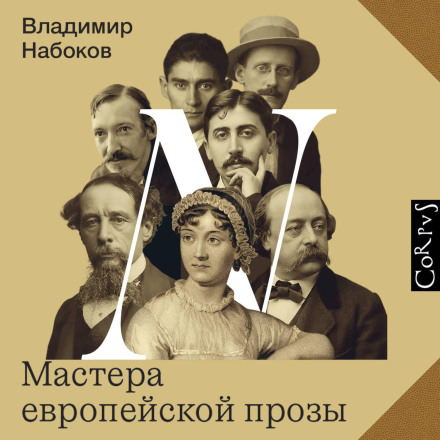
Masters of European Prose
25 hrs. 4 min.
Language
Russian
Author
Vladimir Nabokov
Author
Vladimir Nabokov
Narrator
Oleg Dorman
Narrator
Oleg Dorman
In the early 1980s, thanks to the work of Vladimir Nabokov’s heirs and the American textual scholar F. Bowers, readers were able to see yet another side of the genius of the author of “Lolita” and “Ada.” Nabokov’s university lectures on Russian and European literature, delivered at Wellesley, Cornell, and Harvard in the 1940s–1950s and compiled into three volumes, not only opened up for Western audiences the vivid world of Gogol, Turgenev, Tolstoy, Dostoevsky, and Chekhov, but also shed fresh light on Dickens, Flaubert, Proust, Kafka, and Joyce—unexpectedly enriching the view of Nabokov himself as a writer.
Becoming acquainted with these lectures—where biographical sketches are combined with close analysis and original interpretations of classic texts—turns into the key to understanding Nabokov’s creative thinking and the very nature of literary art. In this edition, for the first time, a complete translation of his lectures on the masters of European prose is published, supplemented with accompanying and facsimile materials. In addition to F. Bowers’s notes, the book includes the editor’s commentary.
Becoming acquainted with these lectures—where biographical sketches are combined with close analysis and original interpretations of classic texts—turns into the key to understanding Nabokov’s creative thinking and the very nature of literary art. In this edition, for the first time, a complete translation of his lectures on the masters of European prose is published, supplemented with accompanying and facsimile materials. In addition to F. Bowers’s notes, the book includes the editor’s commentary.
Masters of European Prose
Nikolai Gogol
(narrated by
Oleg Dorman)
Letters to Vera
(narrated by
Ivan Bukchin)
The Tragedy of Mister Morn
(narrated by
Oleg Dorman)
0.
Lectures on Russian Literature
(narrated by
Oleg Dorman)
0.
Lolita: A Screenplay
(narrated by
Oleg Dorman)
0.
Wanderers. Plays 1918–1924
(narrated by
Oleg Dorman)
0.
Poems
(narrated by
Oleg Dorman)
100%
00:10
01. Набоков Владимир Владимирович - Мастера европейской прозы
11:21
02. От редактора настоящего издания
36:04
03. Предисловие редактора
42:53
04. Введение
21:35
05. О хороших читателях и хороших писателях
3:13:55
06. Джейн Остин 1775–1817 - Мэнсфилд-парк 1814
4:00:11
07. Чарльз Диккенс 1812–1870 - Холодный дом 1852–1853
2:30:26
08. Гюстав Флобер 1821–1880 - Госпожа Бовари 1856
20:51
09. Гюстав Флобер 1821–1880 - Заметки
1:36:42
10. Роберт Льюис Стивенсон 1850–1894 - Странная история доктора Джекила и мистера Хайда 1885
2:25:57
11. Марсель Пруст 1871–1922 - В сторону Свана 1913
1:59:25
12. Франц Кафка 1883–1924 - Превращение 1915
5:10:36
13. Джеймс Джойс 1882–1941 - Улисс 1922
43:41
14. Искусство литературы и здравый смысл. L'envoi
04:42
15. L'envoi
1:06:28
16. Чарльз Диккенс
