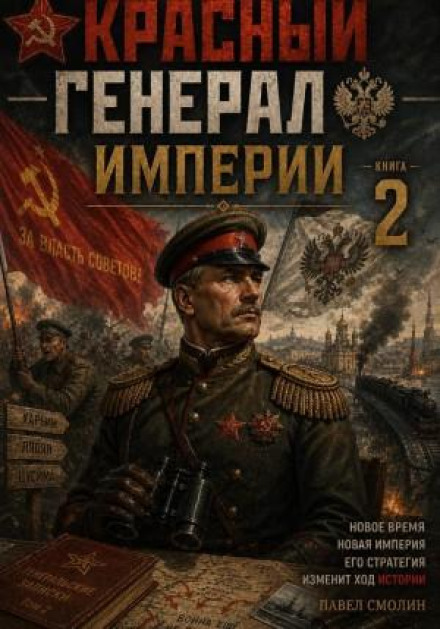
Red General of the Empire 2
9 hrs. 2 min.
Language
Russian
Author
Pavel Smolin
Author
Pavel Smolin
Narrator
Oleg Cvinger
Narrator
Oleg Cvinger
In the spring of 1896, Soviet lieutenant general in reserve Sergei Mikhailovich Lopatин falls asleep in an armchair over a book about the Russo-Japanese War—and wakes up as the Amur Governor-General Nikolai Ivanovich Grodекov in Khabarovsk on May 2, 1900.
In his head—an atheist, a communist, a child of war who lost his father near Kursk and his brother near Vitebsk. In his body—a general of infantry, an orientalist, a hereditary ataman of three Cossack armies. Under his hand—an oblast stretching from the Shilka to Kamchatka, twenty-four battalions of riflemen, six Cossack regiments, and fifty-eight days until the first shells fly from the Chinese bank of the Amur to Blagoveshchensk.
His task is not just to win against the Japanese five years later. The goal is deeper: by 1917, he must have in his hands a circle of people capable of giving the country a different revolution. Without executions on Lubyanka. Without the famine of 1932. Without 1941, when, as a boy, he lost everything.
In his head—an atheist, a communist, a child of war who lost his father near Kursk and his brother near Vitebsk. In his body—a general of infantry, an orientalist, a hereditary ataman of three Cossack armies. Under his hand—an oblast stretching from the Shilka to Kamchatka, twenty-four battalions of riflemen, six Cossack regiments, and fifty-eight days until the first shells fly from the Chinese bank of the Amur to Blagoveshchensk.
His task is not just to win against the Japanese five years later. The goal is deeper: by 1917, he must have in his hands a circle of people capable of giving the country a different revolution. Without executions on Lubyanka. Without the famine of 1932. Without 1941, when, as a boy, he lost everything.
100%
1:00:00
Красный генерал Империи 2 01
1:00:00
Красный генерал Империи 2 02
1:00:00
Красный генерал Империи 2 03
1:00:00
Красный генерал Империи 2 04
1:00:00
Красный генерал Империи 2 05
1:00:00
Красный генерал Империи 2 06
1:00:00
Красный генерал Империи 2 07
1:00:00
Красный генерал Империи 2 08
1:02:18
Красный генерал Империи 2 09
