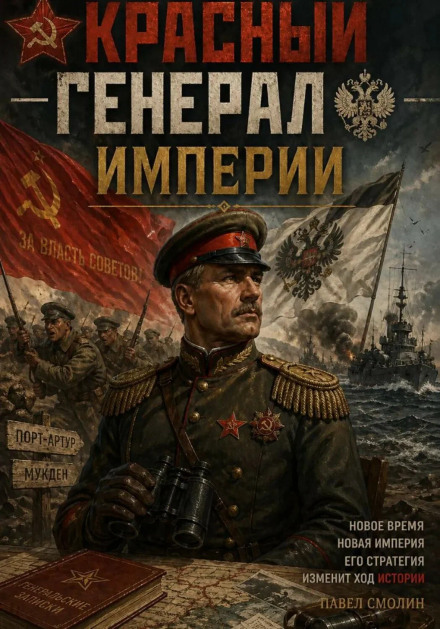
The Red General of the Empire
8 hrs. 27 min.
Language
Russian
Author
Pavel Smolin
Author
Pavel Smolin
Narrator
Oleg Cvinger
Narrator
Oleg Cvinger
In the spring of 1896, the Soviet lieutenant general in retirement, Sergey Mikhailovich Lopatин, dozed off in his chair over a book about the Russo-Japanese War—and woke up already in Khabarovsk, on May 2, 1900, in the role of the Amur general-governor, Nikolai Ivanovich Grodekov.
In his mind—an atheist and a communist, a child of war who lost his father near Kursk and his brother near Vitebsk. In his guise—infantry general, orientalist, and the elected ataman of three Cossack hosts. At his disposal is a region from the Shilka River to Kamchatka: twenty-four rifle battalions, six Cossack regiments, and only fifty-eight days until the first shells will be fired from the Chinese bank of the Amur at Blagoveshchensk.
He needs not only to prepare and defeat the Japanese in five years. The plan is far broader: by 1917, to gather around himself people who can lead the country to another revolution. Without the Lubyanka executions. Without the famine of 1932. Without 1941—the very year when, as a boy, he lost everything.
In his mind—an atheist and a communist, a child of war who lost his father near Kursk and his brother near Vitebsk. In his guise—infantry general, orientalist, and the elected ataman of three Cossack hosts. At his disposal is a region from the Shilka River to Kamchatka: twenty-four rifle battalions, six Cossack regiments, and only fifty-eight days until the first shells will be fired from the Chinese bank of the Amur at Blagoveshchensk.
He needs not only to prepare and defeat the Japanese in five years. The plan is far broader: by 1917, to gather around himself people who can lead the country to another revolution. Without the Lubyanka executions. Without the famine of 1932. Without 1941—the very year when, as a boy, he lost everything.
100%
29:13
Красный генерал Империи 01
52:14
Красный генерал Империи 02
25:56
Красный генерал Империи 03
33:25
Красный генерал Империи 04
27:49
Красный генерал Империи 05
26:13
Красный генерал Империи 06
38:10
Красный генерал Империи 07
25:04
Красный генерал Империи 08
26:50
Красный генерал Империи 09
25:38
Красный генерал Империи 10
20:47
Красный генерал Империи 11
27:10
Красный генерал Империи 12
26:06
Красный генерал Империи 13
20:14
Красный генерал Империи 14
22:08
Красный генерал Империи 15
25:33
Красный генерал Империи 16
34:38
Красный генерал Империи 17
20:35
Красный генерал Империи 18
