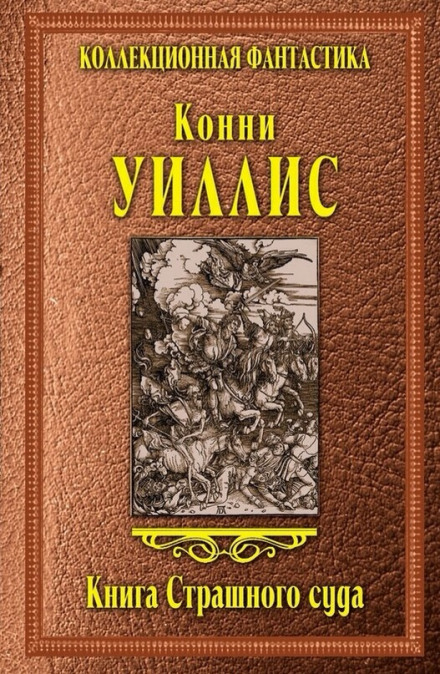
Doomsday Book
22 hrs. 59 min.
Language
Russian
Author
Connie Willis
Author
Connie Willis
Narrator
Igor Knyazev
Narrator
Igor Knyazev
A student is sent with the help of a time machine from the near future into the 14th century. Of course, every researcher undergoes training, studies the era, and receives vaccinations against plague and smallpox. However, it is not always possible to arrive exactly at the right point in time and predict all events correctly. The heroine finds herself in a very difficult and dangerous situation, where she begins to keep the “Doomsday Book.” At the same time, a deadly epidemic breaks out in England in the middle of the 21st century ...
From the narrator: Many fans of time travel know and love J. Finney’s book "Time and Again." And a very substantial part of its charm is created by the detailed descriptions of the lives of people of a bygone era. Well, Connie Willis went much further down that road. With a sort of Victorian luxuriance, she creates absolutely four-dimensional pictures. Everything is detailed and unnecessary, just like in life itself. I don’t know about you, but I like that very much. However, I doubt I’m alone: by the number of the most prestigious science fiction awards, this book is among the most honored. It won the Nebula, the Hugo, and the Locus for 1993, plus another dozen and a half less prominent prizes. And the book is valuable to me not for its science fiction — there isn’t all that much of it. Rather, for the realism of the characters: the student historian Kivrin, her mentor Professor Dunworthy, the reckless boy Colin, and a whole gallery of medieval figures, among whom, it seems to me, the village priest Father Roche is portrayed with particular affection. In short, I think we won’t stop at the first book of the Oxford cycle, but will definitely continue it.
Igor Knyazev
From the narrator: Many fans of time travel know and love J. Finney’s book "Time and Again." And a very substantial part of its charm is created by the detailed descriptions of the lives of people of a bygone era. Well, Connie Willis went much further down that road. With a sort of Victorian luxuriance, she creates absolutely four-dimensional pictures. Everything is detailed and unnecessary, just like in life itself. I don’t know about you, but I like that very much. However, I doubt I’m alone: by the number of the most prestigious science fiction awards, this book is among the most honored. It won the Nebula, the Hugo, and the Locus for 1993, plus another dozen and a half less prominent prizes. And the book is valuable to me not for its science fiction — there isn’t all that much of it. Rather, for the realism of the characters: the student historian Kivrin, her mentor Professor Dunworthy, the reckless boy Colin, and a whole gallery of medieval figures, among whom, it seems to me, the village priest Father Roche is portrayed with particular affection. In short, I think we won’t stop at the first book of the Oxford cycle, but will definitely continue it.
Igor Knyazev
100%
37:15
01-01-01-kniga-strashnogo-suda
02:16
01-01-02-zapis-iz-knigi-strashnogo-suda
39:59
01-02-01-kniga-strashnogo-suda
31:02
01-03-01-kniga-strashnogo-suda
02:29
01-03-02-zapis-iz-knigi-strashnogo-suda
34:35
01-04-01-kniga-strashnogo-suda
00:42
01-04-02-zapis-iz-knigi-strashnogo-suda
36:43
01-05-kniga-strashnogo-suda
18:54
01-06-01-kniga-strashnogo-suda
00:14
01-06-02-zapis-iz-knigi-strashnogo-suda
35:59
01-07-kniga-strashnogo-suda
22:27
01-08-01-kniga-strashnogo-suda
00:53
01-08-02-zapis-iz-knigi-strashnogo-suda
38:50
01-09-01-kniga-strashnogo-suda
00:18
01-09-02-zapis-iz-knigi-strashnogo-suda
45:20
02-10-01-kniga-strashnogo-suda
03:11
02-10-02-zapis-iz-knigi-strashnogo-suda
32:41
02-11-01-kniga-strashnogo-suda
05:57
02-11-02-zapis-iz-knigi-strashnogo-suda
45:33
02-12-01-kniga-strashnogo-suda
07:35
02-12-02-zapis-iz-knigi-strashnogo-suda
35:27
02-13-01-kniga-strashnogo-suda
11:10
02-13-02-zapis-iz-knigi-strashnogo-suda
43:00
02-14-01-kniga-strashnogo-suda
09:18
02-14-02-zapis-iz-knigi-strashnogo-suda
38:29
02-15-kniga-strashnogo-suda
41:36
02-16-kniga-strashnogo-suda
42:00
02-17-01-kniga-strashnogo-suda
04:40
02-17-02-zapis-iz-knigi-strashnogo-suda
37:40
02-18-01-kniga-strashnogo-suda
11:21
02-18-02-zapis-iz-knigi-strashnogo-suda
38:56
02-19-kniga-strashnogo-suda
38:09
02-20-01-kniga-strashnogo-suda
03:32
02-20-02-zapis-iz-knigi-strashnogo-suda
50:23
02-21-01-kniga-strashnogo-suda
03:14
02-21-02-zapis-iz-knigi-strashnogo-suda
34:51
02-22-kniga-strashnogo-suda
37:48
02-23-kniga-strashnogo-suda
42:03
03-24-kniga-strashnogo-suda
25:09
03-25-kniga-strashnogo-suda
42:45
03-26-01-kniga-strashnogo-suda
03:16
03-26-02-zapis-iz-knigi-strashnogo-suda
35:28
03-27-01-kniga-strashnogo-suda
04:50
03-27-02-zapis-iz-knigi-strashnogo-suda
30:13
03-28-01-kniga-strashnogo-suda
05:13
03-28-02-zapis-iz-knigi-strashnogo-suda
26:50
03-29-01-kniga-strashnogo-suda
04:56
03-29-02-zapis-iz-knigi-strashnogo-suda
28:10
03-30-kniga-strashnogo-suda
41:47
03-31-01-kniga-strashnogo-suda
01:30
03-31-02-zapis-iz-knigi-strashnogo-suda
37:45
03-32-kniga-strashnogo-suda
42:29
03-33-01-kniga-strashnogo-suda
01:56
03-33-02-zapis-iz-knigi-strashnogo-suda
36:16
03-34-kniga-strashnogo-suda
25:07
03-35-kniga-strashnogo-suda
19:25
03-36-kniga-strashnogo-suda
