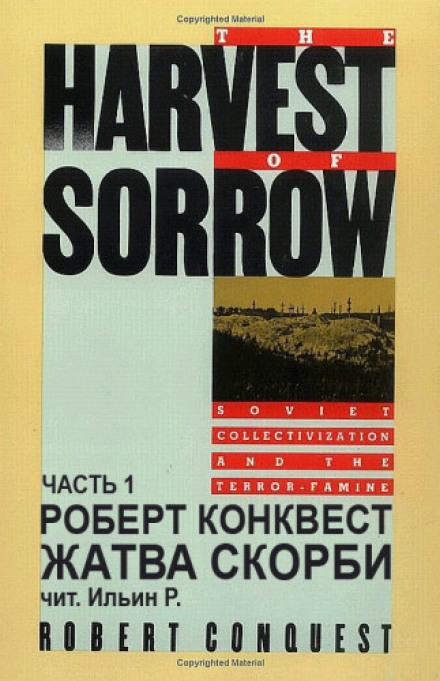
The Harvest of Sorrow. Part 1
4 hrs. 30 min.
Language
Russian
Author
Robert Conquest
Author
Robert Conquest
Narrator
Roman Ilyin
Narrator
Roman Ilyin
“...To date, this book is the only historical account of the most important period of the Soviet past. It depicts the terrible time of the bloody Stalinist epoch, the hardest in terms of the number of its victims. The book shows how, under the tyranny of Stalin and his henchmen, all old peasantry was destroyed—and with them the historical roots of the Russian, Ukrainian, and other peoples were cut down. In the absence of a truthful history of these events, it seems important to me that my book reach the Russian reader...
It was claimed that in 1932–1933 there was no famine, and that talk of it was interpreted as anti-Soviet agitation. Only a few years ago it was acknowledged that the famine did exist, explaining it as the sabotage of the kulaks and drought. Dislike of such an explanation was interpreted as anti-Sovietism. Later, however, it was acknowledged: the famine was provoked by government policy. But still it was not admitted that this was the plan of Stalin and those around him. And this viewpoint was labeled anti-Soviet. Today, in the USSR, people acknowledge that all this did indeed occur, but claims that more than four to five million people died are considered anti-Soviet…
All this must be noted at least to show how “anti-Soviet” assessments are gradually being removed in the Soviet Union. “The inhuman power of lies,” about which B. Pasternak spoke, begins to collapse...”
The first part of the book is presented, “Main Actors. The Peasants, the Party, the People”
It was claimed that in 1932–1933 there was no famine, and that talk of it was interpreted as anti-Soviet agitation. Only a few years ago it was acknowledged that the famine did exist, explaining it as the sabotage of the kulaks and drought. Dislike of such an explanation was interpreted as anti-Sovietism. Later, however, it was acknowledged: the famine was provoked by government policy. But still it was not admitted that this was the plan of Stalin and those around him. And this viewpoint was labeled anti-Soviet. Today, in the USSR, people acknowledge that all this did indeed occur, but claims that more than four to five million people died are considered anti-Soviet…
All this must be noted at least to show how “anti-Soviet” assessments are gradually being removed in the Soviet Union. “The inhuman power of lies,” about which B. Pasternak spoke, begins to collapse...”
The first part of the book is presented, “Main Actors. The Peasants, the Party, the People”
100%
1:21:07
01. Роберт Конквест - Ч.1. Главные действующие лица. Гл.1. Крестьяне и Партия (чит. Ильин Р.)
58:11
02. Роберт Конквест - Ч.1. Гл.2. Украинский национализм (чит. Ильин Р.)
50:50
03. Роберт Конквест - Ч.1. Гл.3. Революция, крестьянская война и голод (чит. Ильин Р.)
1:20:46
04. Роберт Конквест - Ч.1. Гл.4. В тупике (чит. Ильин Р.)
