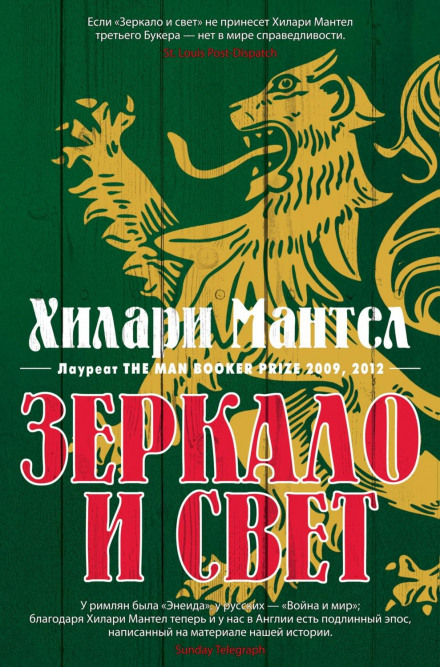
The Mirror & the Light
41 hrs. 22 min.
Language
Russian
Author
Hilary Mantel
Author
Hilary Mantel
Narrator
Pavel Konyshev
Narrator
Pavel Konyshev
For the first time in Russian—“the triumphant finale of a mesmerizing saga” (NPR), the long-awaited conclusion to Hilary Mantel’s celebrated trilogy about Thomas Cromwell, the king’s right-hand man to Henry VIII. It began with the novels “Wolf Hall” (“the best Booker winner in many years,” The Scotsman) and “Bring Up the Bodies,” also awarded the Booker—an unprecedented case in the entire history of the prize. Mantel “recreated the most important period of new English history: the greatest English prose writer of our time brings to life the best-known episodes from England’s past,” said Sir Peter Stothard, chair of the Booker judging panel.
So, after the execution of Anne Boleyn and the king’s marriage to Jane Seymour, Cromwell’s position is stronger than ever. He suppresses the “Graceful Pilgrimage”—the Catholic rebellion provoked by the closing of the monasteries—and one of the rebellion’s leaders, Lord Darcy, prophetically warns Cromwell before his execution: royal mercy is not eternal. It would seem we already know how this story ends—yet Mantel’s novel reads more grippingly than any detective story…
In 2015, the BBC adapted “Wolf Hall” and “Bring Up the Bodies” with Mark Rylance (“Another Boleyn Girl,” “Bridge of Spies,” “Dunkirk”), Damian Lewis (“Romeo and Juliet,” “Once Upon a Time… in Hollywood”), Claire Foy (“The Crown,” “Wolf Hall,” “First Man”). The series, known in Russian as “The Wolf Hall,” was nominated for the Golden Globe in three categories (won in one), for BAFTA—eight (won in three), and for the Emmy—also in eight.
So, after the execution of Anne Boleyn and the king’s marriage to Jane Seymour, Cromwell’s position is stronger than ever. He suppresses the “Graceful Pilgrimage”—the Catholic rebellion provoked by the closing of the monasteries—and one of the rebellion’s leaders, Lord Darcy, prophetically warns Cromwell before his execution: royal mercy is not eternal. It would seem we already know how this story ends—yet Mantel’s novel reads more grippingly than any detective story…
In 2015, the BBC adapted “Wolf Hall” and “Bring Up the Bodies” with Mark Rylance (“Another Boleyn Girl,” “Bridge of Spies,” “Dunkirk”), Damian Lewis (“Romeo and Juliet,” “Once Upon a Time… in Hollywood”), Claire Foy (“The Crown,” “Wolf Hall,” “First Man”). The series, known in Russian as “The Wolf Hall,” was nominated for the Golden Globe in three categories (won in one), for BAFTA—eight (won in three), and for the Emmy—also in eight.
100%
12:17
Зеркало и свет - 0 - Действующие лица
1:05:41
Зеркало и свет - 1 - Часть первая. I. Обломки
7:01:47
Зеркало и свет - 2 - II. Спасение обломков
4:06:56
Зеркало и свет - 3 - III. Обломки
1:09:53
Зеркало и свет - 4 - Часть вторая. I. Приращения
2:02:13
Зеркало и свет - 5 - II. Пять Ра
3:39:25
Зеркало и свет - 6 - III. Подлая кровь
1:46:53
Зеркало и свет - 7 - Часть третья. I. Белильные пол
3:15:20
Зеркало и свет - 8 - II. Образ короля
40:04
Зеркало и свет - 9 - III. Преломлено о тело
1:50:46
Зеркало и свет - 10 - Часть четвертая. I. Нонса
2:34:50
Зеркало и свет - 11 - II. Corpus Christ
17:12
Зеркало и свет - 12 - III. Наследие
2:29:21
Зеркало и свет - 13 - Часть пятая. I. Вознесение
1:41:42
Зеркало и свет - 14 - II. Двенадцатая ночь
4:10:08
Зеркало и свет - 15 - III. Величие
2:47:47
Зеркало и свет - 16 - Часть шестая. I. Зеркало
20:28
Зеркало и свет - 17 - II. Свет
09:39
Зеркало и свет - 18 - Послесловие автора
