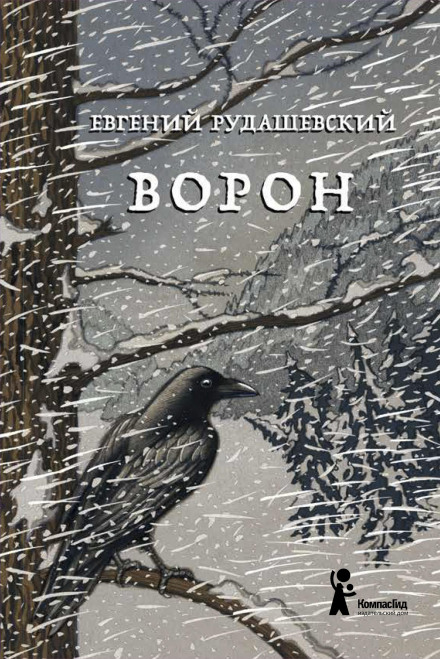
Raven
4 hrs. 20 min.
Language
Russian
Author
Evgeny Rudashevsky
Author
Evgeny Rudashevsky
Narrator
Vyacheslav Gerasimov
Narrator
Vyacheslav Gerasimov
Description
At fourteen, you’re no longer a child. You understand more, you know people better, you feel nature more keenly. Dima went on a long sable hunt with one thought: with the first killed animal he would transform and return to the city as a real man. The guide to the adult world was Uncle Nikolai Nikolayevich, who could read tracks in the snow better than Dima could read his books. Helped the young hunter too—A ringleader Artëm ych and Vitya, an unwilling hunter, and the sensitive dog Tamga—but the real revelation would be a meeting with the elusive raven.
A multi-day sable hunt is an adventure you can’t tell your classmates about in a day or two. The best moment is right there: Dima aims at a nimble creature, squeezes the trigger, joyfully shouts, “Headshot!”—as if in a computer game! Could the boy imagine that his will and courage would come in handy not for this at all, and that stories for friends would have to be completely different?
Dima, like many teenage heroes in Evgeny Rudashevsky’s books, hangs between the world of childhood and the universe of adults. In “The Raven,” as well as in his other tales “Hello, My Brother Bzou!” and “Where Does Kumutkan Go,” Evgeny Rudashevsky creates a peculiar silent dialogue between the two main characters—human and animal. In the behavior of these “conversational partners,” in their fates, there’s something intriguingly similar and hard to name. Maybe it’s the need to get through a heavy moment for the sake of further life, or maybe it’s the loneliness of one that has slipped away from the pack, the loneliness of a creature that has, for the first time, left a cozy nest. The illustrations by Petr Zakharov echo the book’s mood and sharpen the internal conflict experienced by the main hero.
The writer carefully preserves the hunters’ tall tales and wisdom—the rich language full of meaningful nuances: the frost on the branches in the morning, or the whet/icing—an issue of principle. The novella “The Raven” easily takes its place alongside works by James Fenimore Cooper and Vitaly Bianki, and yet it is clearly, unmistakably modern. Dima is flesh of the 21st century. Nature isn’t a workshop or a temple for him: and he himself, the raven, and countless trees in the taiga—all of them are inhabitants of a single shared home, unique and therefore priceless.
A multi-day sable hunt is an adventure you can’t tell your classmates about in a day or two. The best moment is right there: Dima aims at a nimble creature, squeezes the trigger, joyfully shouts, “Headshot!”—as if in a computer game! Could the boy imagine that his will and courage would come in handy not for this at all, and that stories for friends would have to be completely different?
Dima, like many teenage heroes in Evgeny Rudashevsky’s books, hangs between the world of childhood and the universe of adults. In “The Raven,” as well as in his other tales “Hello, My Brother Bzou!” and “Where Does Kumutkan Go,” Evgeny Rudashevsky creates a peculiar silent dialogue between the two main characters—human and animal. In the behavior of these “conversational partners,” in their fates, there’s something intriguingly similar and hard to name. Maybe it’s the need to get through a heavy moment for the sake of further life, or maybe it’s the loneliness of one that has slipped away from the pack, the loneliness of a creature that has, for the first time, left a cozy nest. The illustrations by Petr Zakharov echo the book’s mood and sharpen the internal conflict experienced by the main hero.
The writer carefully preserves the hunters’ tall tales and wisdom—the rich language full of meaningful nuances: the frost on the branches in the morning, or the whet/icing—an issue of principle. The novella “The Raven” easily takes its place alongside works by James Fenimore Cooper and Vitaly Bianki, and yet it is clearly, unmistakably modern. Dima is flesh of the 21st century. Nature isn’t a workshop or a temple for him: and he himself, the raven, and countless trees in the taiga—all of them are inhabitants of a single shared home, unique and therefore priceless.
100%
00:29
00_00_Rudashevskiy_E_Voron_Gerasimov_V
02:44
00_01_Annotatsiya
05:49
00_02_Protiv shersti
23:12
01_Voron
19:38
02_Voron
19:18
03_Voron
24:58
04_Voron
19:06
05_Voron
20:53
06_Voron
15:20
07_Voron
23:14
08_Voron
17:08
09_Voron
19:25
10_Voron
15:27
11_Voron
12:57
12_Voron
13:29
13_Voron
07:14
14_Voron
