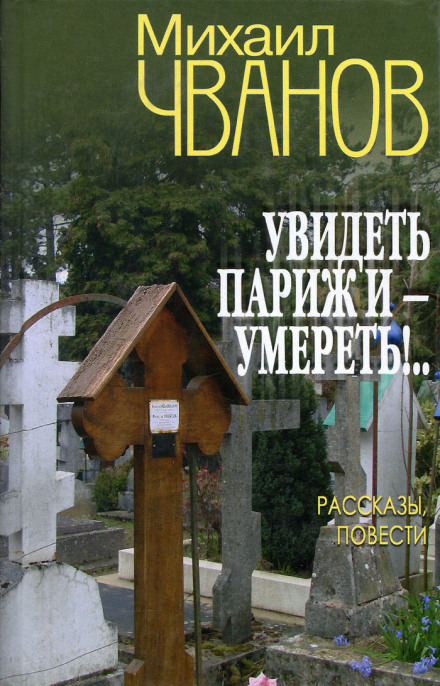
To See Paris and Die!
19 hrs. 37 min.
Language
Russian
Author
Mikhail Chvanov
Author
Mikhail Chvanov
Narrator
Andrey Leonov
Narrator
Andrey Leonov
Description
Mikhail Chvanov became known to a broad circle of readers in the early 1970s, especially thanks to the story “A Ticket to Childhood.” As often happens with truly talented, outstanding works, it was initially rejected by literary magazines, and later people would write that “it—shocking in its depth and artistic expressiveness—entered the collection of the best works of Russian literature.”
It’s no coincidence that at one time Mikhail Ivanov was supported by another writer, also initially rejected by Soviet critics and later world-famous—Vasily Bykov: “Your talent is very deep. Try to use it in a worthy way… Don’t believe there are all kinds of… Better listen to yourself—your talent will guide you…”
“To me, a real discovery—one that made me admire and bow my head before a true enthusiast of culture and a sane thinker—was my introduction, by correspondence, with Mikhail Andreevich Ivanov,” wrote the uncompromising fighter for Russian culture, a well-known restorer and art historian S.V. Yamshchikov. “Literary works coming from Ivanov’s pen fit naturally into the richest treasury of modern Russian literary creativity and hold up in comparisons with the classic works of Rasputin, Astafyev, Abramov, and Nosov…”
The book “To See Paris and—To Die” is included in the two-volume edition “Collected Works” by Mikhail Ivanov (vol. 1).
It’s no coincidence that at one time Mikhail Ivanov was supported by another writer, also initially rejected by Soviet critics and later world-famous—Vasily Bykov: “Your talent is very deep. Try to use it in a worthy way… Don’t believe there are all kinds of… Better listen to yourself—your talent will guide you…”
“To me, a real discovery—one that made me admire and bow my head before a true enthusiast of culture and a sane thinker—was my introduction, by correspondence, with Mikhail Andreevich Ivanov,” wrote the uncompromising fighter for Russian culture, a well-known restorer and art historian S.V. Yamshchikov. “Literary works coming from Ivanov’s pen fit naturally into the richest treasury of modern Russian literary creativity and hold up in comparisons with the classic works of Rasputin, Astafyev, Abramov, and Nosov…”
The book “To See Paris and—To Die” is included in the two-volume edition “Collected Works” by Mikhail Ivanov (vol. 1).
100%
00:25
00_00_Chvanov_M_Uvidet_Parizh_i_-_umeret!_Leonov_A
00:27
00_01_Soderzhanie
29:37
01_01_01_Krasnyy osinovyy list
29:26
01_01_02_Krasnyy osinovyy list
28:53
01_01_03_Krasnyy osinovyy list
29:59
01_02_01_Na beregah Lety
29:06
01_02_02_Na beregah Lety
27:31
01_02_03_Na beregah Lety
27:50
01_02_04_Na beregah Lety
27:29
01_02_05_Na beregah Lety
23:00
01_02_06_Na beregah Lety
22:56
01_02_07_Na beregah Lety
23:03
01_02_08_Na beregah Lety
26:41
01_02_09_Na beregah Lety
26:43
01_02_10_Na beregah Lety
25:26
01_02_11_Na beregah Lety
35:09
01_03_01_I zhenschinu zovut doroga
28:33
01_03_02_I zhenschinu zovut doroga
28:27
01_03_03_I zhenschinu zovut doroga
10:26
01_03_04_I zhenschinu zovut doroga
24:50
02_01_U perevala
24:24
02_02_U perevala
05:49
02_03_U perevala
28:25
02_04_U perevala
28:06
02_05_U perevala
22:46
02_06_01_U perevala
27:24
02_06_02_U perevala
27:41
02_06_03_U perevala
26:44
02_06_04_U perevala
25:58
03_01_Uvidet Parizh i - umeret
21:17
03_02_Uvidet Parizh i - umeret
20:43
03_03_Uvidet Parizh i - umeret
10:06
04_00_Moya bylaya Rossiya
04:18
04_01_Moya bylaya Rossiya
12:52
04_02_Moya bylaya Rossiya
14:38
04_03_Moya bylaya Rossiya
18:21
04_04_Moya bylaya Rossiya
16:59
04_05_Moya bylaya Rossiya
09:49
04_06_Moya bylaya Rossiya
25:26
04_07_Moya bylaya Rossiya
20:40
04_08_Moya bylaya Rossiya
31:32
04_09_Moya bylaya Rossiya
09:51
04_10_Moya bylaya Rossiya
08:06
04_11_Moya bylaya Rossiya
09:43
04_12_Moya bylaya Rossiya
15:25
04_13_Moya bylaya Rossiya
09:14
04_14_Moya bylaya Rossiya
15:55
04_15_Moya bylaya Rossiya
35:53
04_16_Moya bylaya Rossiya
24:11
04_17_Moya bylaya Rossiya
28:00
05_01_Po kom zvonit kolokol!
28:48
05_02_Po kom zvonit kolokol!
15:52
05_03_Po kom zvonit kolokol!
16:02
05_04_Po kom zvonit kolokol!
30:58
05_05_Po kom zvonit kolokol!
