The Tobolsk Knot
7 hrs. 40 min.
Language
Russian
Author
Yury Kurochkin
Author
Yury Kurochkin
Narrator
Vsevolod Kuznetsov
Narrator
Vsevolod Kuznetsov
Description
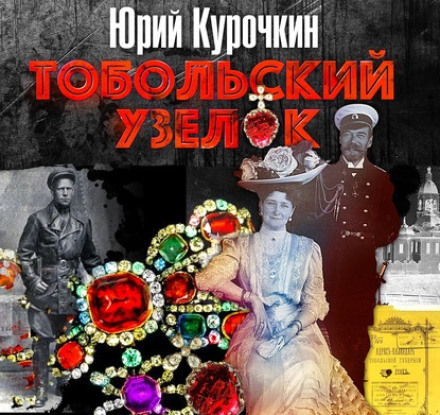
In the early 1930s, employees of the Plenipotentiary Representation of the OGPU in the Urals began receiving fragmentary operational information about a cache left in the city of Tobolsk by the family of the last emperor—Nicholas II. According to reports, the royal family left in Tobolsk for temporary safekeeping decorations and valuable personal items of daily use. To verify the information, an operational group from the OGPU Plenipotentiary Representation in the Urals was sent to Tobolsk—to assist local Chekists in searching for the Romanovs’ treasures. After almost a year, the royal cache was found. A preliminary expert estimate put the value of the treasures at 3,270,693 rubles. If you converted that figure into the equivalent of precious metal at the exchange rate of that time, its weight would have been equal to 2 tons 532 kilograms of gold. The further fate of the diamonds found in Tobolsk in November 1933 turned out to be no less mysterious. From Sverdlovsk they were sent to Moscow—where they simply disappeared.
In his book “Tobolsk Trifle,” the Sverdlovsk writer and local historian Yuri Mikhailovich Kurochkin tells about this successfully carried out operation by the Urals Chekists. The novella was first published in 1968 and, one could say, became in part a forerunner of another book released much later—about the treasures of the royal family: “Coronation, or the last of the novels” by Boris Akunin.
Here is what the author himself writes in the preface about his book: “The story of an operation carried out by the Urals Chekists in the early 1930s set out here does not claim to be a documentary chronicle. Time has not preserved many details without which useful documentary accuracy would be unimaginable. That is why the author considered it possible, at times, to shift events in time and space, to freely interpret scenes whose witnesses are no longer alive, to invent facts that may have taken place but were not recorded in documents; and finally, to portray the appearance and characters of the people involved (naturally, those not reflected in the documents) as the course of events suggested. In connection with this, the author was forced to change the names of many of the people involved.”
Materials from the site “Such a History” were used.
In his book “Tobolsk Trifle,” the Sverdlovsk writer and local historian Yuri Mikhailovich Kurochkin tells about this successfully carried out operation by the Urals Chekists. The novella was first published in 1968 and, one could say, became in part a forerunner of another book released much later—about the treasures of the royal family: “Coronation, or the last of the novels” by Boris Akunin.
Here is what the author himself writes in the preface about his book: “The story of an operation carried out by the Urals Chekists in the early 1930s set out here does not claim to be a documentary chronicle. Time has not preserved many details without which useful documentary accuracy would be unimaginable. That is why the author considered it possible, at times, to shift events in time and space, to freely interpret scenes whose witnesses are no longer alive, to invent facts that may have taken place but were not recorded in documents; and finally, to portray the appearance and characters of the people involved (naturally, those not reflected in the documents) as the course of events suggested. In connection with this, the author was forced to change the names of many of the people involved.”
Materials from the site “Such a History” were used.
