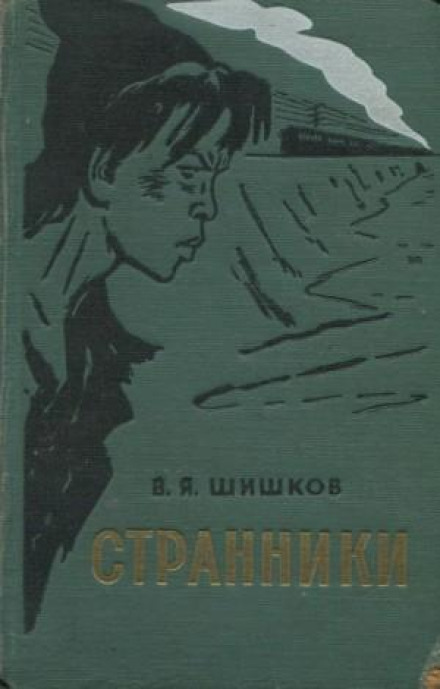
Wanderers
17 hrs. 55 min.
Language
Russian
Author
Vyacheslav Shishkov
Author
Vyacheslav Shishkov
Narrator
Vladimir Rybalchenko
Narrator
Vladimir Rybalchenko
Description
The objective depiction of real sides of life characteristic of great art, the depth of artistic knowledge of reality, and the interest in the problem of personality and society are fully reflected in the works of Vyacheslav Shishkov. In the novella “Strangers” (1931), the author tells about the hard life of homeless boys at the beginning of the 1920s, when the Soviet state was only just being formed. In those oppressive times of liberation struggle, an unavoidable disaster came down on Russian land: hunger, and along with it, typhus...
From the very beginning, the author touches the reader with sincerity and naive goodness of one of the main heroes—the fourteen-year-old boy Filka, left without parents. Together with the blind old man Nefed and the curly dog Sharik, Filka is condemned to an unenviable life—walking through villages and cities, singing songs and стихири, receiving alms for it. But children’s curiosity and gullibility lead Filka into a gang of homeless kids; life with them is forever imprinted in his still-childish heart. With vivid, heartbreaking colors, the author portrays the disgustingness of bandit life of those little runaways and the inevitability of its bitter end.
Each character has their own path, but at the same time each of them has a chance to change everything: someone ends up in prison and gets onto solid Soviet rails of re-education and correction; someone is healed through honest labor. The calls dictated by high-moral Soviet ideology are just as relevant today.
Overall, the book leaves a good impression; it encourages living the right way—through work and respect for others—which is precisely what is lacking these days. The book about the lives of homeless boys has been reissued several times with significant cuts by editors. Here the novella is presented without cuts.
From the very beginning, the author touches the reader with sincerity and naive goodness of one of the main heroes—the fourteen-year-old boy Filka, left without parents. Together with the blind old man Nefed and the curly dog Sharik, Filka is condemned to an unenviable life—walking through villages and cities, singing songs and стихири, receiving alms for it. But children’s curiosity and gullibility lead Filka into a gang of homeless kids; life with them is forever imprinted in his still-childish heart. With vivid, heartbreaking colors, the author portrays the disgustingness of bandit life of those little runaways and the inevitability of its bitter end.
Each character has their own path, but at the same time each of them has a chance to change everything: someone ends up in prison and gets onto solid Soviet rails of re-education and correction; someone is healed through honest labor. The calls dictated by high-moral Soviet ideology are just as relevant today.
Overall, the book leaves a good impression; it encourages living the right way—through work and respect for others—which is precisely what is lacking these days. The book about the lives of homeless boys has been reissued several times with significant cuts by editors. Here the novella is presented without cuts.
