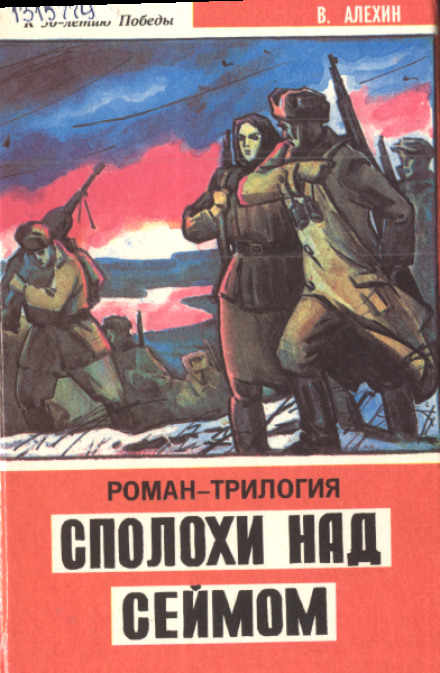
Flashes over the Seym
23 hrs. 42 min.
Language
Russian
Author
Vasily Alyokhin
Author
Vasily Alyokhin
Narrator
Nina Oleshnya
Narrator
Nina Oleshnya
Description
The novel “Sparks Over the Seym” was created over fifteen years. Its documentary foundation recreates events connected with partisan activity carried out by the secretary of the Kрупецкий district committee of the Komsomol, Alexandra Zaitseva. This name is well known in the Bryansk region, in Ukraine, in the Kursk region. In the village of Krupets, a monument has been erected to this legendary woman. The writer found numerous archival testimonies about the 2nd Kursk partisan brigade, where Shura Zaitseva served as a scout.
The writer consistently emphasizes the historical and documentary reliability of events in the narrative; repeatedly, with the accuracy of military reports, he records the deployment of both active army units and partisan formations during those months of the war.
In the novel, the peasant fates are carefully outlined; the atmosphere of difficult partisan battles is recreated. In “Sparks Over the Seym,” the author’s poetic way of thinking came through even more strongly; his painterly brush became more powerful in depicting characters and in revealing the common people’s meaning of the events in the novel.
Full of dramatic power are the pages where the writer draws the protest of young heroes against fascist cruelty—or their agonizing helplessness in the face of such cruelty. But nature in “Sparks Over the Seym” always helps the heroes find the inner strength to stand firm against the fascists.
The writer’s attention as a participant and as a witness of those difficult war months is focused on recreating the everyday reality of military life, on people’s behavior, and, above all, on the people’s opinion—expressed also in the novel’s language, close to everyday speech.
The writer consistently emphasizes the historical and documentary reliability of events in the narrative; repeatedly, with the accuracy of military reports, he records the deployment of both active army units and partisan formations during those months of the war.
In the novel, the peasant fates are carefully outlined; the atmosphere of difficult partisan battles is recreated. In “Sparks Over the Seym,” the author’s poetic way of thinking came through even more strongly; his painterly brush became more powerful in depicting characters and in revealing the common people’s meaning of the events in the novel.
Full of dramatic power are the pages where the writer draws the protest of young heroes against fascist cruelty—or their agonizing helplessness in the face of such cruelty. But nature in “Sparks Over the Seym” always helps the heroes find the inner strength to stand firm against the fascists.
The writer’s attention as a participant and as a witness of those difficult war months is focused on recreating the everyday reality of military life, on people’s behavior, and, above all, on the people’s opinion—expressed also in the novel’s language, close to everyday speech.
100%
06:20
00-01-epilog-vmesto-predisloviya
24:31
00-02-tak-nachinalis-legendy
18:38
01-01-u-zasechnoy-cherty
18:01
01-02-u-zasechnoy-cherty
18:26
01-03-u-zasechnoy-cherty
16:35
01-04-u-zasechnoy-cherty
08:07
01-05-u-zasechnoy-cherty
06:33
01-06-u-zasechnoy-cherty
23:17
01-07-u-zasechnoy-cherty
13:54
01-08-u-zasechnoy-cherty
14:16
01-09-u-zasechnoy-cherty
11:25
01-10-u-zasechnoy-cherty
14:24
01-11-u-zasechnoy-cherty
25:05
01-12-u-zasechnoy-cherty
24:10
01-13-u-zasechnoy-cherty
17:11
01-14-u-zasechnoy-cherty
15:32
01-15-u-zasechnoy-cherty
16:20
01-16-u-zasechnoy-cherty
20:29
01-17-u-zasechnoy-cherty
16:38
02-01-aprel-shury-zaytsevoy
23:32
02-02-aprel-shury-zaytsevoy
09:38
02-03-aprel-shury-zaytsevoy
11:37
02-04-aprel-shury-zaytsevoy
23:07
02-05-aprel-shury-zaytsevoy
15:52
02-06-aprel-shury-zaytsevoy
23:40
02-07-aprel-shury-zaytsevoy
18:22
02-08-aprel-shury-zaytsevoy
30:01
02-09-aprel-shury-zaytsevoy
29:24
02-10-aprel-shury-zaytsevoy
23:03
02-11-aprel-shury-zaytsevoy
18:49
02-12-aprel-shury-zaytsevoy
23:15
02-13-aprel-shury-zaytsevoy
30:24
02-14-aprel-shury-zaytsevoy
39:43
02-15-aprel-shury-zaytsevoy
40:26
02-16-aprel-shury-zaytsevoy
35:13
02-17-aprel-shury-zaytsevoy
36:08
02-18-aprel-shury-zaytsevoy
33:22
02-19-aprel-shury-zaytsevoy
26:35
03-01-pulya-na-dvoih
21:49
03-02-pulya-na-dvoih
12:14
03-03-pulya-na-dvoih
18:20
03-04-pulya-na-dvoih
29:49
03-05-pulya-na-dvoih
32:02
03-06-pulya-na-dvoih
28:03
03-07-pulya-na-dvoih
26:48
03-08-pulya-na-dvoih
39:09
03-09-pulya-na-dvoih
19:43
03-10-pulya-na-dvoih
28:00
03-11-pulya-na-dvoih
35:21
03-12-pulya-na-dvoih
35:29
03-13-pulya-na-dvoih
25:21
03-14-pulya-na-dvoih
37:20
03-15-pulya-na-dvoih
34:10
03-16-pulya-na-dvoih
44:36
03-17-pulya-na-dvoih
33:25
03-18-pulya-na-dvoih
31:00
03-19-pulya-na-dvoih
38:20
03-20-pulya-na-dvoih
29:28
03-21-pulya-na-dvoih
