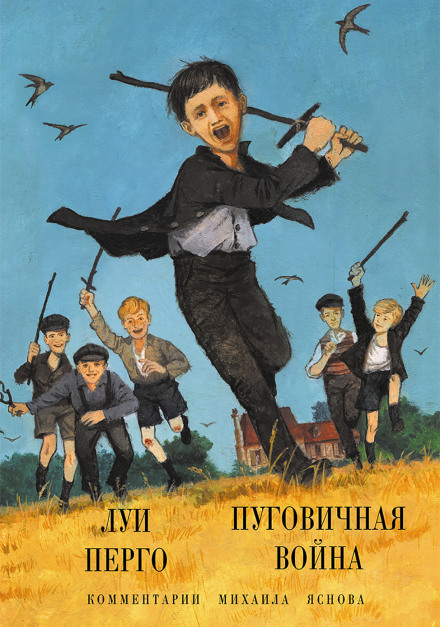
War of the Buttons
7 hrs. 2 min.
Language
Russian
Author
Louis Pergaud
Author
Louis Pergaud
Narrator
Dmitry Kreminsky
Narrator
Dmitry Kreminsky
Description
So it has been since time immemorial: every 12-year-old resident of Longuevern simply can’t stand the inhabitants of Vellrans. And every vellranger, as soon as they’ve learned the alphabet, hates the people of Longuevern. Whoever, in class, doesn’t tremble with impatience—to run away and teach the enemies a good lesson—is a coward and a traitor. Everyone trembles with impatience, in both villages, and rushes after classes to the next fight—well, how else could he become the deciding one?
There’s no war without trophies: the boys celebrate triumph by cutting the enemy’s buttons and clasps off their clothes so the enemy has to trudge to their parents’ well-deserved spanking with his pants still on. The “Button War” went on for years unchanged until, one day, the leader of the people of Longuevern came up with a way to fight au naturel—then you’ll avoid shame and your father’s belt. Who knew that this trick would turn the long-running conflict into a battle that was absolutely not for children…
Louis Perrault knew a thing or two about boys’ psychology: he wrote the book inspired by his teaching experience. At 28, Louis Perrault won the Goncourt Prize, beating such giants as Guillaume Apollinaire and Colette. And at 33, he died in the First World War. “The Button War” was published in France in 1912, and it seems as if a message is encoded in it: when hatred doesn’t subside, it grows—and the smallest stupidity can destroy a fragile world.
Adapted for the screen five times and famous thanks to his fame as the “Grandfather of The Fly-Men,” the novel appears in Russian for the first time. This became possible thanks to two masters—Mikhail Yasnov and Maria Brusovani. They managed to preserve the audacious style of the classic and go beyond the bounds of a historical novel. The edition is illustrated by Vadim Chelak and accompanied by a preface and comments by Mikhail Yasnov.
There’s no war without trophies: the boys celebrate triumph by cutting the enemy’s buttons and clasps off their clothes so the enemy has to trudge to their parents’ well-deserved spanking with his pants still on. The “Button War” went on for years unchanged until, one day, the leader of the people of Longuevern came up with a way to fight au naturel—then you’ll avoid shame and your father’s belt. Who knew that this trick would turn the long-running conflict into a battle that was absolutely not for children…
Louis Perrault knew a thing or two about boys’ psychology: he wrote the book inspired by his teaching experience. At 28, Louis Perrault won the Goncourt Prize, beating such giants as Guillaume Apollinaire and Colette. And at 33, he died in the First World War. “The Button War” was published in France in 1912, and it seems as if a message is encoded in it: when hatred doesn’t subside, it grows—and the smallest stupidity can destroy a fragile world.
Adapted for the screen five times and famous thanks to his fame as the “Grandfather of The Fly-Men,” the novel appears in Russian for the first time. This became possible thanks to two masters—Mikhail Yasnov and Maria Brusovani. They managed to preserve the audacious style of the classic and go beyond the bounds of a historical novel. The edition is illustrated by Vadim Chelak and accompanied by a preface and comments by Mikhail Yasnov.
100%
02:57
00_00_Predislovie ot avtora
16:42
01_01_Obyavlenie voyny
13:57
01_02_Diplomaticheskaya napryazhennost
17:04
01_03_Velikiy den
16:52
01_04_Pervye nevzgody
14:05
01_05_Posledstviya katastrofy
15:13
01_06_Plan operatsii
23:10
01_07_Novye srazheniya
25:51
01_08_Spravedlivoe vozmezdie
13:11
02_01_Voennaya kazna
12:27
02_02_Bezdenezhe – nedug nevynosimyy
13:08
02_03_Buhgalteriya Tentena
15:05
02_04_I snova pobedy
11:18
02_05_Na pytochnom stolbe
16:05
02_06_Muchitelnaya zagadka
19:59
02_07_Neschastya kaznacheya
13:23
02_08_Drugie priemy
18:45
03_01_Stroitelstvo hizhiny
18:50
03_02_Velikie dni Lonzheverna
22:54
03_03_Lesnoy pir
17:22
03_04_Rasskazy o geroicheskih vremenah
12:37
03_05_Mezhdousobnye ssory
13:13
03_06_Chest i shtany Tentena
15:05
03_07_Rashischennaya kazna
14:00
03_08_Nakazannyy predatel
13:44
03_09_Tragicheskoe vozvraschenie
15:12
03_10_Poslednie slova
