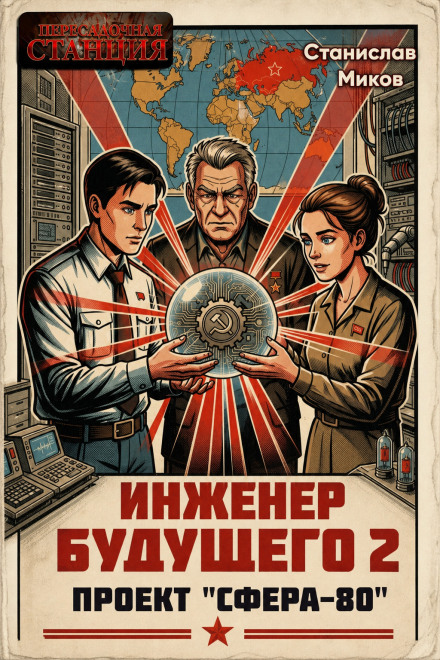
Project Sphere-80-2. Technical Specification for the Past. Part 2
11 hrs. 23 min.
Language
Russian
Author
Stanislav Mikov
Author
Stanislav Mikov
Narrator
Nikita Stepanenko
Narrator
Nikita Stepanenko
In 2026, he was developing microchips.
In 1976—he received a drafting table, clearance, and a hefty folder marked “TOR.”
Aleksei ends up in a Soviet design bureau, where a “home computer” sounds like a suspicious invention, and one careless phrase can bury the work forever. Microchips are obtained through connections, components are pulled through supply channels, and new ideas are hidden in hints and the wording of technical specifications. Here they don’t fight robots—here they wrestle with GOST standards, plans, and the ever-present fear of taking responsibility.
He understands what the dream computer must become.
But he is not allowed to say it out loud.
Is it possible to steer the future without revealing who you are?
Is it possible to disguise a revolution as a harmless “educational and demonstration device”?
And what’s more terrifying—an error in the circuit, or an overly noticeable initiative?
A novel about quiet engineering bravery, Soviet everyday life, and how sometimes the future begins with a properly drafted TOR (technical specification).
In 1976—he received a drafting table, clearance, and a hefty folder marked “TOR.”
Aleksei ends up in a Soviet design bureau, where a “home computer” sounds like a suspicious invention, and one careless phrase can bury the work forever. Microchips are obtained through connections, components are pulled through supply channels, and new ideas are hidden in hints and the wording of technical specifications. Here they don’t fight robots—here they wrestle with GOST standards, plans, and the ever-present fear of taking responsibility.
He understands what the dream computer must become.
But he is not allowed to say it out loud.
Is it possible to steer the future without revealing who you are?
Is it possible to disguise a revolution as a harmless “educational and demonstration device”?
And what’s more terrifying—an error in the circuit, or an overly noticeable initiative?
A novel about quiet engineering bravery, Soviet everyday life, and how sometimes the future begins with a properly drafted TOR (technical specification).
100%
16:37
Проект Сфера-80-2. ТЗ для прошлого. Часть 2 01
25:40
Проект Сфера-80-2. ТЗ для прошлого. Часть 2 02
24:27
Проект Сфера-80-2. ТЗ для прошлого. Часть 2 03
28:20
Проект Сфера-80-2. ТЗ для прошлого. Часть 2 04
22:46
Проект Сфера-80-2. ТЗ для прошлого. Часть 2 05
23:44
Проект Сфера-80-2. ТЗ для прошлого. Часть 2 06
24:34
Проект Сфера-80-2. ТЗ для прошлого. Часть 2 07
24:39
Проект Сфера-80-2. ТЗ для прошлого. Часть 2 08
22:15
Проект Сфера-80-2. ТЗ для прошлого. Часть 2 09
19:47
Проект Сфера-80-2. ТЗ для прошлого. Часть 2 10
19:57
Проект Сфера-80-2. ТЗ для прошлого. Часть 2 11
24:03
Проект Сфера-80-2. ТЗ для прошлого. Часть 2 12
26:33
Проект Сфера-80-2. ТЗ для прошлого. Часть 2 13
23:45
Проект Сфера-80-2. ТЗ для прошлого. Часть 2 14
25:22
Проект Сфера-80-2. ТЗ для прошлого. Часть 2 15
27:21
Проект Сфера-80-2. ТЗ для прошлого. Часть 2 16
27:55
Проект Сфера-80-2. ТЗ для прошлого. Часть 2 17
29:02
Проект Сфера-80-2. ТЗ для прошлого. Часть 2 18
22:53
Проект Сфера-80-2. ТЗ для прошлого. Часть 2 19
20:15
Проект Сфера-80-2. ТЗ для прошлого. Часть 2 20
21:25
Проект Сфера-80-2. ТЗ для прошлого. Часть 2 21
18:31
Проект Сфера-80-2. ТЗ для прошлого. Часть 2 22
21:12
Проект Сфера-80-2. ТЗ для прошлого. Часть 2 23
21:58
Проект Сфера-80-2. ТЗ для прошлого. Часть 2 24
21:48
Проект Сфера-80-2. ТЗ для прошлого. Часть 2 25
18:33
Проект Сфера-80-2. ТЗ для прошлого. Часть 2 26
24:55
Проект Сфера-80-2. ТЗ для прошлого. Часть 2 27
17:11
Проект Сфера-80-2. ТЗ для прошлого. Часть 2 28
18:32
Проект Сфера-80-2. ТЗ для прошлого. Часть 2 29
19:06
Проект Сфера-80-2. ТЗ для прошлого. Часть 2 30
