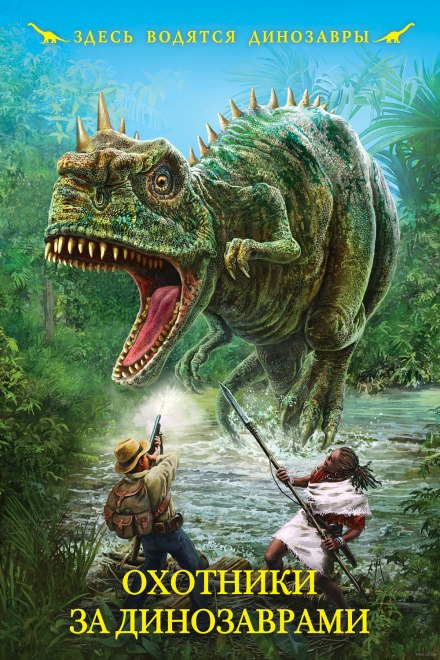
Dinosaur Hunters
2 hrs. 22 min.
Language
Russian
Author
Alexander Shalimov
Author
Alexander Shalimov
Narrator
Alexander Vodyanoy
Narrator
Alexander Vodyanoy
Description
In the swamps of equatorial Africa, an ancient species of reptiles unknown to science has survived to this day. An expedition led by Professor Tursky captured a baby dinosaur. The sun was already setting in the west. It was time to return. We packed up the remains of the movie camera, glass shards, a cigarette butt, and a cartridge in paper, and Kval’i hid them in a backpack along with samples of rock.
On the way back to camp, I already mentally drew up the picture of the crime. Two whites and two blacks go into the jungle. They reach a protected plateau. One records wild animals on film; the other guards him on dangerous routes. They set up camp in a scenic clearing above a gorge. All four head out on a long route to a lake.
A white rhinoceros, disturbed by a tyrannosaurus, attacks the small group. Both blacks become its victims. The rhinoceros is mortally wounded by the hunter, but the hunter and the cameraman don’t manage to approach it. Over the dying rhinoceros, a monstrous tyrannosaurus rises. The movie camera buzzes. The cameraman manages to capture a few frames. But the hunter hesitates—he isn’t sure he can stop the gigantic predator. While the tyrannosaurus tears apart the dead rhinoceros, the cameraman and the hunter retreat from the battlefield area.
They return to their camp above the gorge. But now there are only two of them. They have become owners of a sensation that could bring fame and money. Yet, in truth, the one in control is the cameraman: he managed to photograph the creature.
In the morning, a dispute arises, resolved by a shot from an 8-caliber rifle. The cameraman falls dead. The hunter rips the film cassette from the apparatus. The movie camera flies into the gorge. Now he is the only one—the owner of the sensation. He buries the body not far from the camp and sets off on the return journey.
After a few weeks, after developing the film, he sends a photograph to his patron—Mr. Leslie Baze…
On the way back to camp, I already mentally drew up the picture of the crime. Two whites and two blacks go into the jungle. They reach a protected plateau. One records wild animals on film; the other guards him on dangerous routes. They set up camp in a scenic clearing above a gorge. All four head out on a long route to a lake.
A white rhinoceros, disturbed by a tyrannosaurus, attacks the small group. Both blacks become its victims. The rhinoceros is mortally wounded by the hunter, but the hunter and the cameraman don’t manage to approach it. Over the dying rhinoceros, a monstrous tyrannosaurus rises. The movie camera buzzes. The cameraman manages to capture a few frames. But the hunter hesitates—he isn’t sure he can stop the gigantic predator. While the tyrannosaurus tears apart the dead rhinoceros, the cameraman and the hunter retreat from the battlefield area.
They return to their camp above the gorge. But now there are only two of them. They have become owners of a sensation that could bring fame and money. Yet, in truth, the one in control is the cameraman: he managed to photograph the creature.
In the morning, a dispute arises, resolved by a shot from an 8-caliber rifle. The cameraman falls dead. The hunter rips the film cassette from the apparatus. The movie camera flies into the gorge. Now he is the only one—the owner of the sensation. He buries the body not far from the camp and sets off on the return journey.
After a few weeks, after developing the film, he sends a photograph to his patron—Mr. Leslie Baze…
100%
36:50
Охотники за динозаврами (1ч)
38:25
Охотники за динозаврами (2ч)
34:18
Охотники за динозаврами. (3ч)
32:43
Охотники за динозаврами. (4ч)
