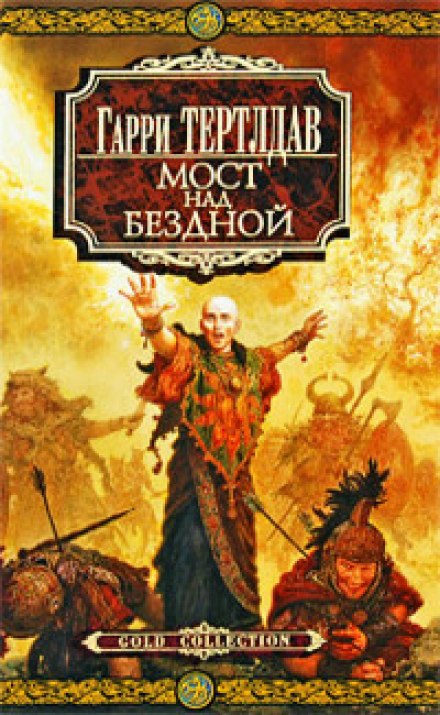
Bridge Over the Abyss
18 hrs. 55 min.
Language
Russian
Author
Harry Turtledove
Author
Harry Turtledove
Narrator
Vyacheslav Gerasimov
Narrator
Vyacheslav Gerasimov
Description
A historical fantasy set in a parallel world, whose main power is the Videss Empire. In fact, the Empire is essentially borrowed by Tertledove from his beloved Byzantium—down to geography, terminology, architecture, the art of war, and many small everyday details. The plot unfolds across different centuries of the Empire’s struggle against internal unrest and external enemies—who, too, have their own historical prototypes. For instance, Makuran is a hybrid of Assyria and Persia, Halogaland is post-Viking Scandinavia, Namdalen is Norman Sicily, Vaspurakan is ancient Armenia, and so on. In Tertledove’s novels, magic takes up very little space; it is merely auxiliary (though these novels aren’t spoiled by it), while the emphasis is on politics, intrigue, and wars. Still, each subcycle has its own overriding task and idea.
At the center of the story is the emperor’s cousin, a priest named Rshava. When another civil war breaks out in Videss, Rshava begins to doubt the doctrines he defended all his life. The local dark god, Scotoc, grants the heretic powerful magic—and soon the former servant of a good god turns into a hardened villain.
At the center of the story is the emperor’s cousin, a priest named Rshava. When another civil war breaks out in Videss, Rshava begins to doubt the doctrines he defended all his life. The local dark god, Scotoc, grants the heretic powerful magic—and soon the former servant of a good god turns into a hardened villain.
100%
10:06
001_Most nad bezdnoj
10:04
002_Most nad bezdnoj
10:01
003_Most nad bezdnoj
10:05
004_Most nad bezdnoj
10:03
005_Most nad bezdnoj
10:11
006_Most nad bezdnoj
10:05
007_Most nad bezdnoj
10:17
008_Most nad bezdnoj
10:06
009_Most nad bezdnoj
10:17
010_Most nad bezdnoj
10:11
011_Most nad bezdnoj
10:07
012_Most nad bezdnoj
10:31
013_Most nad bezdnoj
10:19
014_Most nad bezdnoj
10:01
015_Most nad bezdnoj
10:02
016_Most nad bezdnoj
10:02
017_Most nad bezdnoj
10:02
018_Most nad bezdnoj
10:17
019_Most nad bezdnoj
10:12
020_Most nad bezdnoj
10:54
021_Most nad bezdnoj
10:01
022_Most nad bezdnoj
10:10
023_Most nad bezdnoj
11:19
024_Most nad bezdnoj
10:02
025_Most nad bezdnoj
10:27
026_Most nad bezdnoj
10:15
027_Most nad bezdnoj
10:26
028_Most nad bezdnoj
10:04
029_Most nad bezdnoj
10:03
030_Most nad bezdnoj
10:03
031_Most nad bezdnoj
10:02
032_Most nad bezdnoj
10:02
033_Most nad bezdnoj
11:03
034_Most nad bezdnoj
10:14
035_Most nad bezdnoj
10:20
036_Most nad bezdnoj
10:14
037_Most nad bezdnoj
10:14
038_Most nad bezdnoj
10:07
039_Most nad bezdnoj
10:02
040_Most nad bezdnoj
10:19
041_Most nad bezdnoj
10:37
042_Most nad bezdnoj
10:06
043_Most nad bezdnoj
10:10
044_Most nad bezdnoj
10:17
045_Most nad bezdnoj
10:19
046_Most nad bezdnoj
10:14
047_Most nad bezdnoj
10:06
048_Most nad bezdnoj
10:02
049_Most nad bezdnoj
10:28
050_Most nad bezdnoj
10:12
051_Most nad bezdnoj
10:19
052_Most nad bezdnoj
10:02
053_Most nad bezdnoj
10:03
054_Most nad bezdnoj
10:03
055_Most nad bezdnoj
10:02
056_Most nad bezdnoj
10:30
057_Most nad bezdnoj
10:11
058_Most nad bezdnoj
10:07
059_Most nad bezdnoj
10:06
060_Most nad bezdnoj
10:08
061_Most nad bezdnoj
10:02
062_Most nad bezdnoj
10:18
063_Most nad bezdnoj
10:58
064_Most nad bezdnoj
11:37
065_Most nad bezdnoj
10:16
066_Most nad bezdnoj
10:18
067_Most nad bezdnoj
10:36
068_Most nad bezdnoj
10:39
069_Most nad bezdnoj
10:15
070_Most nad bezdnoj
10:09
071_Most nad bezdnoj
10:04
072_Most nad bezdnoj
10:23
073_Most nad bezdnoj
10:28
074_Most nad bezdnoj
10:03
075_Most nad bezdnoj
10:10
076_Most nad bezdnoj
10:02
077_Most nad bezdnoj
10:07
078_Most nad bezdnoj
10:20
079_Most nad bezdnoj
10:07
080_Most nad bezdnoj
10:03
081_Most nad bezdnoj
10:07
082_Most nad bezdnoj
10:21
083_Most nad bezdnoj
10:10
084_Most nad bezdnoj
10:13
085_Most nad bezdnoj
10:11
086_Most nad bezdnoj
11:30
087_Most nad bezdnoj
10:32
088_Most nad bezdnoj
10:19
089_Most nad bezdnoj
10:07
090_Most nad bezdnoj
10:38
091_Most nad bezdnoj
10:06
092_Most nad bezdnoj
10:27
093_Most nad bezdnoj
10:10
094_Most nad bezdnoj
10:07
095_Most nad bezdnoj
10:07
096_Most nad bezdnoj
10:30
097_Most nad bezdnoj
10:32
098_Most nad bezdnoj
10:03
099_Most nad bezdnoj
10:03
100_Most nad bezdnoj
10:02
101_Most nad bezdnoj
10:16
102_Most nad bezdnoj
10:10
103_Most nad bezdnoj
10:09
104_Most nad bezdnoj
10:52
105_Most nad bezdnoj
10:12
106_Most nad bezdnoj
10:12
107_Most nad bezdnoj
10:06
108_Most nad bezdnoj
10:06
109_Most nad bezdnoj
10:14
110_Most nad bezdnoj
06:24
111_Most nad bezdnoj
