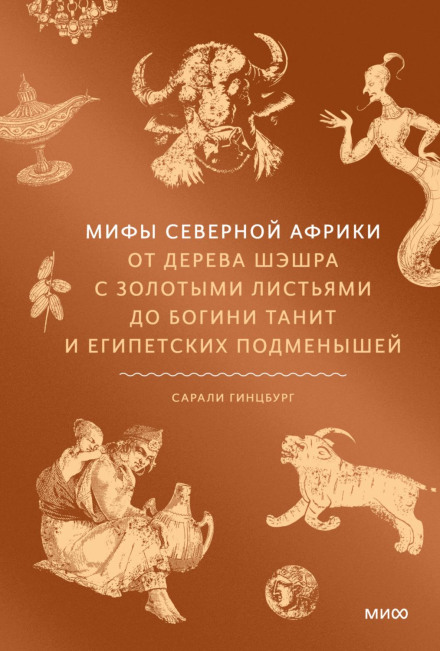
Myths of North Africa: From the Tree of Sheshru with Golden Leaves to the Goddess Tanit and Egyptian Changelings
4 hrs. 53 min.
Language
Russian
Author
Sarali Gintzburg
Author
Sarali Gintzburg
Narrator
Ekaterina Salova
Narrator
Ekaterina Salova
Description
North Africa—the “cradle of civilizations” and a true cultural mosaic. But what do we really know about the myths of its indigenous peoples? Very little. Some plots dissolve into Islam, others fade from memory, yet even through centuries of layers, there appears a surprisingly vivid universe where the world stands on the horns of a bull, the sky reflects emerald mountains, and a casually thrown date seed can end up straight in a djinn…
Sarahly Ginzburg’s book is the first Russian-language edition devoted to the ancient beliefs, legends, and rituals of the peoples of Egypt, Libya, Tunisia, Algeria, and Morocco. You’ll discover the cosmogonic myths of the Kabyles and their key characters—the First Bull, the Ant-Woman, and the First Mother; learn where efrits are born; meet the djinn Aisha Kandishah and the heirs of the ancient Egyptian god Bes; hear incredible stories about saints who continue to wander after death, and understand the meaning of “protective” patterns applied with henna.
Why, at the beginning of time, were women the rulers—and how did they lose that power? Who are ghuls and how did lions originate from people? Why does the crow repeat “I made a mistake,” and what is the First Mother’s main purpose—“to give bad advice”? What beings are made from “scorching fire”? How do djinns, efrits, and shaitans differ—and what separates white, black, and red djinns? Into whom (or into what) do the righteous turn after death, and how does the link between the word “carnival” and Isis fit in?
These are only part of the questions you’ll find answers to as you dive into the folklore of North African peoples who managed to preserve their distinctiveness despite time and change.
Who is this book for:
For everyone interested in folklore, myths, and how they continue to live in modern times.
For those who collect the series “Myths from A to Z.”
For readers curious about culture in its most unexpected forms.
From the author:
This book is the first Russian-language edition about the myths of North Africa. But it’s not just a selection of ancient legends, tales, and traditions. It is a living, multilayered cultural code through which the peoples of the region, over thousands of years, explained the structure of the world, nature, social relations, and themselves—from Berber water spirits to the deities of Ancient Egypt; from Arabic stories about djinns to Sufi allegories. North African mythology is a mosaic whose elements do not argue with each other, but come together into a unified picture.
The folk culture of North Africa demonstrates an unusual resilience of oral tradition. Despite colonization, urbanization, and the influence of globalization, many plots, heroes, and images continue to resonate in fairy tales, songs, rituals, and even everyday speech. Traditional beliefs still perform important functions today: they help explain the incomprehensible, transmit norms of behavior, and support a sense of community and belonging.
Studying the myths of North Africa means not only reconstructing archaic ideas, but also better understanding modern processes in the region. These stories provide keys to deep ideas about justice and power, good and evil, nature and humans—ideas that have shaped and continue to shape the identity of millions of people.
Sarahly Ginzburg’s book is the first Russian-language edition devoted to the ancient beliefs, legends, and rituals of the peoples of Egypt, Libya, Tunisia, Algeria, and Morocco. You’ll discover the cosmogonic myths of the Kabyles and their key characters—the First Bull, the Ant-Woman, and the First Mother; learn where efrits are born; meet the djinn Aisha Kandishah and the heirs of the ancient Egyptian god Bes; hear incredible stories about saints who continue to wander after death, and understand the meaning of “protective” patterns applied with henna.
Why, at the beginning of time, were women the rulers—and how did they lose that power? Who are ghuls and how did lions originate from people? Why does the crow repeat “I made a mistake,” and what is the First Mother’s main purpose—“to give bad advice”? What beings are made from “scorching fire”? How do djinns, efrits, and shaitans differ—and what separates white, black, and red djinns? Into whom (or into what) do the righteous turn after death, and how does the link between the word “carnival” and Isis fit in?
These are only part of the questions you’ll find answers to as you dive into the folklore of North African peoples who managed to preserve their distinctiveness despite time and change.
Who is this book for:
For everyone interested in folklore, myths, and how they continue to live in modern times.
For those who collect the series “Myths from A to Z.”
For readers curious about culture in its most unexpected forms.
From the author:
This book is the first Russian-language edition about the myths of North Africa. But it’s not just a selection of ancient legends, tales, and traditions. It is a living, multilayered cultural code through which the peoples of the region, over thousands of years, explained the structure of the world, nature, social relations, and themselves—from Berber water spirits to the deities of Ancient Egypt; from Arabic stories about djinns to Sufi allegories. North African mythology is a mosaic whose elements do not argue with each other, but come together into a unified picture.
The folk culture of North Africa demonstrates an unusual resilience of oral tradition. Despite colonization, urbanization, and the influence of globalization, many plots, heroes, and images continue to resonate in fairy tales, songs, rituals, and even everyday speech. Traditional beliefs still perform important functions today: they help explain the incomprehensible, transmit norms of behavior, and support a sense of community and belonging.
Studying the myths of North Africa means not only reconstructing archaic ideas, but also better understanding modern processes in the region. These stories provide keys to deep ideas about justice and power, good and evil, nature and humans—ideas that have shaped and continue to shape the identity of millions of people.
100%
21:25
00
45:44
01
55:23
02
48:35
03
1:01:01
04
55:48
05
05:24
06
