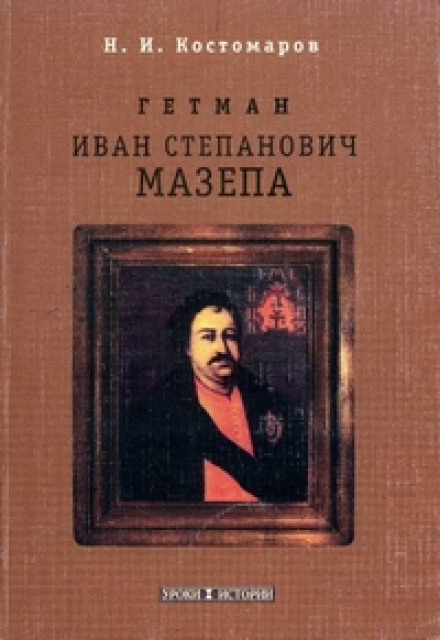
Mazepa
21 hrs. 42 min.
Language
Russian
Author
Nikolay Kostomarov
Author
Nikolay Kostomarov
Narrator
Evgeny Ternovsky
Narrator
Evgeny Ternovsky
Description
The founder of Russian historical thought, N. I. Kostomarov (1817–1885), devoted one of his serious scholarly works to Mazepa—an eponymous monograph, which to this day remains the most detailed study of this controversial figure. The name of Mazepa is connected with an important period in Ukrainian history—the “Hetmanate”—which, despite the centuries that have passed, still remains one of the most politicized, and Mazepa’s figure is still the subject of endless disputes.
The name of Ivan Stepanovich Mazepa is known to the modern reader most likely as one of the characters in A. S. Pushkin’s poem “Poltava,” from which we borrowed the succinct Pushkin characterization and used it as the title of this preface. A real historical person associated in one way or another with the history of Peter’s era, Mazepa is interesting not only in the context of the Great Northern War between Peter the Great and Charles XII. This figure appeared on the horizon of the Ukrainian people’s history during a time when the euphoria of reunification with Russia had already blown away under the harsh pressure of the tsar’s fist; when, instead of the Polish system of serfdom, Ukrainian peasants were subjected to enslavement by their own “fellow-blooded” nobility, under the aegis of— and with intensified support from—the ruling class of the Russian state.
The name of Ivan Stepanovich Mazepa is known to the modern reader most likely as one of the characters in A. S. Pushkin’s poem “Poltava,” from which we borrowed the succinct Pushkin characterization and used it as the title of this preface. A real historical person associated in one way or another with the history of Peter’s era, Mazepa is interesting not only in the context of the Great Northern War between Peter the Great and Charles XII. This figure appeared on the horizon of the Ukrainian people’s history during a time when the euphoria of reunification with Russia had already blown away under the harsh pressure of the tsar’s fist; when, instead of the Polish system of serfdom, Ukrainian peasants were subjected to enslavement by their own “fellow-blooded” nobility, under the aegis of— and with intensified support from—the ruling class of the Russian state.
100%
23:08
00_01_01_Getman-zlodey B_G_Litvak
20:35
00_01_02_Getman-zlodey B_G_Litvak
20:14
00_01_03_Getman-zlodey B_G_Litvak
21:50
01_01_Mazepa
25:37
01_02_Mazepa
20:41
02_01_Mazepa
23:07
02_02_Mazepa
26:07
03_01_Mazepa
22:08
03_02_Mazepa
21:24
03_03_Mazepa
24:38
04_01_Mazepa
21:27
04_02_Mazepa
22:41
04_03_Mazepa
27:45
04_04_Mazepa
23:01
05_01_Mazepa
24:17
05_02_Mazepa
21:37
06_01_Mazepa
16:43
06_02_Mazepa
23:01
06_03_Mazepa
22:03
07_01_Mazepa
26:11
07_02_Mazepa
25:14
08_01_Mazepa
23:32
08_02_Mazepa
19:06
08_03_Mazepa
29:18
08_04_Mazepa
28:12
09_01_Mazepa
23:43
09_02_Mazepa
29:14
10_01_Mazepa
29:34
11_01_Mazepa
27:03
11_02_Mazepa
26:19
11_03_Mazepa
24:39
11_04_Mazepa
28:05
12_01_Mazepa
05:01
12_02_Mazepa
28:03
12_03_Mazepa
16:28
12_04_Mazepa
25:48
12_05_Mazepa
26:08
12_06_Mazepa
28:44
12_07_Mazepa
25:58
13_01_Mazepa
29:59
13_02_Mazepa
17:02
13_03_Mazepa
18:34
13_04_Mazepa
28:08
14_01_Mazepa
24:33
14_02_Mazepa
17:47
14_03_Mazepa
20:39
14_04_Mazepa
25:24
15_01_Mazepa
27:03
15_02_Mazepa
19:43
15_03_Mazepa
31:53
16_00_Mazepa
26:37
17_01_Mazepa
19:20
17_02_Mazepa
23:39
17_03_Mazepa
24:10
18_00_Istochniki
