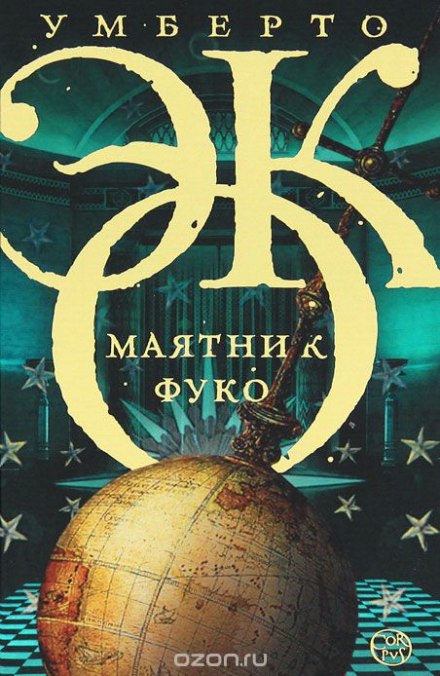
Foucault's Pendulum
22 hrs. 16 min.
Language
Russian
Author
Umberto Eco
Author
Umberto Eco
Narrator
Evgeny Ternovsky
Narrator
Evgeny Ternovsky
Description
“Foucault’s Pendulum” is the second novel by Italian writer and philosopher, professor of semiotics at the University of Bologna, Umberto Eco. It was first published in Italian in 1988.
The plot of the novel (like the eponymous pendulum) revolves around three friends—Belbo, Diotallevi, and Casabona—who work at the “factory of fame” (“factory of fame” or “vanity press” is a publishing house that prints books paid for by the authors, often by people who write without talent) in Milan. After reading many manuscripts devoted to occult conspiracy theories, they decide they can do better—and begin, for entertainment, to create their own theory. They call this satirical-intellectual game “The Plan.”
The more Belbo, Diotallevi, and Casabona developed their brainchild, the more, without noticing it, they plunged into the depths of their “Plan,” sometimes even forgetting that it was only a game. What’s more, when the supporters of other conspiracy theories learned about “The Plan,” they took it completely seriously. In the end, Belbo discovers that he is the target of a real secret society, which believes that he holds the solution to the mystery of the lost treasure of the Templars.
Many subplots of the work weave into the main theme of creating “The Plan.” For example, the reasons for Belbo’s obsession with “The Plan” come from his childhood spent in Italy during World War II, from his unrequited love for the fickle Lorenza Pellegrini, and from his desire to free himself from the constant feeling of his own inadequacy. Using the Plan of the Templar Order for world domination, the novel demonstrates the innate gullibility and tendency toward mystification that is inherent in all people.
Because a magazine version has been recorded, there will inevitably be cuts. Tracks are named according to chapter numbers, so the numbering order has gaps.
The plot of the novel (like the eponymous pendulum) revolves around three friends—Belbo, Diotallevi, and Casabona—who work at the “factory of fame” (“factory of fame” or “vanity press” is a publishing house that prints books paid for by the authors, often by people who write without talent) in Milan. After reading many manuscripts devoted to occult conspiracy theories, they decide they can do better—and begin, for entertainment, to create their own theory. They call this satirical-intellectual game “The Plan.”
The more Belbo, Diotallevi, and Casabona developed their brainchild, the more, without noticing it, they plunged into the depths of their “Plan,” sometimes even forgetting that it was only a game. What’s more, when the supporters of other conspiracy theories learned about “The Plan,” they took it completely seriously. In the end, Belbo discovers that he is the target of a real secret society, which believes that he holds the solution to the mystery of the lost treasure of the Templars.
Many subplots of the work weave into the main theme of creating “The Plan.” For example, the reasons for Belbo’s obsession with “The Plan” come from his childhood spent in Italy during World War II, from his unrequited love for the fickle Lorenza Pellegrini, and from his desire to free himself from the constant feeling of his own inadequacy. Using the Plan of the Templar Order for world domination, the novel demonstrates the innate gullibility and tendency toward mystification that is inherent in all people.
Because a magazine version has been recorded, there will inevitably be cuts. Tracks are named according to chapter numbers, so the numbering order has gaps.
100%
00:27
000_Eko_U_Mayatnik_Fuko_Ternovskiy_E
26:10
001_Keter
35:01
002_Keter
24:01
003_Hohma
15:02
004_Hohma
30:01
005_Hohma
10:13
006_Hohma
15:05
007_Bina
18:58
008_Bina
09:34
009_Bina
19:28
010_Bina
15:19
011_Bina
21:23
012_Bina
30:13
013_Bina
22:12
014_Bina
12:37
015_Bina
04:16
016_Bina
18:22
017_Bina
19:21
018_Bina
29:41
019_Bina
28:26
020_Bina
12:57
021_Bina
15:53
022_Bina
02:54
023_Hesed
16:53
024_Hesed
04:26
025_Hesed
14:46
026_Hesed
15:39
027_Hesed
08:43
028_Hesed
13:19
029_Hesed
12:54
030_Hesed
02:04
031_Hesed
04:30
032_Hesed
21:58
033_Hesed
19:48
034_Gevura
08:25
035_Gevura
19:56
036_Gevura
11:51
037_Gevura
23:24
038_Gevura
24:09
039_Gevura
11:52
042_Gevura
18:48
045_Gevura
11:22
046_Gevura
16:10
047_Gevura
15:48
048_Gevura
16:21
050_Gevura
12:29
051_Gevura
09:11
052_Gevura
26:13
053_Gevura
07:53
054_Gevura
20:13
055_Gevura
19:04
056_Gevura
18:27
067_Tiferet
24:05
068_Tiferet
03:12
069_Tiferet
12:47
070_Tiferet
14:22
071_Tiferet
12:01
072_Tiferet
02:14
073_Tiferet
14:12
074_Tiferet
21:37
075_Tiferet
12:27
076_Tiferet
09:01
077_Tiferet
12:36
078_Tiferet
07:22
079_Tiferet
03:43
080_Tiferet
03:25
081_Tiferet
08:42
082_Tiferet
00:11
083_Tiferet
05:25
084_Tiferet
01:55
085_Tiferet
05:02
086_Tiferet
09:00
087_Tiferet
00:55
088_Tiferet
00:53
089_Tiferet
08:49
090_Tiferet
05:00
091_Tiferet
06:39
092_Tiferet
05:09
093_Tiferet
03:25
094_Tiferet
01:29
095_Tiferet
12:53
096_Tiferet
25:32
106_Tiferet
18:34
107_Netsah
24:16
108_Netsah
19:27
109_Netsah
10:09
110_Netsah
11:51
111_Netsah
49:30
113_God
13:13
117_God
27:01
118_Yesod
33:06
119_Yesod
11:16
120_Malhut
