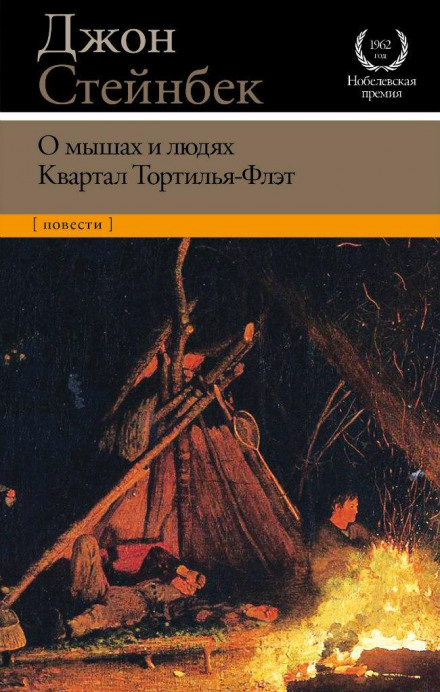
Tortilla Flat
7 hrs. 56 min.
Language
Russian
Author
John Steinbeck
Author
John Steinbeck
Narrator
Vyacheslav Gerasimov
Narrator
Vyacheslav Gerasimov
Description
John Steinbeck (1902–1968) is one of the most prominent and complex figures in the history of modern American literature; his human and literary fate is woven from deep contradictions.
A humanist artist, creator of vivid works devoted to working, democratic America, in the last years of his life he dealt a serious blow to his reputation as an uncompromising critic of the bourgeois way of life—by supporting the shameful interference of the US ruling circles in the internal affairs of the peoples of Indochina. For a long time, Steinbeck was among the leading representatives of the socially critical trend in American prose, and in “The Grapes of Wrath” (1939) progressive criticism saw a further development of the progressive traditions of 20th-century American literature associated with the names of John Reed, Theodore Dreiser, Upton Sinclair, and writers of the “proletarian novel” school of the 1930s. Later, bourgeois literary scholarship made considerable efforts to diminish the significance of Steinbeck’s best books and present him as a “living relic,” a fragment of an era forever gone. The creative decline clearly marked in Steinbeck from the end of the 1940s did indeed give grounds for pessimistic judgments for a time—however, the publication of the novel “The Winter of Our Discontent” (1961) and the travel notes “Travels with Charley…” (1962) once again confirmed the high mastery of the American prose writer and his devotion to the ideals of active humanism.
Not everything written by Steinbeck over nearly forty years of literary work is equally valuable, and not all of it can be counted among achievements of American critical realism. If the writer’s path in the 1930s was marked by a steady strengthening of realistic tendencies and an increase in critical potential, afterward he published a number of openly weak books saturated with abstract moralizing and semi-mystical moods. The complexity of the author’s creative evolution from “The Grapes of Wrath” is undeniable, yet even in the years of rapid growth of his popularity—and in the grim times of McCarthyism, which left a crushing imprint on all spiritual life in America—the writer remained faithful to democratic principles: the leading and most fruitful factor in the intricate system of his ideological and aesthetic views.
A humanist artist, creator of vivid works devoted to working, democratic America, in the last years of his life he dealt a serious blow to his reputation as an uncompromising critic of the bourgeois way of life—by supporting the shameful interference of the US ruling circles in the internal affairs of the peoples of Indochina. For a long time, Steinbeck was among the leading representatives of the socially critical trend in American prose, and in “The Grapes of Wrath” (1939) progressive criticism saw a further development of the progressive traditions of 20th-century American literature associated with the names of John Reed, Theodore Dreiser, Upton Sinclair, and writers of the “proletarian novel” school of the 1930s. Later, bourgeois literary scholarship made considerable efforts to diminish the significance of Steinbeck’s best books and present him as a “living relic,” a fragment of an era forever gone. The creative decline clearly marked in Steinbeck from the end of the 1940s did indeed give grounds for pessimistic judgments for a time—however, the publication of the novel “The Winter of Our Discontent” (1961) and the travel notes “Travels with Charley…” (1962) once again confirmed the high mastery of the American prose writer and his devotion to the ideals of active humanism.
Not everything written by Steinbeck over nearly forty years of literary work is equally valuable, and not all of it can be counted among achievements of American critical realism. If the writer’s path in the 1930s was marked by a steady strengthening of realistic tendencies and an increase in critical potential, afterward he published a number of openly weak books saturated with abstract moralizing and semi-mystical moods. The complexity of the author’s creative evolution from “The Grapes of Wrath” is undeniable, yet even in the years of rapid growth of his popularity—and in the grim times of McCarthyism, which left a crushing imprint on all spiritual life in America—the writer remained faithful to democratic principles: the leading and most fruitful factor in the intricate system of his ideological and aesthetic views.
100%
00:29
00_00_Steynbek_D_Kvartal_Tortilya-Flet_Gerasimov_V
03:38
00_01_Predislovie
09:00
00_02_Vstuplenie
15:33
01_Kvartal Tortilya-Flet
12:27
02_Kvartal Tortilya-Flet
17:44
03_Kvartal Tortilya-Flet
28:20
04_Kvartal Tortilya-Flet
24:17
05_Kvartal Tortilya-Flet
14:21
06_Kvartal Tortilya-Flet
45:25
07_Kvartal Tortilya-Flet
52:57
08_Kvartal Tortilya-Flet
30:39
09_Kvartal Tortilya-Flet
20:04
10_Kvartal Tortilya-Flet
13:07
11_Kvartal Tortilya-Flet
35:50
12_Kvartal Tortilya-Flet
23:49
13_Kvartal Tortilya-Flet
34:35
14_Kvartal Tortilya-Flet
37:05
15_Kvartal Tortilya-Flet
34:59
16_Kvartal Tortilya-Flet
21:42
17_Kvartal Tortilya-Flet
