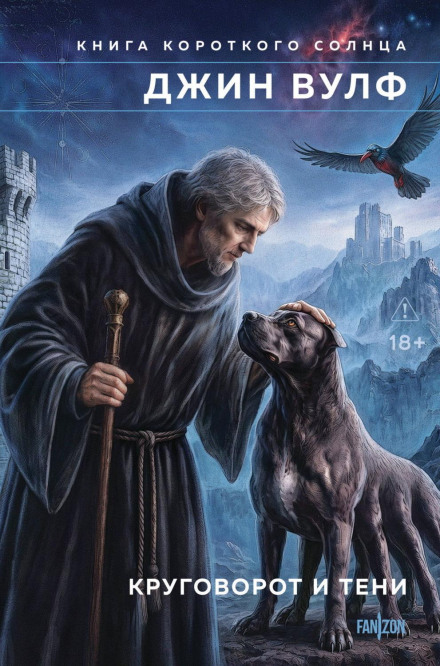
Turnturn and Shadows
35 hrs. 25 min.
Language
Russian
Author
Gene Wolfe
Author
Gene Wolfe
Narrator
Miroslav Velesov
Narrator
Miroslav Velesov
“Return to the Tidal Winding” is the third book of “The Book of the Short Sun” and the final part of the grand cycle “Briar.”
The story is presented once again as a chronicle of Peavey, who sets out in search of the hero and the pater’s commander, Silk. His journey runs from the oceans of the Blue Tidal Winding to the mysterious jungles of the Green; he has been on the majestic starship “The Long Sun Tidal Winding,” and somehow ends up even on the distant planet Urth under the light of a dying red star.
At the same time, Peavey’s very identity grows increasingly ambiguous: this riddle is woven into a narrative that is deliberately arranged in an unusual way—jumping between places and times, from the present to the past. It’s possible that Peavey and Silk are no longer two separate figures, but a single whole.
In addition to the novel, the omnibus edition is supplemented with a collection of essays and interviews, “Shadows of the New Sun”: it includes rare and hard-to-find materials, especially valuable for long-time readers and scholars of Wolfe.
The essays are devoted to the very nature of writing—from the creation of heroes and the building of composition to reflections on the writer’s craft. The edition also includes interviews with the author, and a true gem for fans of “The Book of the New Sun”: the essay “Books from the “ “The Book of the New Sun” ”.”
The Russian-language edition completes the publication of one of the largest epic cycles of Anglo-American science fiction, standing alongside “Foundation/Academy” by Asimov, “Dune” by Herbert, “Hyperion” by Simmons, and Le Guin’s Earthsea Cycle.
“Stunning literary craftsmanship.” – Interzone
“Proposal upon proposal, Wolfe demonstrates the mastery that far from every science-fiction author can boast. He sets high demands for the reader, and this challenge is worth accepting.” – The New York Times Book Review
“Gene Wolfe is a mesmerizing—and at the same time infuriating—author: his indirect style, complex tonalities, playful manner, and persistent insistence that you read between the lines—much more carefully than most science-fiction writers—force you to closely analyze his novels, but generously reward you for it.
Of course, this book will prove exceptionally valuable.” – Science Fiction Studies
