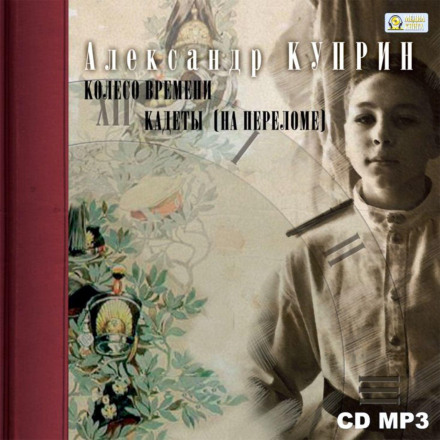
The Wheel of Time: Cadets
5 hrs. 56 min.
Language
Russian
Author
Alexander Kuprin
Author
Alexander Kuprin
Narrator
Yulia Tarasova
Narrator
Yulia Tarasova
Description
The Wheel of Time is one of the most outstanding novels by A. I. Kuprin. ‘You say—too much? Nonsense. Light wine… No, my friend: I’m not a man who has sunk—I’d say, I’m emptied out. My soul is gone, and all that remains of me is just a bodily shell. I live by the unbreakable law of inertia. There’s business, there’s money. I’m healthy; in the mornings I read the papers and drink coffee—everything’s fine. I taste wine only on occasion, in company, though the company itself doesn’t amuse me in the least. But the soul has flown away. I watch the passing days indifferently, like an old film.’
The special value of the work The Cadets lies in its autobiographical character, for it was during the time of his “military youth” that Kuprin was already dreaming of becoming a “poet or a novelist.” In the very same year, military schools turned into cadet corps. It happened quite simply: the cadets were read out the highest decree, and then a few days later they were led to the dormitories and ordered, instead of the old caps, to wear round caps with a red band and a visor. Then came colored belts and the letters painted in oil on the epaulettes. It was a time of upheaval, a time of all kinds of ferment; a time of terrible distrust between teachers and students; slackness in ranks and in discipline; excessive strictness and absurd leniencies; a time when humane, milutinian—and civilian—principles collided with the harsh soldierly regimen.’ ‘The Cadets’
A. I. Kuprin
The special value of the work The Cadets lies in its autobiographical character, for it was during the time of his “military youth” that Kuprin was already dreaming of becoming a “poet or a novelist.” In the very same year, military schools turned into cadet corps. It happened quite simply: the cadets were read out the highest decree, and then a few days later they were led to the dormitories and ordered, instead of the old caps, to wear round caps with a red band and a visor. Then came colored belts and the letters painted in oil on the epaulettes. It was a time of upheaval, a time of all kinds of ferment; a time of terrible distrust between teachers and students; slackness in ranks and in discipline; excessive strictness and absurd leniencies; a time when humane, milutinian—and civilian—principles collided with the harsh soldierly regimen.’ ‘The Cadets’
A. I. Kuprin
100%
10:04
101_01
09:49
101_02
09:46
102_01
08:56
103_01
07:16
103_02
06:54
104_01
06:36
105_01
09:37
106_01
11:52
107_01
13:12
108_01
08:01
109_01
07:59
109_02
08:04
110_01
08:01
110_02
09:55
111_01
10:18
111_02
10:42
112_01
09:30
112_02
08:41
113_01
07:08
201_01
08:40
201_02
10:04
202_01
10:10
202_02
08:55
203_01
08:26
203_02
12:03
203_03
10:28
204_01
08:44
204_02
09:40
204_03
10:19
205_01
10:47
205_02
11:49
205_03
08:30
206_01
09:20
206_02
09:02
206_03
09:12
206_04
07:31
207_01
10:58
207_02
