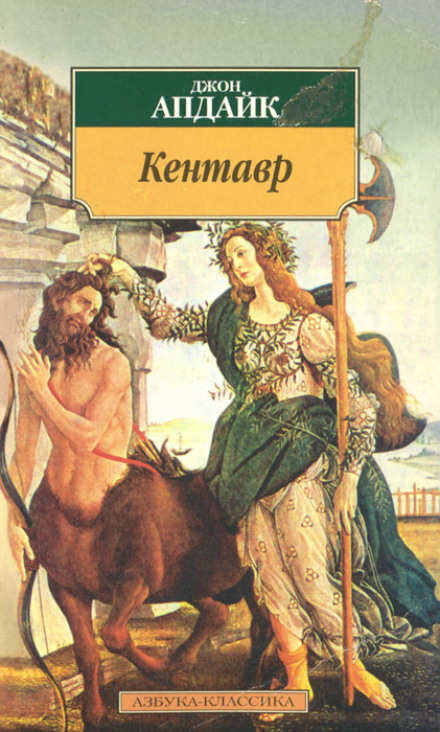
The Centaur
14 hrs. 43 min.
Language
Russian
Author
John Updike
Author
John Updike
Narrator
Viktor Pronin
Narrator
Viktor Pronin
Description
The novel bewilders with its unusualness, because it intertwines ancient Greek myths and modern reality.
Updike identifies his hero with the centaur Chiron—who sacrifices himself, like Christ, and his immortality for humanity—thus enabling the writer to elevate the everyday problems of a schoolteacher to the level of eternal themes…
Caldwell turned away, and at that very moment an arrow pierced his ankle. The class erupted in laughter. Pain shot up along the thin core of his shin, bored through the knee’s folds, and, growing, surged into his abdomen. He stared at the blackboard on which he had just written in chalk: 5,000,000,000—the assumed age of the universe in years. The class’s laughter, first breaking out as surprised loud barking, turned into a unified jeering, surrounding him from all sides, destroying the solitude he so craved—he wanted to keep the pain all to himself, to measure its strength, to listen as it would fade, to dissect it carefully. Pain sent a tentacle into his skull, spreading wet wings in his chest, and suddenly—blinded by a bloody fog—it seemed to him that he himself was an enormous bird that had shaken itself awake from sleep. The board, washed since the evening, was covered with whitish smears like a film and enveloped his consciousness. Pain pressed with furry paws on his heart and lungs; it crept up to his throat, and it seemed to him now that his brain was a piece of meat he had lifted high on a plate to save it from the hungry teeth of predators. Several boys in bright shirts of all the colors of the rainbow jumped up, flung into the dirty shoes onto the hinged seats of their desks, with sparkling eyes—they continued tormenting their teacher. It was impossible to endure this kind of pandemonium. Caldwell limped to the door and shut it behind him under a savage, triumphant roar.
Updike identifies his hero with the centaur Chiron—who sacrifices himself, like Christ, and his immortality for humanity—thus enabling the writer to elevate the everyday problems of a schoolteacher to the level of eternal themes…
Caldwell turned away, and at that very moment an arrow pierced his ankle. The class erupted in laughter. Pain shot up along the thin core of his shin, bored through the knee’s folds, and, growing, surged into his abdomen. He stared at the blackboard on which he had just written in chalk: 5,000,000,000—the assumed age of the universe in years. The class’s laughter, first breaking out as surprised loud barking, turned into a unified jeering, surrounding him from all sides, destroying the solitude he so craved—he wanted to keep the pain all to himself, to measure its strength, to listen as it would fade, to dissect it carefully. Pain sent a tentacle into his skull, spreading wet wings in his chest, and suddenly—blinded by a bloody fog—it seemed to him that he himself was an enormous bird that had shaken itself awake from sleep. The board, washed since the evening, was covered with whitish smears like a film and enveloped his consciousness. Pain pressed with furry paws on his heart and lungs; it crept up to his throat, and it seemed to him now that his brain was a piece of meat he had lifted high on a plate to save it from the hungry teeth of predators. Several boys in bright shirts of all the colors of the rainbow jumped up, flung into the dirty shoes onto the hinged seats of their desks, with sparkling eyes—they continued tormenting their teacher. It was impossible to endure this kind of pandemonium. Caldwell limped to the door and shut it behind him under a savage, triumphant roar.
100%
00:26
00_00_Apdayk_D_Kentavr_Pronin_V
26:04
00_01_Olipm, Pensilvaniya, 1947
15:57
01_01_Kentavr
26:50
01_02_Kentavr
17:53
01_03_Kentavr
16:44
01_04_Kentavr
19:29
01_05_Kentavr
22:33
01_06_Kentavr
26:38
02_01_Kentavr
24:16
02_02_Kentavr
20:06
02_03_Kentavr
26:54
02_04_Kentavr
23:04
02_05_Kentavr
16:56
03_Kentavr
19:00
04_01_Kentavr
15:36
04_02_Kentavr
19:23
04_03_Kentavr
19:30
04_04_Kentavr
23:11
04_05_Kentavr
26:36
04_06_Kentavr
22:24
04_07_Kentavr
21:02
04_08_Kentavr
18:39
04_09_Kentavr
13:17
05_Kentavr
37:35
06_Kentavr
29:30
07_01_Kentavr
23:27
07_02_Kentavr
20:31
07_03_Kentavr
24:25
07_04_Kentavr
23:57
07_05_Kentavr
22:15
07_06_Kentavr
20:17
07_07_Kentavr
27:35
07_08_Kentavr
16:10
08_01_Kentavr
17:24
08_02_Kentavr
17:12
08_03_Kentavr
22:32
08_04_Kentavr
17:20
09_Kentavr
00:38
10_Kentavr
27:50
11_01_Kentavr
29:57
11_02_Kentavr
21:57
11_03_Kentavr
