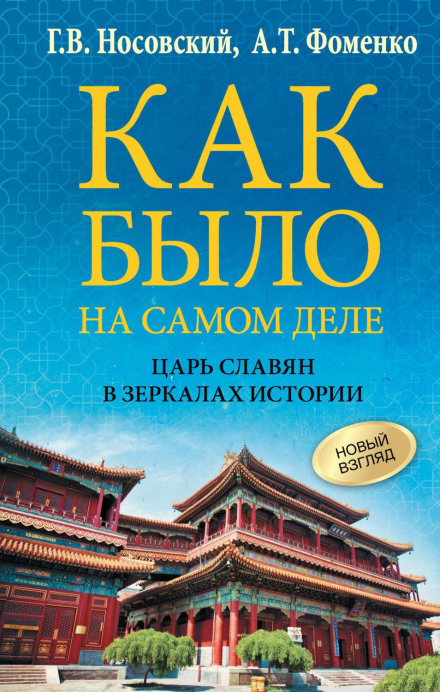
How It Really Was. The Tsar of the Slavs in the Mirrors of History
13 hrs. 42 min.
Language
Russian
Author
Gleb Nosovsky
Author
Anatoly Fomenko
Narrator
Dmitry Shabrov
Narrator
Dmitry Shabrov
Description
The famous 12th-century Chinese national hero Yue Fei turns out to be a vivid reflection of Andronicus-Christ—Andrei Bogolyubsky from the 12th century. The biography of Yue Fei was based on a version of the European Gospel brought to China by the Horde settlers in the 14th–15th centuries. This Tale was respectfully adapted—"dressed in Chinese clothes." The “biography” of Yue Fei known today contains many parallels with the biography of Andronicus-Christ.
The Persians also “took for themselves” (on paper) some central plots of the 12th-century Rus’-Horde history and “dressed them in Persian garments.” Well-known Persian characters—Selim the Precious and his enemy, the cruel king Hajjaj—turn out to be vivid reflections of Emperor Andronicus-Christ and King Herod.
Today the name Don Juan has become a common noun for a rake and seducer. It turns out this famous Spanish story is a negative anti-Gospel. It is based, it seems, on a negative version of the biography of Andronicus-Christ (that is, Andrei Bogolyubsky), extracted from medieval “Chronicles” by Nikita Khoniat and Robert de Clari.
The Persians also “took for themselves” (on paper) some central plots of the 12th-century Rus’-Horde history and “dressed them in Persian garments.” Well-known Persian characters—Selim the Precious and his enemy, the cruel king Hajjaj—turn out to be vivid reflections of Emperor Andronicus-Christ and King Herod.
Today the name Don Juan has become a common noun for a rake and seducer. It turns out this famous Spanish story is a negative anti-Gospel. It is based, it seems, on a negative version of the biography of Andronicus-Christ (that is, Andrei Bogolyubsky), extracted from medieval “Chronicles” by Nikita Khoniat and Robert de Clari.
