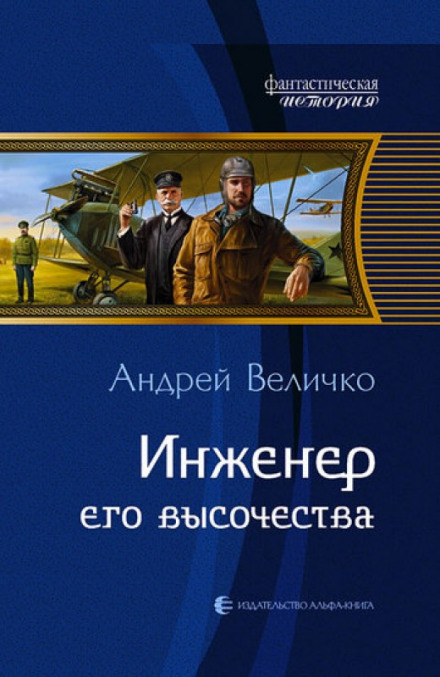
His Highness's Engineer
10 hrs. 40 min.
Language
Russian
Author
Andrey Velichko
Author
Andrey Velichko
Narrator
Alexey Yazov
Narrator
Alexey Yazov
The end of the 19th century: Russia. The Grand Prince, the heir to the throne, is ill with tuberculosis—he has only a short time left to live. And now, our hero. Age: over fifty. Occupation: an engineer-inventor. Up to the 1990s he worked at a major Moscow research institute; after the collapse of the USSR, he turned to tuning motorcycle engines.
In general, he’s satisfied with life and for his age leads an extremely active life—he flies airplanes, jumps with a parachute, and takes part in motorcycle races. It happened that he opened a portal to 1899, right to Grand Prince Georgy, who is dying of tuberculosis—a disease that at the time was considered incurable. Having brought Georgy into our world, the protagonist lays him in a clinic (as it turns out, when both the prince and the engineer are here, time in Georgy’s homeland stops) and saves him from death.
That’s essentially the premise. What can await Russia at the beginning of the 21st century for a former honored inventor, a former lead engineer, and now a pre-retirement-age motorcycle mechanic? Nothing except a meager pension. What can await, at the end of the 19th century, a sick person with tuberculosis in the final stage—even if he is the heir to the throne? Nothing except the inevitable, close death. And what will await the Russian Empire at the beginning of the 20th century? Nothing good… meaning: destruction in the fire of two lost wars and three revolutions. But what happens if you add those three “nothing” together?
In general, he’s satisfied with life and for his age leads an extremely active life—he flies airplanes, jumps with a parachute, and takes part in motorcycle races. It happened that he opened a portal to 1899, right to Grand Prince Georgy, who is dying of tuberculosis—a disease that at the time was considered incurable. Having brought Georgy into our world, the protagonist lays him in a clinic (as it turns out, when both the prince and the engineer are here, time in Georgy’s homeland stops) and saves him from death.
That’s essentially the premise. What can await Russia at the beginning of the 21st century for a former honored inventor, a former lead engineer, and now a pre-retirement-age motorcycle mechanic? Nothing except a meager pension. What can await, at the end of the 19th century, a sick person with tuberculosis in the final stage—even if he is the heir to the throne? Nothing except the inevitable, close death. And what will await the Russian Empire at the beginning of the 20th century? Nothing good… meaning: destruction in the fire of two lost wars and three revolutions. But what happens if you add those three “nothing” together?
1.
His Highness's Engineer
1.
The Engineer. 'Wings' for the Tsarevich
(narrated by
Boris Kleinberg)
2.
The Engineer. Golden Epaulettes
(narrated by
Boris Kleinberg)
2.
His Majesty's General
(narrated by
Alexey Yazov)
3.
The Gatchina Kite
(narrated by
Alexey Yazov)
3.
The Engineer: Sky Predator
(narrated by
Boris Kleinberg)
4.
Chancellor of the Empire
(narrated by
Alexey Yazov)
100%
09:39
00 Пролог
14:14
01 Гл 1
12:12
02 Гл 2
24:04
03 Гл 3
14:48
04 Гл 4
16:01
05 Гл 5
19:02
06 Гл 6
17:51
07 Гл 7
15:27
08 Гл 8
16:24
09 Гл 9
15:40
10 Гл 10
16:02
11 Гл 11
16:19
12 Гл 12
17:03
13 Гл 13
15:48
14 Гл 14
15:31
15 Гл 15
15:53
16 Гл 16
18:08
17 Гл 17
15:38
18 Гл 18
16:54
19Гл 19
17:01
20 Гл 20
15:17
21 Гл 21
19:08
22 Гл 22
15:31
23 Гл 23
15:54
24 Гл 24
16:01
25 Гл 25
17:29
26 Гл 26
16:43
27 Гл 27
14:20
28 Гл 28
16:22
29 Гл 29
15:58
30 Гл 30
17:02
31 Гл 31
15:57
32 Гл 32
16:24
33 Гл 33
15:42
34 Гл 34
16:57
35 Гл 35
15:48
36 Гл 36
16:26
37 Гл 37
14:29
38 Гл 38
06:59
39 Гл 39
01:59
40 Эпилог
