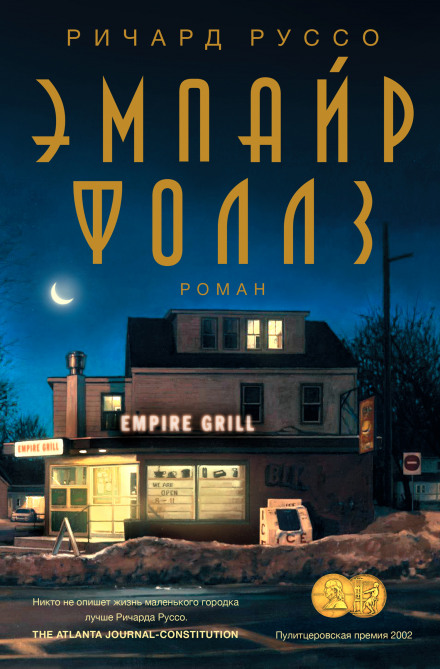
Empire Falls
25 hrs. 14 min.
Language
Russian
Author
Richard Russo
Author
Richard Russo
Narrator
Vladimir Levasheov
Narrator
Vladimir Levasheov
Description
For twenty years, Miles Roby has been cooking burgers at the “Imperial Grill.” The job cost him a higher education and a fair share of self-respect. Miles is a good guy, but in his character there’s one tragic flaw — he can’t take decisive action. And sometimes his kindness is indistinguishable from his willingness to go with the flow. Only the current in the town of Empire Falls is rather complicated. Even the river Nokс makes a loop here, sweeping away everything it gathered upstream and pinning it to the shore.
So Miles, ever since youth, has been circling around his own life instead of breaking free from his stuffy hometown. What keeps him here? Maybe the smart, tough-skinned daughter Tick, who can’t survive local school without his support. Or Janine, almost Miles’s ex-wife, who has started a romance with the endlessly self-absorbed owner of a fitness club? Or the domineering Franсine Whiting, the owner of everything the town has — and, apparently, that “everything” includes Miles himself? Or perhaps the need to care for his elderly father, who is too lively in his unbearable escapades. Or maybe it’s the secrets of the past that determined not only Miles’s life but the lives of many others in the town.
In “Empire Falls,” Richard Russo immerses the reader in the world of small-town life, where quirks, intrigue, passions, funny and tragic events are bubbling away.
“Empire Falls” is a humane novel, full of humor, compassion, sadness, and joy. In 2002, the book received the Pulitzer Prize.
Richard Russo was almost never translated into Russian (a couple of stories in the magazine version don’t count), and that’s a big oversight, because Russo is not only a major writer praised by critics, crowned with awards and loved by readers — his books should be especially close to the Russian audience.
So Miles, ever since youth, has been circling around his own life instead of breaking free from his stuffy hometown. What keeps him here? Maybe the smart, tough-skinned daughter Tick, who can’t survive local school without his support. Or Janine, almost Miles’s ex-wife, who has started a romance with the endlessly self-absorbed owner of a fitness club? Or the domineering Franсine Whiting, the owner of everything the town has — and, apparently, that “everything” includes Miles himself? Or perhaps the need to care for his elderly father, who is too lively in his unbearable escapades. Or maybe it’s the secrets of the past that determined not only Miles’s life but the lives of many others in the town.
In “Empire Falls,” Richard Russo immerses the reader in the world of small-town life, where quirks, intrigue, passions, funny and tragic events are bubbling away.
“Empire Falls” is a humane novel, full of humor, compassion, sadness, and joy. In 2002, the book received the Pulitzer Prize.
Richard Russo was almost never translated into Russian (a couple of stories in the magazine version don’t count), and that’s a big oversight, because Russo is not only a major writer praised by critics, crowned with awards and loved by readers — his books should be especially close to the Russian audience.
