Mosses from an Old Manse
5 hrs. 27 min.
Language
Russian
Author
Nathaniel Hawthorne
Author
Nathaniel Hawthorne
Narrator
Svetlana Repina
Narrator
Svetlana Repina
Description
Writing about Hawthorne is hard—not even because Hawthorne was a great writer. If you’re going to do hierarchical research, then it’s unlikely he would have made it into the top ten American writers of the last century. Let alone the top ten worldwide. The difficulty is something else. As we know, Borges wrote about Hawthorne. But then—about whom didn’t he write?
So here is the thing: there exists a set of unspoken but obligatory rules for readers. One of them says: it’s stupid to start talking about a book that Borges has already talked about. You won’t be able to say anything new anyway. And, unfortunately, that is the truth. And from it follows the necessity to refuse the conversation about books altogether. Look at the last sentence of the previous paragraph. And that’s when the question arises: why, after all, did Borges write about Hawthorne? The last sentence of the first paragraph mentioned above gives an answer to that—at least one possible one: Borges wrote about everyone who wrote before him. But with Hawthorne, it seems, it’s more complicated. Or simpler. In this particular case, I won’t be the judge.
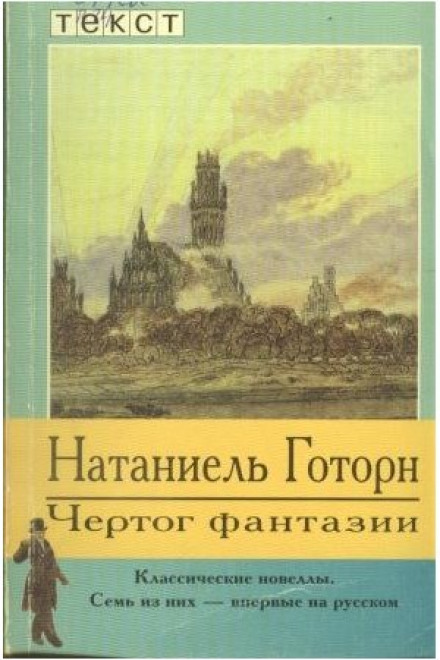
A small collection of short stories by Nathaniel Hawthorne, published by “Tekst” (“Text”), containing nine tales—not, by the way, the very best ones by this author—explains a lot. I don’t know if it happened by chance, but these very nine (seven—first time in Russian) short stories clarify better than the famous and beloved, by the way, Borges’s “The Scarlet Letter,” why Borges nevertheless noticed Hawthorne.
So here is the thing: there exists a set of unspoken but obligatory rules for readers. One of them says: it’s stupid to start talking about a book that Borges has already talked about. You won’t be able to say anything new anyway. And, unfortunately, that is the truth. And from it follows the necessity to refuse the conversation about books altogether. Look at the last sentence of the previous paragraph. And that’s when the question arises: why, after all, did Borges write about Hawthorne? The last sentence of the first paragraph mentioned above gives an answer to that—at least one possible one: Borges wrote about everyone who wrote before him. But with Hawthorne, it seems, it’s more complicated. Or simpler. In this particular case, I won’t be the judge.
A small collection of short stories by Nathaniel Hawthorne, published by “Tekst” (“Text”), containing nine tales—not, by the way, the very best ones by this author—explains a lot. I don’t know if it happened by chance, but these very nine (seven—first time in Russian) short stories clarify better than the famous and beloved, by the way, Borges’s “The Scarlet Letter,” why Borges nevertheless noticed Hawthorne.
100%
00:32
00_Gotorn
05:08
01_Vizit_01
05:07
01_Vizit_02
03:43
01_Vizit_03
05:26
02_Sobranie_01
05:06
02_Sobranie_02
05:11
02_Sobranie_03
05:05
02_Sobranie_04
05:10
02_Sobranie_05
05:18
02_Sobranie_06
05:09
02_Sobranie_07
05:04
02_Sobranie_08
05:05
02_Sobranie_09
05:10
02_Sobranie_10
05:11
02_Sobranie_11
02:07
02_Sobranie_12
05:18
03_Chertog_01
05:21
03_Chertog_02
05:40
03_Chertog_03
05:04
03_Chertog_04
05:18
03_Chertog_05
05:04
03_Chertog_06
05:12
05_Put_v_Nebesa_01
05:13
05_Put_v_Nebesa_02
05:23
05_Put_v_Nebesa_03
05:14
05_Put_v_Nebesa_04
05:14
05_Put_v_Nebesa_05
05:14
05_Put_v_Nebesa_06
05:16
05_Put_v_Nebesa_07
05:18
05_Put_v_Nebesa_08
04:32
05_Put_v_Nebesa_09
05:01
06_Vedomstvo_01
05:03
06_Vedomstvo_02
05:04
06_Vedomstvo_03
05:11
06_Vedomstvo_04
05:22
06_Vedomstvo_05
05:11
06_Vedomstvo_06
05:26
06_Vedomstvo_07
05:09
07_Iskuplenie_01
05:04
07_Iskuplenie_02
05:16
07_Iskuplenie_03
05:16
07_Iskuplenie_04
05:19
07_Iskuplenie_05
05:02
07_Iskuplenie_06
05:35
07_Iskuplenie_07
05:08
07_Iskuplenie_08
05:29
07_Iskuplenie_09
04:15
07_Iskuplenie_10
05:01
08_Zvanny_vecher_01
05:13
08_Zvanny_vecher_02
05:10
08_Zvanny_vecher_03
05:25
08_Zvanny_vecher_04
06:12
08_Zvanny_vecher_05
05:22
08_Zvanny_vecher_06
05:03
08_Zvanny_vecher_07
00:09
08_Zvanny_vecher_08
05:07
09_Poslaniya_P_01
06:17
09_Poslaniya_P_02
05:05
09_Poslaniya_P_03
05:11
09_Poslaniya_P_04
05:10
09_Poslaniya_P_05
05:18
09_Poslaniya_P_06
05:15
09_Poslaniya_P_07
05:18
09_Poslaniya_P_08
05:23
09_Poslaniya_P_09
01:48
09_Poslaniya_P_10
