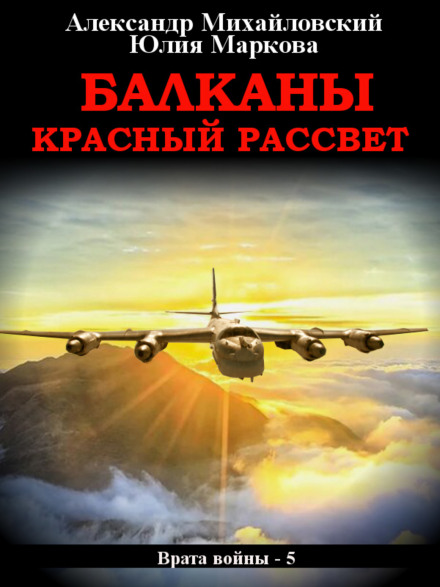
The Balkans. Red Dawn
13 hrs. 54 min.
Language
Russian
Author
Alexander Mikhaylovsky
Author
Yulia Markova
Narrator
Pyotr Korshunkov
Narrator
Pyotr Korshunkov
Thanks to the unexpected help of the Russian Federation from the 21st century, the losses of the RKKA in the summer-autumn campaign are much smaller than in our reality, and the Wehrmacht loses a third of its combat strength and irreversibly weakens. In addition, by the end of the year the Soviet Union completes its mobilization activities, and the size of the active army becomes a record twelve million men—allowing divisions on the front to be rotated while preserving their combat core. The Red Army grows not only in numbers, but is also re-armed—both with weapons arriving from the 21st century and with the production of Soviet industry, which has shifted to wartime rails.
Rotation also takes place in the Expeditionary Corps. Soldiers and officers who gained invaluable combat experience return to their time, and others take their places. The Russian Army formation in the Great Patriotic War is again ready to take part in battles.
After defeating Finland and securing its northern flank, in spring 1942 Soviet command turns its attention to the enemy Army Group “South.” Ahead lies the spring-summer campaign—the time for the final expulsion of the enemy from Soviet land.
Rotation also takes place in the Expeditionary Corps. Soldiers and officers who gained invaluable combat experience return to their time, and others take their places. The Russian Army formation in the Great Patriotic War is again ready to take part in battles.
After defeating Finland and securing its northern flank, in spring 1942 Soviet command turns its attention to the enemy Army Group “South.” Ahead lies the spring-summer campaign—the time for the final expulsion of the enemy from Soviet land.
1.
Gates of War
(narrated by
Pyotr Korshunkov)
2.
Smolensk Knockdown
(narrated by
Pyotr Korshunkov)
3.
Snow Typhoon
(narrated by
Pyotr Korshunkov)
4.
The Second Winter War
(narrated by
Pyotr Korshunkov)
5.
The Balkans. Red Dawn
6.
Operation Furious Noon
(narrated by
Pyotr Korshunkov)
7.
Beyond the Point of No Return. Morning of the Hound's Bark
(narrated by
Pyotr Korshunkov)
7.
Beyond the Point of No Return. Morning of the Hound's Bark
(narrated by
Evgeny Alexandrov)
8.
Beyond the Point of No Return. Midday of Battle
(narrated by
Pyotr Korshunkov)
9.
Beyond the Point of No Return. Victory Evening
(narrated by
Yury Ivanov)
100%
45:10
001
25:20
002
51:08
003
51:27
004
33:51
005
29:10
006
47:52
007
30:20
008
39:36
009
38:48
010
29:26
011
31:39
012
43:46
013
25:44
014
41:59
015
49:36
016
21:02
017
45:14
018
45:35
019
33:10
020
56:56
021
17:39
022
