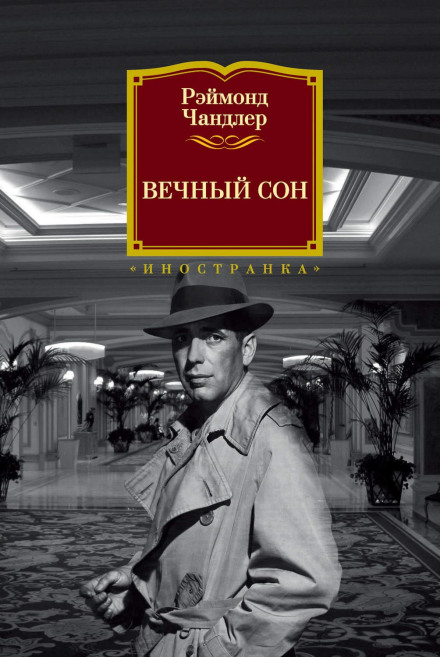
The Big Sleep
7 hrs. 36 min.
Language
Russian
Author
Raymond Chandler
Author
Raymond Chandler
Narrator
Egor Partin
Narrator
Egor Partin
Raymond Chandler’s books about Philip Marlowe not only laid the foundations of the “hard-boiled” detective genre, but also became a modern classic in the broadest sense. This edition contains the first three novels about the famous private investigator—“The Big Sleep,” “Farewell, My Lovely,” and “The High Window.” Marlowe represents a new type of detective hero: a romantic, sentimental knight who always keeps his individuality and follows a code of honor. He isn’t looking for adventures—they find him instead, and the plot, brimming with the signature dizzying twists and turns, usually begins quite innocently. Thus, in “The Big Sleep,” the retired General Sternwood hires Marlowe to deal with a swindler who’s blackmailing his younger daughter; in the first scene of “Farewell, My Lovely,” the detective merely reminds a tough guy that he has to pay for his drinks; and in “The High Window,” Mrs. Murdock, a widow, asks Marlowe to find Brashere’s doubloon—a rare gold coin stolen from her late husband’s collection…
Several benchmark film noirs have been made based on Chandler’s plots, and for many people Marlowe’s image is firmly associated with the persona of Humphrey Bogart—who played the role several times, starting with the 1946 adaptation of “The Big Sleep,” directed by Howard Hawks, with William Faulkner as co-writer. But Bogart was not the first: even before his “The Big Sleep,” two adaptations of “Farewell, My Lovely” had already been made—one in 1942 with George Sanders and another in 1944 with Dick Powell. “The High Window” was adapted twice: in 1942 under the title “Time to Kill” and in 1947 as “The Brashere Doubloon” (“Blood Money” in the Russian translation). In the latter film, Marlowe was played by the western star George Montgomery.
1.
The Big Sleep
(narrated by
Evgeny Ternovsky)
1.
The Big Sleep
2.
Farewell, My Lovely
(narrated by
Egor Partin)
2.
Farewell, My Lovely
(narrated by
Evgeny Ternovsky)
3.
The High Window
(narrated by
Egor Partin)
4.
The Lady in the Lake
(narrated by
Egor Partin)
6.
The Long Goodbye
(narrated by
Egor Partin)
6.
The Long Goodbye
(narrated by
Vladimir Shevyakov)
9.
Two Little Sisters from Honolulu (Goldfish)
(narrated by
Vyacheslav Gerasimov)
