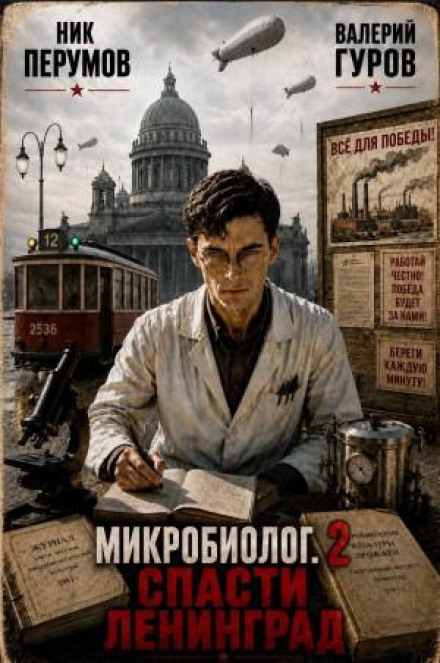
Microbiologist 2. Save Leningrad
7 hrs. 33 min.
Language
Russian
Author
Nick Perumov
Author
Valery Gurov
Narrator
Andrey Finagin
Narrator
Andrey Finagin
Leningrad is still alive: children play in courtyards, radio broadcasts sound from the windows, people believe the communiqués and wait for the enemy to be driven back soon.
But modern microbiologist Alexander Sheremetev, who on June 23, 1941 found himself in the body of a young lab assistant, knows this: in two and a half months, the siege ring around the city will close—"one hundred twenty-five blockade grams, with fire and blood half and half," frozen apartments, sleds carrying bodies along winter streets.
In his future, his family has already died of hunger, and he will not allow it to happen a second time. He has no army and no power—only knowledge, a laboratory, and a few weeks to seize equipment, save strains, and set up the production of protein, alcohol, and medicines.
The fascists want to starve Leningrad. Sheremetev will make it so that instead of a dead city they get a living fortress.
His front is the laboratory. His enemy is Hunger. The fascist will be beaten. The Russian people will endure. And until Victory will live those whom history has condemned.
But modern microbiologist Alexander Sheremetev, who on June 23, 1941 found himself in the body of a young lab assistant, knows this: in two and a half months, the siege ring around the city will close—"one hundred twenty-five blockade grams, with fire and blood half and half," frozen apartments, sleds carrying bodies along winter streets.
In his future, his family has already died of hunger, and he will not allow it to happen a second time. He has no army and no power—only knowledge, a laboratory, and a few weeks to seize equipment, save strains, and set up the production of protein, alcohol, and medicines.
The fascists want to starve Leningrad. Sheremetev will make it so that instead of a dead city they get a living fortress.
His front is the laboratory. His enemy is Hunger. The fascist will be beaten. The Russian people will endure. And until Victory will live those whom history has condemned.
100%
1:00:00
Микробиолог 2. Спасти Ленинград 01
1:00:00
Микробиолог 2. Спасти Ленинград 02
1:00:00
Микробиолог 2. Спасти Ленинград 03
1:00:00
Микробиолог 2. Спасти Ленинград 04
1:00:00
Микробиолог 2. Спасти Ленинград 05
1:00:00
Микробиолог 2. Спасти Ленинград 06
1:00:00
Микробиолог 2. Спасти Ленинград 07
33:35
Микробиолог 2. Спасти Ленинград 08
