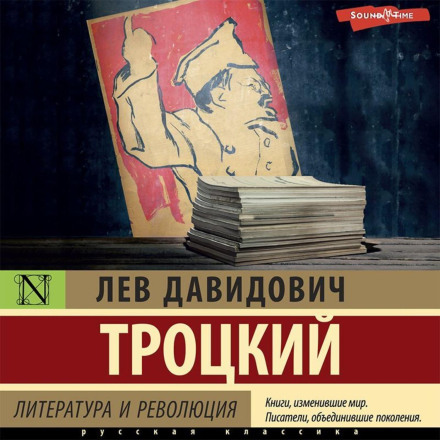
Literature and Revolution
17 hrs. 41 min.
Language
Russian
Author
Leon Trotsky
Author
Leon Trotsky
Narrator
Alexey Voskoboynikov
Narrator
Alexey Voskoboynikov
Description
Trotsky’s work, translated into many languages, was widely popular among the "left" intellectuals of the West. First published in 1923, it was later banned in the USSR and published in Russia only in 1991.
The book is based on the author’s work done in fragments over many years, from 1907 to 1923.
In his forceful and highly expressive style, the author reflects on the ideological role of art— and not only literature, but also painting, theater, and even architecture— in shaping a "new" type of personality. He harshly criticizes, on the one hand, the "proletarian arrogance" of semi-literate ideologues and the representatives of the influential bohemian avant-garde who affected them and dreamed of "throwing the old culture off the ship of modernity." On the other hand, he attacks no less sharply the traditionally patriarchal preferences in art associated with Lenin and especially Stalin (though none of them is named directly in the book).
The book is based on the author’s work done in fragments over many years, from 1907 to 1923.
In his forceful and highly expressive style, the author reflects on the ideological role of art— and not only literature, but also painting, theater, and even architecture— in shaping a "new" type of personality. He harshly criticizes, on the one hand, the "proletarian arrogance" of semi-literate ideologues and the representatives of the influential bohemian avant-garde who affected them and dreamed of "throwing the old culture off the ship of modernity." On the other hand, he attacks no less sharply the traditionally patriarchal preferences in art associated with Lenin and especially Stalin (though none of them is named directly in the book).
100%
19:23
01_00_01
54:58
01_01_01
16:39
01_01_02
05:04
01_02_01
15:58
01_02_02
05:12
01_02_03
15:17
01_02_04
29:32
01_02_05
28:39
01_02_06
11:47
01_02_07
05:51
01_02_08
05:16
01_02_09
18:24
01_03_01
1:13:55
01_04_01
06:22
01_04_02
02:11
01_05_01
43:17
01_05_02
1:01:36
01_06_01
24:51
01_07_01
59:05
01_08_01
23:07
02_01_01
29:12
02_01_02
20:55
02_01_03
05:06
02_01_04
17:37
02_01_05
20:55
02_01_06
07:08
02_01_07
09:14
02_01_08
37:10
02_01_09
41:38
02_01_10
28:23
02_01_11
14:42
02_01_12
16:58
02_01_13
16:48
02_01_14
22:50
02_01_15
36:21
02_02_01
18:02
02_02_02
54:45
02_02_03
36:16
02_02_04
41:27
02_02_05
13:23
02_02_06
27:01
02_02_07
19:09
02_02_08
