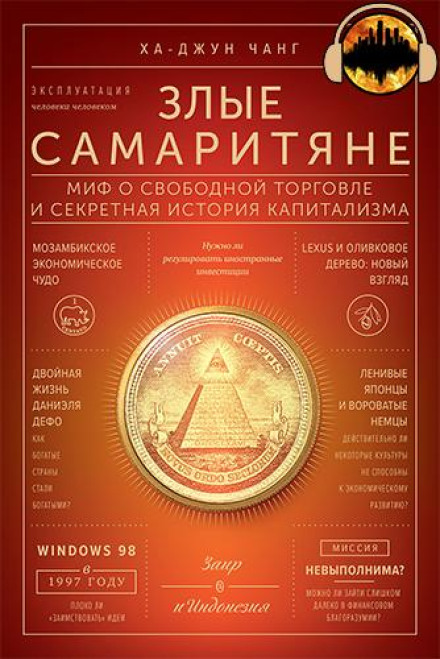
Bad Samaritans: The Myth of Free Trade and the Secret History of Capitalism
13 hrs. 0 min.
Language
Russian
Author
Ha-Joon Chang
Author
Ha-Joon Chang
Narrator
Chelovek Prostoy
Narrator
Chelovek Prostoy
Description
This book was written not for academics, but for ordinary readers who want to understand how the global economy really works and why accepted truths often turn out to be myths that benefit only those who are already rich. It is a fascinating investigation into how countries become successful and why the mission to save the world from poverty often seems impossible.
Did you know that the United States and Great Britain became the richest countries in the world not thanks to the free market, but despite it? Ha-Joon Chang, a world-renowned economist who grew up in South Korea during its rapid transformation from an agrarian country into a technological giant, reveals the “secret history of capitalism.”
The author calls modern developed nations “bad Samaritans”: they impose free-trade rules on poor countries that they themselves stubbornly ignored while climbing to the top of prosperity. This is the famous cunning trick of “kicking away the ladder,” so that no one else can use it.
In this book you will find answers to questions that can completely change the way you see the world:
Why would Toyota never have released Lexus if Japan had listened to Western experts in the 1960s?
Why was the Japanese nation once considered lazy, and the German one thieving, and how does the economy actually change the culture of an entire people?
Why is the protection of intellectual property rights sometimes like trying to forbid the poor from learning?
Why is corruption not always bad? Zaire versus Indonesia: a comparison of two dictatorships shows that corruption affects the economy in different ways. Mobutu (Zaire) and Suharto (Indonesia) stole billions of dollars, but under Suharto, incomes tripled, because he kept the looted money inside the country, creating investment and jobs, while Mobutu’s money flowed into Swiss banks.
Why did Great Britain declare war on China in 1841? The Opium Wars and “free trade”: Great Britain, which preached “liberalism,” declared war on China in 1841 solely because China tried to ban the illegal drug trade in opium, which Britain exported to reduce its trade deficit. In the end, China was forced into an “unequal treaty” that deprived it of the right to set its own tariffs.
And much more.
The author masterfully explains the complex mechanisms of globalization through simple, vivid examples: from raising a six-year-old child to the history of creating Windows 98. Chang convincingly shows that “free trade” has often been the result of military pressure rather than a voluntary choice.
In 2008, Ha-Joon Chang’s work was included in a list of twenty-three banned publications in South Korea, the author’s homeland.
Did you know that the United States and Great Britain became the richest countries in the world not thanks to the free market, but despite it? Ha-Joon Chang, a world-renowned economist who grew up in South Korea during its rapid transformation from an agrarian country into a technological giant, reveals the “secret history of capitalism.”
The author calls modern developed nations “bad Samaritans”: they impose free-trade rules on poor countries that they themselves stubbornly ignored while climbing to the top of prosperity. This is the famous cunning trick of “kicking away the ladder,” so that no one else can use it.
In this book you will find answers to questions that can completely change the way you see the world:
Why would Toyota never have released Lexus if Japan had listened to Western experts in the 1960s?
Why was the Japanese nation once considered lazy, and the German one thieving, and how does the economy actually change the culture of an entire people?
Why is the protection of intellectual property rights sometimes like trying to forbid the poor from learning?
Why is corruption not always bad? Zaire versus Indonesia: a comparison of two dictatorships shows that corruption affects the economy in different ways. Mobutu (Zaire) and Suharto (Indonesia) stole billions of dollars, but under Suharto, incomes tripled, because he kept the looted money inside the country, creating investment and jobs, while Mobutu’s money flowed into Swiss banks.
Why did Great Britain declare war on China in 1841? The Opium Wars and “free trade”: Great Britain, which preached “liberalism,” declared war on China in 1841 solely because China tried to ban the illegal drug trade in opium, which Britain exported to reduce its trade deficit. In the end, China was forced into an “unequal treaty” that deprived it of the right to set its own tariffs.
And much more.
The author masterfully explains the complex mechanisms of globalization through simple, vivid examples: from raising a six-year-old child to the history of creating Windows 98. Chang convincingly shows that “free trade” has often been the result of military pressure rather than a voluntary choice.
In 2008, Ha-Joon Chang’s work was included in a list of twenty-three banned publications in South Korea, the author’s homeland.
100%
56:05
01. Часть 01
1:07:24
02. Часть 02
1:14:56
03. Часть 03
1:14:07
04. Часть 04
1:15:10
05. Часть 05
1:05:47
06. Часть 06
1:11:30
07. Часть 07
1:25:47
08. Часть 08
1:17:34
09. Часть 09
1:05:31
10. Часть 10
1:06:30
11. Часть 11
