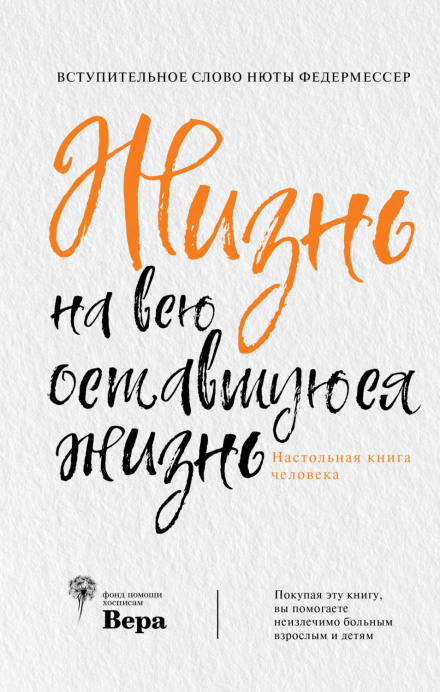
Life for All Remaining Life: A Handbook for a Person
3 hrs. 43 min.
Language
Russian
Author
Collection
Author
Collection
Narrator
Semyon Mendelson
Narrator
Irina Patrakova
Narrator
Marina Titova
Description
The Ardis audio studio presents a collection compiled and prepared by employees of the “Vera” Charitable Foundation to show that because of a serious illness, a person’s life doesn’t stop—and life is possible for the rest of their life.
“Exactly in a hospice, when you stop running and give yourself time to love, to feel pity, and to forgive—this is where every little thing becomes so important and so noticeable. Exactly here you understand that happiness is made of little things” (Nuta Federmesser). Listen, look for answers to difficult questions, try to notice the life around you and feel what this audio book was made for—the possibility of happiness here and now.
I’m sure that helping others—in every way—is a good occupation: you feel a little better yourself when you managed to help someone. Try it and see!
I talked about this with my late friend Vera Millionщикова, who organized the First Moscow Hospice. This is a difficult life task—to work in a hospice: not everyone can handle it. But in the end, only those remain who can.
However, it isn’t necessary to work in a hospice—you can help it in other ways too.
Lyudmila Ulitskaya, a member of the Board of Trustees of the “Vera” Charitable Foundation for Help to Hospices...
Nuta Federmesser, daughter of Vera Millionщикова, founder of the “Vera” hospice help fund, led us to show a miracle of miracles: people greet each other warmly, there is no gloom, no false sorrow, no meaningful silence. It feels as if I came to a jazz club. Flowers bloom, dogs live with their owners, the kitchen works 24 hours a day. If someone wants ice cream, they run to buy it. I understood that it’s almost paradise. But I decided to clarify: “Nuta, do you have miracles here?” Nuta says: “There are—come, I’ll show you.”
Tatyana Drubich, co-chair of the Board of Trustees of the “Vera” hospice help fund...
“we talk about the quality of life, we emphasize that a hospice is about living. Every person has a point of departure—that’s an undeniable fact; all of us will leave. As Camus said, it’s only a matter of time and patience. Why should the last days of a person be worse than their entire life? Now, finally, a law has been adopted stating that we have the right to pain relief, we have the right to care without pain. Probably one of the most important things in a hospice is the attitude of staff and volunteers toward patients and toward their relatives.”
Ingeborga Dapkunaite, co-chair of the Board of Trustees of the “Vera” hospice help fund
“Exactly in a hospice, when you stop running and give yourself time to love, to feel pity, and to forgive—this is where every little thing becomes so important and so noticeable. Exactly here you understand that happiness is made of little things” (Nuta Federmesser). Listen, look for answers to difficult questions, try to notice the life around you and feel what this audio book was made for—the possibility of happiness here and now.
I’m sure that helping others—in every way—is a good occupation: you feel a little better yourself when you managed to help someone. Try it and see!
I talked about this with my late friend Vera Millionщикова, who organized the First Moscow Hospice. This is a difficult life task—to work in a hospice: not everyone can handle it. But in the end, only those remain who can.
However, it isn’t necessary to work in a hospice—you can help it in other ways too.
Lyudmila Ulitskaya, a member of the Board of Trustees of the “Vera” Charitable Foundation for Help to Hospices...
Nuta Federmesser, daughter of Vera Millionщикова, founder of the “Vera” hospice help fund, led us to show a miracle of miracles: people greet each other warmly, there is no gloom, no false sorrow, no meaningful silence. It feels as if I came to a jazz club. Flowers bloom, dogs live with their owners, the kitchen works 24 hours a day. If someone wants ice cream, they run to buy it. I understood that it’s almost paradise. But I decided to clarify: “Nuta, do you have miracles here?” Nuta says: “There are—come, I’ll show you.”
Tatyana Drubich, co-chair of the Board of Trustees of the “Vera” hospice help fund...
“we talk about the quality of life, we emphasize that a hospice is about living. Every person has a point of departure—that’s an undeniable fact; all of us will leave. As Camus said, it’s only a matter of time and patience. Why should the last days of a person be worse than their entire life? Now, finally, a law has been adopted stating that we have the right to pain relief, we have the right to care without pain. Probably one of the most important things in a hospice is the attitude of staff and volunteers toward patients and toward their relatives.”
Ingeborga Dapkunaite, co-chair of the Board of Trustees of the “Vera” hospice help fund
100%
19:41
Жизнь на всю оставшуюся жизнь_ настольная книга человека - 1 - Жизнь на всю оставшуюся жизнь_ настольная книга_02
24:04
Жизнь на всю оставшуюся жизнь_ настольная книга человека - 2 - Жизнь на всю оставшуюся жизнь_ настольная книга_03
20:29
Жизнь на всю оставшуюся жизнь_ настольная книга человека - 3 - Жизнь на всю оставшуюся жизнь_ настольная книга_04
21:43
Жизнь на всю оставшуюся жизнь_ настольная книга человека - 4 - Жизнь на всю оставшуюся жизнь_ настольная книга_05
30:08
Жизнь на всю оставшуюся жизнь_ настольная книга человека - 5 - Жизнь на всю оставшуюся жизнь_ настольная книга_06
31:18
Жизнь на всю оставшуюся жизнь_ настольная книга человека - 6 - Жизнь на всю оставшуюся жизнь_ настольная книга_07
28:41
Жизнь на всю оставшуюся жизнь_ настольная книга человека - 7 - Жизнь на всю оставшуюся жизнь_ настольная книга_08
34:48
Жизнь на всю оставшуюся жизнь_ настольная книга человека - 8 - Жизнь на всю оставшуюся жизнь_ настольная книга_09
07:51
Жизнь на всю оставшуюся жизнь_ настольная книга человека - 9 - Жизнь на всю оставшуюся жизнь_ настольная книга_10
04:33
Жизнь на всю оставшуюся жизнь_ настольная книга человека - 10 - Жизнь на всю оставшуюся жизнь_ настольная книга_11
