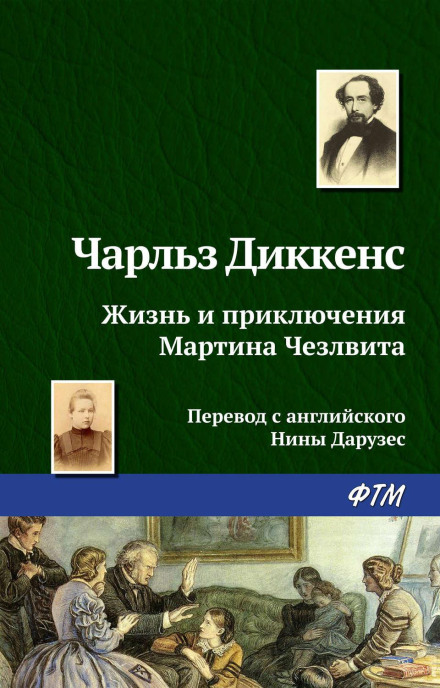
The Life and Adventures of Martin Chuzzlewit
40 hrs. 13 min.
Language
Russian
Author
Charles Dickens
Author
Charles Dickens
Narrator
Charly Smith
Narrator
Charly Smith
Description
This novel by Charles Dickens tells the story of wealthy old Martin Chuzzlewit and his complicated relationships with his many—and quite self-serving—relatives. Secretive, despotic, and suspicious, worn out by people’s hypocrisy, Mr. Martin Chuzzlewit drives away even the one relative he truly loves—his grandson. Proud and self-confident, the young man who decides to prove to his grandfather that he is capable and has means, sets out from England for recognition and fortune in America. The novel caused outrage in American public opinion over Dickens’s criticism of the American way of life described by the author. Thomas Carlyle remarked: “The Yankees boiled like an enormous bottle of soda.”
In England and in Europe, the novel was received positively. V. G. Belinsky wrote about it: “...hardly not the best novel by the gifted Dickens. It is a complete picture of modern England through the lens of manners, and at the same time a vivid—though perhaps one-sided—picture of the society of the North American States. What inventiveness! What a variety of characters, so deeply conceived and so accurately drawn! What humor! What style!… In ‘Martin Chuzzlewit’ one can see extraordinary maturity of the author’s talent; the truth is, the resolution of this novel is reminiscent of commonplaces; but that is how the resolutions are in all Dickens novels.”
The American chapters interested even the Slavophile I. S. Aksakov: “Recently I read the second part of Dickens’s novel. The description of America is very interesting, though one can see national hatred. How disgusting are the United States—these rotten fruits of Europe on foreign soil, these prematurely overripe children.”
It is also known that Dostoevsky admired Dickens: there is a suggestion that Dickens’s depiction of the psychology of the killer Jonas in ‘Martin Chuzzlewit’ may have influenced the emergence of the image of Raskolnikov. The hypocrisy of Mr. Pecksniff (“I want to love mankind—and to know that I will not be disappointed in my neighbors”) is compared with Foma Opiskin in Dostoevsky (“Give me, give me a man, so that I can love him!”). Jonas’s torment, who believed that he had killed his father, has been repeatedly compared with the dilemmas in ‘The Brothers Karamazov.’ L. N. Tolstoy also reread the novel many times.
In England and in Europe, the novel was received positively. V. G. Belinsky wrote about it: “...hardly not the best novel by the gifted Dickens. It is a complete picture of modern England through the lens of manners, and at the same time a vivid—though perhaps one-sided—picture of the society of the North American States. What inventiveness! What a variety of characters, so deeply conceived and so accurately drawn! What humor! What style!… In ‘Martin Chuzzlewit’ one can see extraordinary maturity of the author’s talent; the truth is, the resolution of this novel is reminiscent of commonplaces; but that is how the resolutions are in all Dickens novels.”
The American chapters interested even the Slavophile I. S. Aksakov: “Recently I read the second part of Dickens’s novel. The description of America is very interesting, though one can see national hatred. How disgusting are the United States—these rotten fruits of Europe on foreign soil, these prematurely overripe children.”
It is also known that Dostoevsky admired Dickens: there is a suggestion that Dickens’s depiction of the psychology of the killer Jonas in ‘Martin Chuzzlewit’ may have influenced the emergence of the image of Raskolnikov. The hypocrisy of Mr. Pecksniff (“I want to love mankind—and to know that I will not be disappointed in my neighbors”) is compared with Foma Opiskin in Dostoevsky (“Give me, give me a man, so that I can love him!”). Jonas’s torment, who believed that he had killed his father, has been repeatedly compared with the dilemmas in ‘The Brothers Karamazov.’ L. N. Tolstoy also reread the novel many times.
