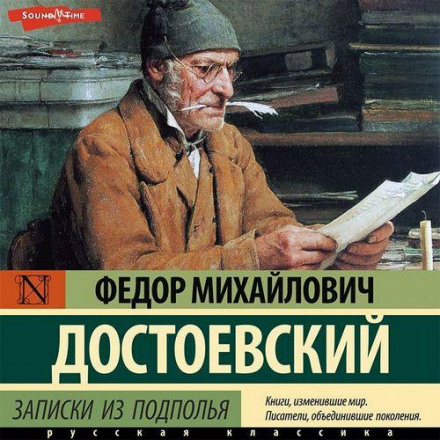
Notes from Underground. The Eternal Husband. Bobok
10 hrs. 51 min.
Language
Russian
Author
Fyodor Dostoevsky
Author
Fyodor Dostoevsky
Narrator
Georgy Arsenyev
Narrator
Georgy Arsenyev
Description
A collection of Dostoevsky’s works that exposes human vices.
The collection includes three works: the novellas “Notes from Underground” (1864), “The Eternal Husband” (1870), and the story “Bobok” (1873).
“Notes from Underground,” probably, is the most prophetic of all Dostoevsky’s works. In it, the writer in many ways anticipated the ideas of the 20th century, including the prose of Camus and Sartre; he was the first to show that irrational, incomprehensible beginnings can be more significant and more powerful than rational thought.
“The Eternal Husband” is an astonishing psychological portrait of a betrayed husband tormented by the most contradictory feelings: anger at his deceased wife, love for their shared child, and the desire to take out his rage on him; hatred for the offender who seduced his wife; and kind feelings toward the person who, once, had been his friend.
“Bobok” is a vicious satire that mocks, in grotesque form, human vices—vices that even death cannot eradicate.
The collection includes three works: the novellas “Notes from Underground” (1864), “The Eternal Husband” (1870), and the story “Bobok” (1873).
“Notes from Underground,” probably, is the most prophetic of all Dostoevsky’s works. In it, the writer in many ways anticipated the ideas of the 20th century, including the prose of Camus and Sartre; he was the first to show that irrational, incomprehensible beginnings can be more significant and more powerful than rational thought.
“The Eternal Husband” is an astonishing psychological portrait of a betrayed husband tormented by the most contradictory feelings: anger at his deceased wife, love for their shared child, and the desire to take out his rage on him; hatred for the offender who seduced his wife; and kind feelings toward the person who, once, had been his friend.
“Bobok” is a vicious satire that mocks, in grotesque form, human vices—vices that even death cannot eradicate.
100%
08:30
01 ЗАПИСКИ ИЗ ПОДПОЛЬЯ. ЧАСТЬ I. Подполье. Глава 1
07:18
02 Глава 2
09:40
03 Глава 3
04:10
04 Глава 4
06:07
05 Глава 5
03:02
06 Глава 6
13:21
07 Глава 7
12:50
08 Глава 8
07:42
09 Глава 9
04:01
10 Глава 10
08:24
11 Глава 11
29:09
12 ЧАСТЬ II. По поводу мокрого снега. Глава 1
10:28
13 Глава 2
21:09
14 Глава 3
21:32
15 Глава 4
11:05
16 Глава 5
23:16
17 Глава 6
17:10
18 Глава 7
24:07
19 Глава 8
16:22
20 Глава 9
12:14
21 Глава 10
18:00
22 РАССКАЗЫ. Вечный муж. Часть 1. ВЕЛЬЧАНИНОВ
25:37
23 Часть 2. ГОСПОДИН С КРЕПОМ НА ШЛЯПЕ
20:41
24 Часть 3. ПАВЕЛ ПАВЛОВИЧ ТРУСОЦКИЙ
17:29
25 Часть 4. ЖЕНА, МУЖ И ЛЮБОВНИК
22:44
26 Часть 5. ЛИЗА
14:54
27 Часть 6. НОВАЯ ФАНТАЗИЯ ПРАЗДНОГО ЧЕЛОВЕКА
22:24
28 Часть 7. МУЖ И ЛЮБОВНИК ЦЕЛУЮТСЯ
11:56
29 Часть 8. ЛИЗА БОЛЬНА
17:05
30 Часть 9. ПРИВИДЕНИЕ
17:28
31 Часть 10. НА КЛАДБИЩЕ
19:21
32 Часть 11. ПАВЕЛ ПАВЛОВИЧ ЖЕНИТСЯ
42:33
33 Часть 12. У ЗАХЛЕБИНИНЫХ
15:19
34 Часть 13. НА ЧЬЕМ КРАЮ БОЛЬШЕ
17:50
35 Часть 14. САШЕНЬКА И НАДЕНЬКА
19:20
36 Часть 15. СКВИТАЛИСЬ
19:05
37 Часть 16. АНАЛИЗ
19:26
38 Часть 17. ВЕЧНЫЙ МУЖ
38:33
39 БОБОК. ЗАПИСКИ ОДНОГО ЛИЦА
