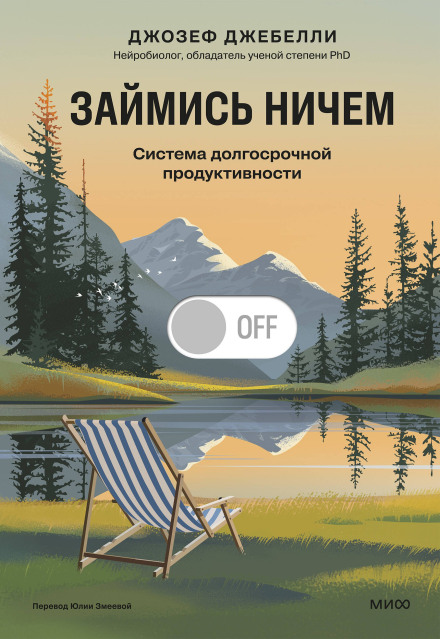
Do Nothing: The Long-Term Productivity System
7 hrs. 24 min.
Language
Russian
Author
Joseph Jebelli
Author
Joseph Jebelli
Narrator
Maxim Kireyev
Narrator
Maxim Kireyev
Description
When was the last time you truly did nothing—without a smartphone, without tasks, without endless checklists? We’ve gotten used to thinking that rest is weakness, and nonstop busyness is a measure of success. But neuroscience says the opposite: the brain urgently needs breaks. Neuroscientist Joseph Jebelli, who has gone through workaholism himself, shows that walks, meditation, and “doing nothing” aren’t a whim—they’re an essential foundation for a happy and productive life. The book brings together scientific data, real stories, and practical recommendations.
Many outstanding people knew how to slow down on purpose: Charles Darwin would go fishing and regularly rest; Maya Angelou promoted the idea of a “rest day” with baths, walks, and pauses in the park; Poincaré could spend hours aimlessly riding buses; Leonardo da Vinci would stare at “The Last Supper” for a long time, add one brushstroke—and leave.
For years we’ve been told that doing nothing is weakness of will, indulgence, and almost irresponsibility—meaning it’s the direct opposite of success. But what if it’s the other way around: people often achieve more not despite pauses, but because of them? When we allow ourselves quiet with no tasks or external stimuli, the DMN network turns on—the default mode network associated with insights, creative thinking, decision-making, and stress resilience.
The author explains how constant overload undermines cognitive abilities and health, and why attempts to “just get your act together” often only make the problem worse. This book is for those who are tired of living in an endless rush and are looking for a more sustainable, healthy, and sensible way to work and live. It’s read in the USA, Canada, Spain, Greece, China, Germany, Italy, and the Netherlands.
Many outstanding people knew how to slow down on purpose: Charles Darwin would go fishing and regularly rest; Maya Angelou promoted the idea of a “rest day” with baths, walks, and pauses in the park; Poincaré could spend hours aimlessly riding buses; Leonardo da Vinci would stare at “The Last Supper” for a long time, add one brushstroke—and leave.
For years we’ve been told that doing nothing is weakness of will, indulgence, and almost irresponsibility—meaning it’s the direct opposite of success. But what if it’s the other way around: people often achieve more not despite pauses, but because of them? When we allow ourselves quiet with no tasks or external stimuli, the DMN network turns on—the default mode network associated with insights, creative thinking, decision-making, and stress resilience.
The author explains how constant overload undermines cognitive abilities and health, and why attempts to “just get your act together” often only make the problem worse. This book is for those who are tired of living in an endless rush and are looking for a more sustainable, healthy, and sensible way to work and live. It’s read in the USA, Canada, Spain, Greece, China, Germany, Italy, and the Netherlands.
