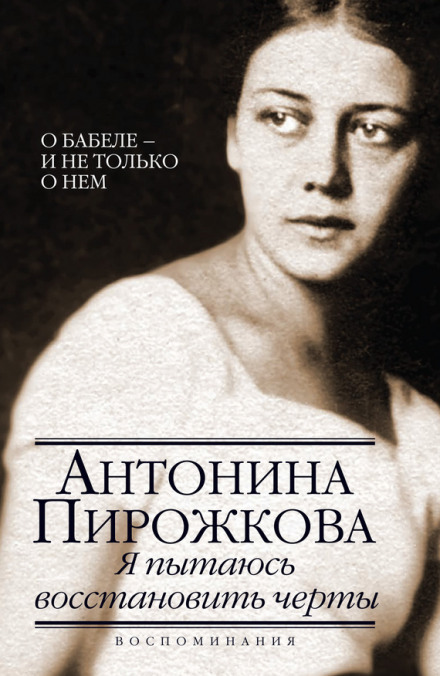
I Am Trying to Reconstruct the Features
19 hrs. 6 min.
Language
Russian
Author
Antonina Pirozhkova
Author
Antonina Pirozhkova
Narrator
Larisa Luganskaya
Narrator
Larisa Luganskaya
Description
Even during her lifetime, Antonina Nikolaevna Pirozhkova (1909–2010) was called one of the great widows. For forty years she first waited for Isaac Babel’s return—who had been arrested by the NKVD in 1939—then, as the first after the dictator’s death, secured her husband’s posthumous rehabilitation. She “pushed through” his works, gathered memories about him, and wrote her own.
In them she tried “to restore the features of a person endowed with great spiritual kindness, a passionate interest in people, and the wonderful gift of portraying them….”
That wonderful gift was given also to A. N. Pirozhkova herself. She had a direct role in creating the “grand style”; her engineering pen produced masterpieces of the Moscow metro—stations “Ploshchad Revolyutsii,” “Paveletskaya,” and two “Kievskaya” stations. This book is also, in a way, a “grand style.” Siberia, Moscow, the Caucasus, Europe—and, in essence, the entire 20th century. The memoir heroes—along with Babel, beside Babel, after Babel—include S. Eisenstein, S. Mikhoels, Y. Erdman, Y. Olesha, E. Peshkova, I. Ehrenburg, colleagues—well-known metro-construction engineers, public figures Avel Enukidze and Betal Kalmikov. And alongside them—ordinary people, regardless of rank or title—just as in Babel’s way.
In them she tried “to restore the features of a person endowed with great spiritual kindness, a passionate interest in people, and the wonderful gift of portraying them….”
That wonderful gift was given also to A. N. Pirozhkova herself. She had a direct role in creating the “grand style”; her engineering pen produced masterpieces of the Moscow metro—stations “Ploshchad Revolyutsii,” “Paveletskaya,” and two “Kievskaya” stations. This book is also, in a way, a “grand style.” Siberia, Moscow, the Caucasus, Europe—and, in essence, the entire 20th century. The memoir heroes—along with Babel, beside Babel, after Babel—include S. Eisenstein, S. Mikhoels, Y. Erdman, Y. Olesha, E. Peshkova, I. Ehrenburg, colleagues—well-known metro-construction engineers, public figures Avel Enukidze and Betal Kalmikov. And alongside them—ordinary people, regardless of rank or title—just as in Babel’s way.
100%
00:32
00_00_Pirozhkova_A_Ya_pytayus_vosstanovit_cherty_O_Babele_i_ne_tolko_o_nYom_Luganskaya_L
01:17
00_01_Annotatsiya
02:43
00_02_Soderzhavnie
19:27
00_03_01_Ob Antonine Nikolaevne Pirozhkovoy, ee knige i o tom, chto ostalos za predelami knigi
22:36
00_03_02_Ob Antonine Nikolaevne Pirozhkovoy, ee knige i o tom, chto ostalos za predelami knigi
05:43
01_01_Moi roditeli
33:39
01_02_Detstvo v sele Krasnyy Yar
36:59
01_03_Selo Bogotol- revolyutsiya nachinaetsya
19:47
01_04_01_Shkolnye gody v gorode Bogotol
20:21
01_04_02_Shkolnye gody v gorode Bogotol
19:18
01_04_03_Shkolnye gody v gorode Bogotol
27:37
01_05_01_Ucheba v Tomske
28:14
01_05_02_Ucheba v Tomske
28:29
01_05_03_Ucheba v Tomske
15:59
01_06_01_Na Kuznetskstroe- «Printsessa Turandot iz konstruktorskogo otdela»
13:50
01_06_02_V kruzhke Aleksandri
08:29
01_06_03_V Moskvu!
13:20
02_01_Pervye polgoda v Moskve
15:39
02_02_Vstrecha s Babelem
31:15
02_03_Otezd Babelya za granitsu
15:15
02_04_Avel Enukidze
10:42
02_05_Nikolay Erdman i «Veselye rebyata»
31:10
02_06_Betal Kalmykov
14:08
02_07_U Furera- pervyy Novyy god s Babelem
16:18
02_08_Metroproekt do voyny
25:02
02_09_S Babelem v Nikolovorobinskom pereulke- Andre Malro
09:38
02_10_S Babelem na Kievschine i v Odesse
08:47
02_11_Gorkiy
20:35
02_12_«Samyy veselyy chelovek iz chlenov RABISa»
21:11
02_13_Ryskind, Mihoels, Eyzenshteyn
07:21
02_14_Snova v Odesse
03:39
02_15_Emi Syao
05:21
02_16_Rabota v Metroproekte v 1937–1939 godah
17:59
02_17_Rozhdenie docheri Lidy
12:33
02_18_Lion Feyhtvanger i drugie
19:32
02_19_01_«Teper mne zhit ne dadut»
22:27
02_19_02_«Teper mne zhit ne dadut»
20:48
03_01_Voyna zastala nas v doroge
25:32
03_02_Nashi hozyaeva Arut i Olya Yanukyan
12:10
03_03_«Horosho zhivet Takush…»
09:33
03_04_1943 god
04:07
04_01_Vozvraschenie v Moskvu
22:30
04_02_01_Metroproekt posle voyny
21:51
04_02_02_Metroproekt posle voyny
25:20
04_02_03_Metroproekt posle voyny
13:01
04_03_Vstrechi i poteri- Yuriy Olesha i Veniamin Ryskind
28:00
04_04_Sudba Babelya
22:10
04_05_01_Zamechatelnye zhenschiny (Ekaterina Pavlovna Peshkova)
24:44
04_05_02_Zamechatelnye zhenschiny (Ekaterina Pavlovna Peshkova)
29:42
04_06_O detstve Lidy
12:04
04_07_Moskovskiy institut inzhenerov transporta
06:58
04_08_Semen Grigorevich Geht
06:30
04_09_Kievskie druzya
06:38
04_10_Severnaya Osetiya i Krym
03:22
04_11_Zakarpate
08:54
04_12_Uchebnik «Tonneli i metropoliteny»
04:45
04_13_Studencheskaya zhizn i zamuzhestvo Lidy
04:10
04_14_Maleevka
06:46
04_15_U Aruta i Oli
13:00
04_16_Arhiv Babelya
17:57
04_17_01_Ilya Grigorevich Erenburg
26:03
04_17_02_Ilya Grigorevich Erenburg
03:29
04_18_Kult Babelya
14:46
04_19_Poezdka v Sibir
03:47
04_20_Pereezd na novuyu kvartiru
22:55
05_01_Vengriya, 1966 god
08:37
05_02_Rozhdenie vnuka
04:08
05_03_Vengriya, 1968 god
07:56
05_04_Poslednee leto u Erenburgov
29:02
05_05_Kniga vospominaniy o Babele
20:13
05_06_Frantsiya, 1991 god
21:54
05_07_Germaniya i Italiya, 1992 god
01:56
05_08_Germaniya, 1993 god
03:54
05_09_Otezd v Ameriku
