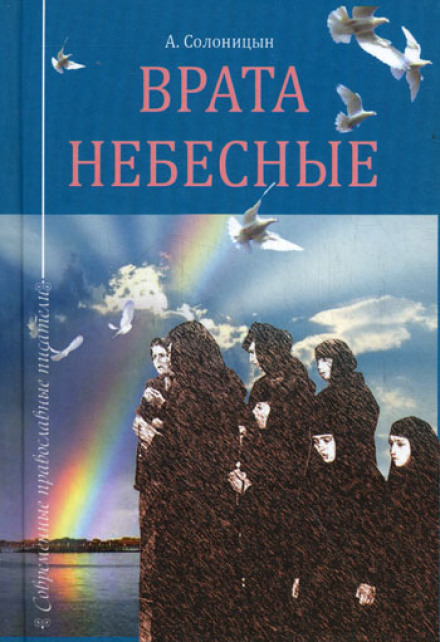
The Heavenly Gates
5 hrs. 33 min.
Language
Russian
Author
Alexey Solonitsyn
Author
Alexey Solonitsyn
Narrator
Larisa Luganskaya
Narrator
Larisa Luganskaya
Description
In a new book, Alexey Solonitsyn includes stories written recently and novellas created earlier. The characters of these works are united by service to Christ and by choosing a life path they do not deviate from a single step.
This is also Alyosha, a teenager who with his grandmother repairs the church dome in a village that is almost gone, from the story “Alyoshka’s Star”; and Patriarch Tikhon, who meets Easter in 1918 at the Marfo-Mariinsky Convent founded by Grand Duchess Elizabeth Feodorovna on the eve of their arrest and martyr’s death; and the heroes of such an wonderful story as “The Meeting That Didn’t Happen,” where, by the author’s will, Emperor Nicholas II and Anton Pavlovich Chekhov meet.
The same choice of a godfather’s (cross) path is visible in the writer’s novellas—the path that opens the gates of heaven. In my view, the novella of the same name is one of the best contemporary literary works about the new martyrs of Russia. It’s about the martyr-like feat of the sisters of the Iversky Women’s Monastery of Samara. Describing the past, the writer, in fact, speaks about the present—because “Jesus Christ is the same yesterday, today, and forever” (Heb. 13:8). The fates of seven nuns carefully and lovingly drawn by Solonitsyn resonate with modern reality more than ever.
“Oh, Lord, how far today’s people are from faith! People know about monastery life from French novels… How few people have encountered who understood that serving God is a calling, and that there is no tragedy at all in entering a monastery.” Such reasoning can belong not only to a nun at the beginning of the 20th century, but also to our confused times. The gates of heaven are open to us too. But reaching them is possible only for the one who overcomes temptations and wages constant spiritual battle. For that, faith is necessary, and “faith requires courage and spiritual strength,” Father Ilarion said, addressing Tatyana—the future nun Epsistimiya. Isn’t his call still relevant today? Propagandists like the hero of the novella Yartsev, who thinks “that the Russian people are dark and wild,” have not disappeared. Seven nuns of Alexey Solonitsyn, representing the whole social spectrum of Russia—from a peasant woman to a noblewoman—refute Yartsev’s vile lie about our people.
And in conclusion, I want to note that Alexey Solonitsyn managed the most important thing: he filled both his stories and the dramatic narrative about a modern priest, and the tragic story about the nuns—with the light of Christian optimism and warm prayer.
For which he deserves special thanks.
Protoierey Nikolay Agafonov, a member of the Union of Writers of Russia.
This is also Alyosha, a teenager who with his grandmother repairs the church dome in a village that is almost gone, from the story “Alyoshka’s Star”; and Patriarch Tikhon, who meets Easter in 1918 at the Marfo-Mariinsky Convent founded by Grand Duchess Elizabeth Feodorovna on the eve of their arrest and martyr’s death; and the heroes of such an wonderful story as “The Meeting That Didn’t Happen,” where, by the author’s will, Emperor Nicholas II and Anton Pavlovich Chekhov meet.
The same choice of a godfather’s (cross) path is visible in the writer’s novellas—the path that opens the gates of heaven. In my view, the novella of the same name is one of the best contemporary literary works about the new martyrs of Russia. It’s about the martyr-like feat of the sisters of the Iversky Women’s Monastery of Samara. Describing the past, the writer, in fact, speaks about the present—because “Jesus Christ is the same yesterday, today, and forever” (Heb. 13:8). The fates of seven nuns carefully and lovingly drawn by Solonitsyn resonate with modern reality more than ever.
“Oh, Lord, how far today’s people are from faith! People know about monastery life from French novels… How few people have encountered who understood that serving God is a calling, and that there is no tragedy at all in entering a monastery.” Such reasoning can belong not only to a nun at the beginning of the 20th century, but also to our confused times. The gates of heaven are open to us too. But reaching them is possible only for the one who overcomes temptations and wages constant spiritual battle. For that, faith is necessary, and “faith requires courage and spiritual strength,” Father Ilarion said, addressing Tatyana—the future nun Epsistimiya. Isn’t his call still relevant today? Propagandists like the hero of the novella Yartsev, who thinks “that the Russian people are dark and wild,” have not disappeared. Seven nuns of Alexey Solonitsyn, representing the whole social spectrum of Russia—from a peasant woman to a noblewoman—refute Yartsev’s vile lie about our people.
And in conclusion, I want to note that Alexey Solonitsyn managed the most important thing: he filled both his stories and the dramatic narrative about a modern priest, and the tragic story about the nuns—with the light of Christian optimism and warm prayer.
For which he deserves special thanks.
Protoierey Nikolay Agafonov, a member of the Union of Writers of Russia.
100%
00:23
00_00_Solonitsyn_A_Vrata_nebesnye_Luganskaya_L
00:57
00_01_Soderzhanie
03:06
00_02_Predislovie
05:40
01_00_Prolog
18:57
01_01_Aleksandra - sestra Feodora
08:31
01_02_Aleksandra - sestra Feodora (prodolzhenie)
26:43
01_03_Lyubov-sestra Evfrosiniya
15:24
01_04_Vera-sestra Marfa
13:41
01_05_Praskovya i Varvara
22:11
01_06_Tatyana - sestra Epistimiya
11:07
01_07_Tatyana - sestra Epistimiya (prodolzhenie)
06:35
01_08_Nadezhda - sestra Fotiniya
09:52
01_09_Nadezhda - sestra Fotiniya (prodolzhenie)
04:26
01_10_Epilog
14:02
02_01_Sudnyy den
18:06
02_02_Sudnyy den
07:27
02_03_Sudnyy den
09:15
02_04_Sudnyy den
21:37
02_05_Sudnyy den
02:39
02_06_Sudnyy den
15:44
03_01_Pasha 1918 goda
28:05
03_02_Vstrecha, kotoroy ne bylo
21:40
03_03_Malenkoy Yolochke holodno zimoy
07:28
03_04_01_AlYoshkina zvezda
05:22
03_04_02_AlYoshkina zvezda
09:48
03_04_03_AlYoshkina zvezda
06:42
03_05_Odinokiy golos fleyty
18:17
03_06_Eldorado
