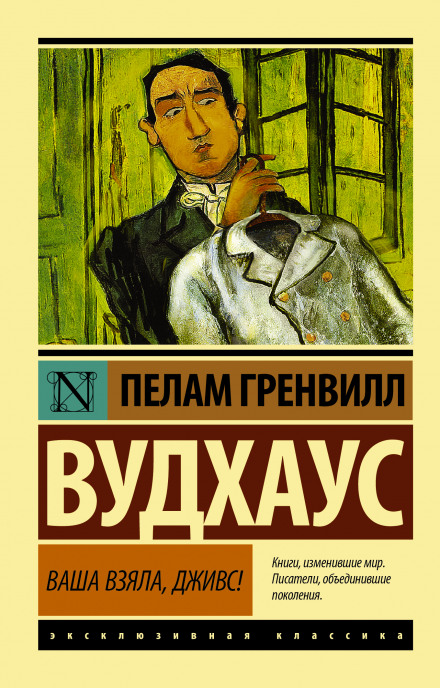
Right Ho, Jeeves
8 hrs. 49 min.
Language
Russian
Author
P.G. Wodehouse
Author
P.G. Wodehouse
Narrator
Vladimir Drыzhak
Narrator
Vladimir Drыzhak
Description
Pelham Grenville Wodehouse (Pelham Grenville Wodehouse; October 15, 1881 — February 14, 1975) carried on the world literary tradition laid down in English literature—probably as early as Shakespeare—and continued by Sterne, Swift, Stevenson, Chesterton, and Jerome.
In Russian literature, this tradition, to one degree or another, was supported by Gogol, Saltykov-Shchedrin, Dostoevsky, Bulgakov, Zoshchenko, and, of course, Ilf and Petrov.
There’s a lot one could say in praise of Wodehouse’s work— and literary scholars probably do—so the following interesting facts might convince readers who don’t read prefaces and don’t know Wodehouse to get acquainted with him.
In the summer of 1936, a strange incident occurred at one of England’s privileged schools. The teacher of English burst into the classroom, T. H. White, and said: “Chesterton is dead. Now our best writer is Wodehouse.”
It is precisely Pelham Wodehouse to whom the phrase “Elementary, my dear Watson” (“Elementary, my dear Watson”) is attributed—though Conan Doyle never used it, and it later appeared in Sherlock Holmes films. In this form, it was used for the first time in Wodehouse’s novel “Psmith, Journalist.”
The saga of Jeeves and Wooster is perhaps Wodehouse’s best-known and most widely read set of works. It can be characterized by terms like “humorous prose,” “ironic prose,” and “comedy of situations.” Wodehouse’s plots are simple, but the quality of the writer is revealed precisely in that from any plot he can make something that keeps the reader from putting the book down—sometimes even forgetting about basic needs.
Describing the relationships between the main characters of the saga, we can say the following.
Jeeves—Bertram Wooster’s personal valet and “servant for all”—has earned a well-deserved reputation among friends, relatives, and acquaintances of being an unsurpassed master of wise everyday advice—and he consistently lives up to that reputation. Wooster, in turn, considers himself an unsurpassed master of social polish and a connoisseur of relationships between the fair sex and the sex burdened with all other advantages—and, as turns out throughout the plots, his deepest and most arrogant misunderstanding. As a result, when Bertram, despite all his efforts, can’t extricate himself from another predicament that his very unloved Aunt Agatha or his beloved aunt Dalia literally drags him into, all he can do is call on the help of his valet and then, unwillingly, admit: “You’ve got it, Jeeves.”
In the chronology of the Jeeves and Wooster saga, this first novel is the one in which the foundation for the twists and turns of all the other novels is laid—their plots usually develop under the threat of Wooster’s imminent marriage to the romantic Madeline Bassett, whom (marrying her, or any other woman) he tries with all his might to avoid. Here Bertram is still trying to preserve his reputation and even to teach Jeeves. In the future, he’ll stop trying and will see Jeeves as a panacea for all his troubles in any situation.
In Russian literature, this tradition, to one degree or another, was supported by Gogol, Saltykov-Shchedrin, Dostoevsky, Bulgakov, Zoshchenko, and, of course, Ilf and Petrov.
There’s a lot one could say in praise of Wodehouse’s work— and literary scholars probably do—so the following interesting facts might convince readers who don’t read prefaces and don’t know Wodehouse to get acquainted with him.
In the summer of 1936, a strange incident occurred at one of England’s privileged schools. The teacher of English burst into the classroom, T. H. White, and said: “Chesterton is dead. Now our best writer is Wodehouse.”
It is precisely Pelham Wodehouse to whom the phrase “Elementary, my dear Watson” (“Elementary, my dear Watson”) is attributed—though Conan Doyle never used it, and it later appeared in Sherlock Holmes films. In this form, it was used for the first time in Wodehouse’s novel “Psmith, Journalist.”
The saga of Jeeves and Wooster is perhaps Wodehouse’s best-known and most widely read set of works. It can be characterized by terms like “humorous prose,” “ironic prose,” and “comedy of situations.” Wodehouse’s plots are simple, but the quality of the writer is revealed precisely in that from any plot he can make something that keeps the reader from putting the book down—sometimes even forgetting about basic needs.
Describing the relationships between the main characters of the saga, we can say the following.
Jeeves—Bertram Wooster’s personal valet and “servant for all”—has earned a well-deserved reputation among friends, relatives, and acquaintances of being an unsurpassed master of wise everyday advice—and he consistently lives up to that reputation. Wooster, in turn, considers himself an unsurpassed master of social polish and a connoisseur of relationships between the fair sex and the sex burdened with all other advantages—and, as turns out throughout the plots, his deepest and most arrogant misunderstanding. As a result, when Bertram, despite all his efforts, can’t extricate himself from another predicament that his very unloved Aunt Agatha or his beloved aunt Dalia literally drags him into, all he can do is call on the help of his valet and then, unwillingly, admit: “You’ve got it, Jeeves.”
In the chronology of the Jeeves and Wooster saga, this first novel is the one in which the foundation for the twists and turns of all the other novels is laid—their plots usually develop under the threat of Wooster’s imminent marriage to the romantic Madeline Bassett, whom (marrying her, or any other woman) he tries with all his might to avoid. Here Bertram is still trying to preserve his reputation and even to teach Jeeves. In the future, he’ll stop trying and will see Jeeves as a panacea for all his troubles in any situation.
100%
28:51
01-ВУДХАУЗ-ВашаВзялаДживс(Дрыжак)
17:17
02-ВУДХАУЗ-ВашаВзялаДживс(Дрыжак)
07:48
03-ВУДХАУЗ-ВашаВзялаДживс(Дрыжак)
13:45
04-ВУДХАУЗ-ВашаВзялаДживс(Дрыжак)
12:14
05-ВУДХАУЗ-ВашаВзялаДживс(Дрыжак)
13:16
06-ВУДХАУЗ-ВашаВзялаДживс(Дрыжак)
27:50
07-ВУДХАУЗ-ВашаВзялаДживс(Дрыжак)
17:23
08-ВУДХАУЗ-ВашаВзялаДживс(Дрыжак)
42:01
09-ВУДХАУЗ-ВашаВзялаДживс(Дрыжак)
22:23
10-ВУДХАУЗ-ВашаВзялаДживс(Дрыжак)
33:00
11-ВУДХАУЗ-ВашаВзялаДживс(Дрыжак)
17:13
12-ВУДХАУЗ-ВашаВзялаДживс(Дрыжак)
21:21
13-ВУДХАУЗ-ВашаВзялаДживс(Дрыжак)
15:25
14-ВУДХАУЗ-ВашаВзялаДживс(Дрыжак)
23:57
15-ВУДХАУЗ-ВашаВзялаДживс(Дрыжак)
30:49
16-ВУДХАУЗ-ВашаВзялаДживс(Дрыжак)
44:11
17-ВУДХАУЗ-ВашаВзялаДживс(Дрыжак)
17:03
18-ВУДХАУЗ-ВашаВзялаДживс(Дрыжак)
14:59
19-ВУДХАУЗ-ВашаВзялаДживс(Дрыжак)
24:26
20-ВУДХАУЗ-ВашаВзялаДживс(Дрыжак)
24:10
21-ВУДХАУЗ-ВашаВзялаДживс(Дрыжак)
36:44
22-ВУДХАУЗ-ВашаВзялаДживс(Дрыжак)
23:40
23-ВУДХАУЗ-ВашаВзялаДживс(Дрыжак)
