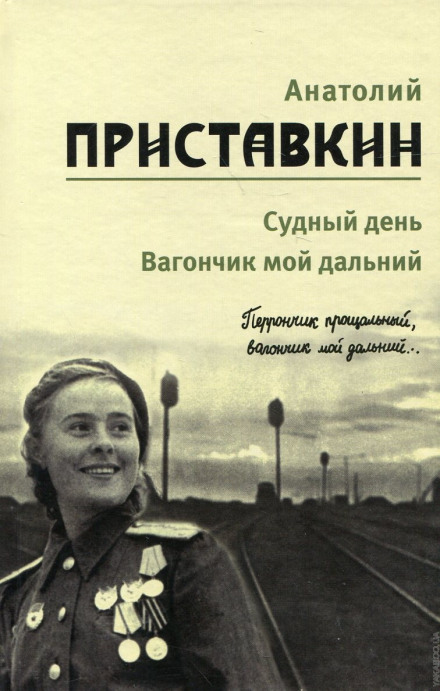
My Distant Railcar
6 hrs. 21 min.
Language
Russian
Author
Anatoly Pristavkin
Author
Anatoly Pristavkin
Narrator
Lyudmila Kungurova
Narrator
Lyudmila Kungurova
Description
A. Pristavkin’s novella “My Little Wagon” continues the autobiographical theme of the harsh world of childhood that fell on the years of war.
Contents:
The buffer plates clanged loudly. The train jerked twice and stopped.
It became quiet; only the wooden paneling of our carriage creaked as if continuing to move. Probably not only I—everyone who was here, even those who, out of habit, were dozing, tensed up, lifting their heads and trying to catch even one sound outside.
Of course, a stop isn’t the end of the journey. Not speaking of liberation.
We’d already forgotten what it means. What would we have to be liberated from, if the wagon for us isn’t only a prison, but also a home? Holding our breath, we waited: somewhere the cars rattled, the shunting “cuckoo” sounded—its piercing little voice we knew by heart. Then, in the distance, hurried steps—probably female—rather than boots, in soft fur boots—but they had nothing to do with us, with our carriage. Just like the distant, mechanical voice through the intercom of the dispatcher giving someone instructions: du-du-du… du-du-du.
Contents:
The buffer plates clanged loudly. The train jerked twice and stopped.
It became quiet; only the wooden paneling of our carriage creaked as if continuing to move. Probably not only I—everyone who was here, even those who, out of habit, were dozing, tensed up, lifting their heads and trying to catch even one sound outside.
Of course, a stop isn’t the end of the journey. Not speaking of liberation.
We’d already forgotten what it means. What would we have to be liberated from, if the wagon for us isn’t only a prison, but also a home? Holding our breath, we waited: somewhere the cars rattled, the shunting “cuckoo” sounded—its piercing little voice we knew by heart. Then, in the distance, hurried steps—probably female—rather than boots, in soft fur boots—but they had nothing to do with us, with our carriage. Just like the distant, mechanical voice through the intercom of the dispatcher giving someone instructions: du-du-du… du-du-du.
100%
05:23
01_00_Grust bez oboznacheniya
06:36
01_01_Grust bez oboznacheniya
11:30
01_02_Grust bez oboznacheniya
13:14
01_03_Grust bez oboznacheniya
12:13
01_04_Grust bez oboznacheniya
13:10
01_05_Grust bez oboznacheniya
15:55
01_06_Grust bez oboznacheniya
10:43
01_07_Grust bez oboznacheniya
03:27
01_08_Grust bez oboznacheniya
18:55
01_09_Grust bez oboznacheniya
12:02
01_10_Grust bez oboznacheniya
12:03
01_11_Grust bez oboznacheniya
15:53
01_12_Grust bez oboznacheniya
15:12
01_13_Grust bez oboznacheniya
13:00
01_14_Grust bez oboznacheniya
19:26
01_15_Grust bez oboznacheniya
03:06
01_16_Grust bez oboznacheniya
09:34
01_17_Grust bez oboznacheniya
16:23
02_18_Dikaya roza v pole
11:02
02_19_Dikaya roza v pole
18:55
02_20_Dikaya roza v pole
12:19
02_21_Dikaya roza v pole
11:48
02_22_Dikaya roza v pole
30:19
02_23_Dikaya roza v pole
16:18
02_24_Dikaya roza v pole
21:21
02_25_Dikaya roza v pole
09:48
02_26_Dikaya roza v pole
13:39
02_27_Dikaya roza v pole
08:20
03_Epilog
