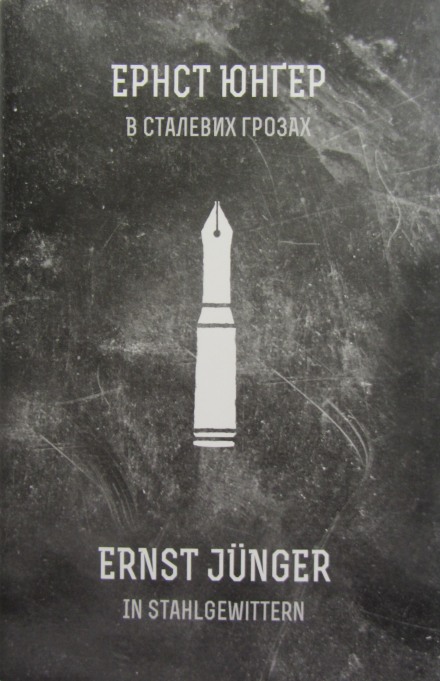
Storm of Steel
7 hrs. 22 min.
Language
Russian
Author
Ernst Jünger
Author
Ernst Jünger
Narrator
Alexander Ratnikov
Narrator
Alexander Ratnikov
Description
“In the Steel Storms” is rightfully considered the most powerful text about World War I. Published almost immediately after the Great War ended, E. Jünger’s memoirs—essentially processed front-line diary entries—went through numerous reprints and consistently enjoyed tremendous popularity.
No one among the contemporaries called the “First World War” by that name. It was called by a word that implied not only grandness, but also uniqueness: “The Great.” If it had remained unique, then Jünger’s book “In the Steel Storms” would probably have stayed the strongest work on the topic of war…
But after the First World War—shocking the imaginations of contemporaries— came the Second, which overshadowed all human experiences and caused not only a cultural turning point in European civilization, but also a break in national mindsets.
And this emphasis is felt so well in Jünger’s book: the war is described not only by a representative of high European culture (the author is a famous writer and philosopher), but also by a German—someone who feels the war precisely the way the German mentality can feel it. Anyone from other participating sides—an Englishman, a Frenchman, a Russian—feels the war differently. But such nuances were possible only until Nazism appeared, which, in the whirlwind of the world war, would blur the multi-colored national cultures of Europe so strongly. And these wounds likely will never truly heal.
But young officer Ernst Jünger still doesn’t know this. He is brave and faithful to duty. And he demands the same of his fellow countrymen.
The author of the memoirs took part in fighting on the Western Front from December 1914 to November 1918; he took part in several great battles—Somme, Passchendaele, Cambrai, the Spring Offensive, and the August Offensive. He received 14 wounds. He was awarded the Iron Cross and the Knight’s Cross of the House of Hohenzollern. For the feat accomplished at the very end of the war, in August 1918, when Lieutenant Jünger, having a through-and-through chest wound, saved his company from encirclement, he received the highest military award of Kaiser Germany—the “Pour le Mérite” order.
Ernst Jünger died in 1998, having lived to the age of 102.
No one among the contemporaries called the “First World War” by that name. It was called by a word that implied not only grandness, but also uniqueness: “The Great.” If it had remained unique, then Jünger’s book “In the Steel Storms” would probably have stayed the strongest work on the topic of war…
But after the First World War—shocking the imaginations of contemporaries— came the Second, which overshadowed all human experiences and caused not only a cultural turning point in European civilization, but also a break in national mindsets.
And this emphasis is felt so well in Jünger’s book: the war is described not only by a representative of high European culture (the author is a famous writer and philosopher), but also by a German—someone who feels the war precisely the way the German mentality can feel it. Anyone from other participating sides—an Englishman, a Frenchman, a Russian—feels the war differently. But such nuances were possible only until Nazism appeared, which, in the whirlwind of the world war, would blur the multi-colored national cultures of Europe so strongly. And these wounds likely will never truly heal.
But young officer Ernst Jünger still doesn’t know this. He is brave and faithful to duty. And he demands the same of his fellow countrymen.
The author of the memoirs took part in fighting on the Western Front from December 1914 to November 1918; he took part in several great battles—Somme, Passchendaele, Cambrai, the Spring Offensive, and the August Offensive. He received 14 wounds. He was awarded the Iron Cross and the Knight’s Cross of the House of Hohenzollern. For the feat accomplished at the very end of the war, in August 1918, when Lieutenant Jünger, having a through-and-through chest wound, saved his company from encirclement, he received the highest military award of Kaiser Germany—the “Pour le Mérite” order.
Ernst Jünger died in 1998, having lived to the age of 102.
