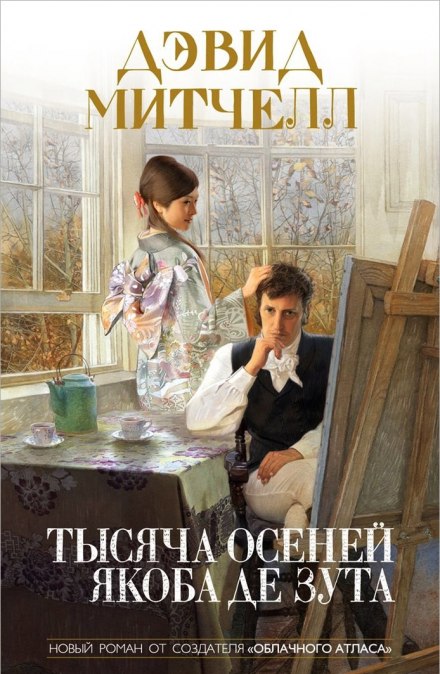
The Thousand Autumns of Jacob de Zoet
21 hrs. 27 min.
Language
Russian
Author
David Mitchell
Author
David Mitchell
Narrator
Igor Knyazev
Narrator
Igor Knyazev
Description
The end of the 18th century. A young Dutchman, Jacob de Zout, sails to Deshima—a Dutch colony in Japan. He needs to earn money—his beloved Anna’s father won’t consent to his marrying a poor man.
Jakob is sure that he will soon return to his homeland, become Anna’s husband, and the years spent in Japan will be remembered as a small adventure. But fate decides otherwise—he will have to spend almost his entire life in a foreign land, experience many things, meet love and lose it.
Mitchell skillfully weaves together a multitude of destinies, filling the world he has created with mysterious symbols and colorful details, inviting the reader to experience all the trials that fall to the hero’s lot.
Jakob is sure that he will soon return to his homeland, become Anna’s husband, and the years spent in Japan will be remembered as a small adventure. But fate decides otherwise—he will have to spend almost his entire life in a foreign land, experience many things, meet love and lose it.
Mitchell skillfully weaves together a multitude of destinies, filling the world he has created with mysterious symbols and colorful details, inviting the reader to experience all the trials that fall to the hero’s lot.
From the performer
This is a very beautiful book. I couldn’t manage the famous “Cloud Atlas”—probably the mood wasn’t right: I peeked in and closed it, thinking it was another Pavich. So, “Thousand Autumns” is completely different. As someone wrote, in essence it’s a book about the clash of two alien cultures in a closed space. That’s an accurate description, but it absolutely doesn’t reflect the literary side. From that perspective, we see a magnificent set of highly vivid characters, fascinating details, and a slow, yet sufficiently tense plot with a kind of detective-mystical framework. The peculiar style of narration—something like a fugue, where two complex sentences intertwine and create, as it were, a double angle of observation—this manner, very interesting on paper, cost me as a performer quite a lot of blood ) Another thing that catches the eye is the alternation of Japanese watercolor-like descriptions with blatant naturalism (or, quoting another review, “pleasantly stinky”). The point is clear: the effect of presence in a place and time we have never seen and never will. And it is done masterfully. I’ll add that Mitchell knows how to write great endings—tension keeps rising and in the end it is released through a set of striking psychological scenes. Everything becomes clear and nothing needs to be guessed, although many authors now love open endings. That’s not the case here: the writer has enough talent to express things with maximum clarity and power. By the setting, I also thought of Akunin’s “Diamond Chariot,” though, of course, de Zout is much more realistic.
In short: one of the best books lately—thank you to those of you who pointed me to it ) And, of course, thanks to Sveta for proofreading, to Igor Mal’tsev for cleaning up the text, to Dima for adapting the book cover design, and to Viktor Weber and the EXMO publishing house for a good translation.
In short: one of the best books lately—thank you to those of you who pointed me to it ) And, of course, thanks to Sveta for proofreading, to Igor Mal’tsev for cleaning up the text, to Dima for adapting the book cover design, and to Viktor Weber and the EXMO publishing house for a good translation.
100%
00:29
00_00_Mitchell_D_Tysyacha_oseney_Yakoba_de_Zuta_Knyazev_I
01:06
00_01_Avtorskoe predislovie
17:36
01_01_Dom Kavasemi, nalozhnitsy, nad Nagasaki
12:40
01_02_Kayuta kapitana Leysi na korable «SHenandoa»
22:06
01_03_01_Na sampane, prishvartovannom k «SHenandoa»
24:06
01_03_02_Na sampane, prishvartovannom k «SHenandoa»
21:47
01_04_01_Ryadom s ubornoy u sadovogo domika na Dedzime
25:51
01_04_02_Ryadom s ubornoy u sadovogo domika na Dedzime
35:08
01_05_Sklad «Kolyuchka» na Dedzime
22:30
01_06_01_Komnata Yakoba v Vysokom Dome na Dedzime
21:32
01_06_02_Komnata Yakoba v Vysokom Dome na Dedzime
28:04
01_07_01_Vysokiy Dom na Dedzime
27:31
01_07_02_Vysokiy Dom na Dedzime
21:15
01_08_01_Paradnyy zal v rezidentsii direktora na Dedzime
22:19
01_08_02_Paradnyy zal v rezidentsii direktora na Dedzime
21:26
01_08_03_Paradnyy zal v rezidentsii direktora na Dedzime
39:01
01_09_Apartamenty klerka de Zuta v vysokom dome
21:17
01_10_01_Ogorod na Dedzime
24:32
01_10_02_Ogorod na Dedzime
25:22
01_11_Sklad «Dub»
34:12
01_12_Paradnyy zal v rezidentsii direktora na Dedzime
38:22
01_13_Flagovaya ploschad na Dedzime
32:33
02_14_Nad derevney Kurozane v Feode Kioga
38:01
02_15_Dom Sester v monastyre na gore Shiranui
32:53
02_16_Akademiya Shirando v rezidentsii Otsuki v Nagasaki
37:03
02_17_Altarnaya komnata v Dome Sester hrama na gore Shiranui
33:32
02_18_Operatsionnaya na Dedzime
28:12
02_19_Dom Sester, hram na gore Shiranui
27:18
02_20_Dvesti stupeney k hramu Ryugadzi v Nagasaki
38:17
02_21_Kelya Orito v dome Sester
26:07
02_22_Komnata Shuzai v ego dodzYo v Nagasaki
12:44
02_23_Kelya Yaioi v dome sester hrama na gore Shiranui
30:59
02_24_Komnata Ogavy Mimasaku v rezidentsii Ogavy v Nagasaki
10:29
02_25_Apartamenty vladyki — nastoyatelya v hrame na gore Shiranui
18:30
03_27_Dedzima
23:16
03_28_01_Kayuta kapitana Pengaligona na bortu korablya «Feb»
26:27
03_28_02_Kayuta kapitana Pengaligona na bortu korablya «Feb»
32:11
03_29_Neopredelennoe mesto
38:56
03_31_U poruchney baka korablya «Feb»
16:28
03_32_Storozhevaya bashnya Dedzimy
10:38
03_33_Zal Shestidesyati Tsinovok v magistrature
34:53
03_34_Kayuta kapitana Pengaligona na bortu korablya «Feb»
24:05
03_35_01_Morskaya komnata rezidentsii direktora na Dedzime
25:24
03_35_02_Morskaya komnata rezidentsii direktora na Dedzime
21:50
03_37_01_Kayuta kapitana Pengaligona
24:04
03_37_02_Kayuta kapitana Pengaligona
20:02
03_37_03_Kayuta kapitana Pengaligona
21:02
03_38_01_Storozhevaya bashnya na Dedzime
19:51
03_38_02_Storozhevaya bashnya na Dedzime
37:08
03_39_S verandy komnaty posledney hrizantemy v magistrature
21:11
04_40_Hram na gore I Nasa nad Nagasaki
15:01
05_41_Kvarterdek «Proroka», Nagasakskaya Buhta
