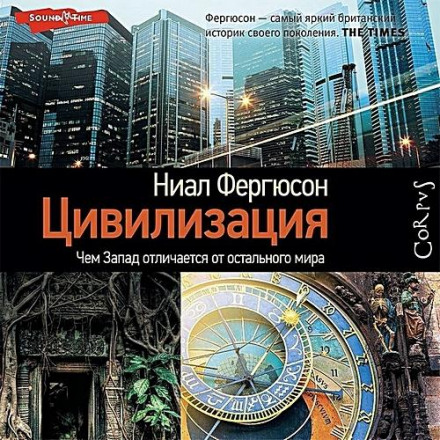
Civilization: The West and the Rest
12 hrs. 32 min.
Language
Russian
Author
Niall Ferguson
Author
Niall Ferguson
Narrator
Ilya Dementyev
Narrator
Ilya Dementyev
Description
At the start of the 15th century, the world looked very different from today. We would have been struck by the contrast between powerful Asia and Europe suffering from hunger, civil wars, and epidemics; between anarchic North America and the empires of Central and South America. The idea that the West could dominate the world—militarily, economically, or culturally—would have seemed strange. Nevertheless, over the next half millennium, Western countries set the tone. The notorious British historian reconstructs the “recipe for the West’s success” and asks whether it’s really time, in our days, to talk about its “decline.”
“ I’m trying to remember where and when I first asked myself that question: in 2005 in Shanghai, walking along the Bund? Or in 2008 in smoky, dusty Chongqing, trying—after following a local communist official—to see, in a huge pile of rubble, the financial Mecca of China’s South-West? Or did it happen in 2009 at Carnegie Hall? I sat there, hypnotized by the music of Angel Lam—an astonishingly talented young Chinese composer embodying the ‘orientalization’ of the classics. Yes, probably at the end of the first decade of the 21st century, I clearly understood: the end had come to 500 years of Western power.
And here is the question that seems to me the most interesting of the ones facing historians of the modern era: why, starting around 1500, did a handful of small states on the western edge of Eurasia begin to rule the rest of the world—including densely populated, developed countries of Eastern Eurasia? And if we can find a convincing explanation for Western dominance, can we predict its future? Are we really witnessing a new flourishing of the East? Are we seeing the end of an era in which a large share of the world’s population, to one degree or another, was subordinate to the civilization that arose in Western Europe in the age of the Renaissance and Reformation—driven by the scientific revolution and the Enlightenment, reaching even the islands of the Antipodes and reaching the peak of its power in the century of revolutions, industry, and empires? ”
Niall Ferguson
“ I’m trying to remember where and when I first asked myself that question: in 2005 in Shanghai, walking along the Bund? Or in 2008 in smoky, dusty Chongqing, trying—after following a local communist official—to see, in a huge pile of rubble, the financial Mecca of China’s South-West? Or did it happen in 2009 at Carnegie Hall? I sat there, hypnotized by the music of Angel Lam—an astonishingly talented young Chinese composer embodying the ‘orientalization’ of the classics. Yes, probably at the end of the first decade of the 21st century, I clearly understood: the end had come to 500 years of Western power.
And here is the question that seems to me the most interesting of the ones facing historians of the modern era: why, starting around 1500, did a handful of small states on the western edge of Eurasia begin to rule the rest of the world—including densely populated, developed countries of Eastern Eurasia? And if we can find a convincing explanation for Western dominance, can we predict its future? Are we really witnessing a new flourishing of the East? Are we seeing the end of an era in which a large share of the world’s population, to one degree or another, was subordinate to the civilization that arose in Western Europe in the age of the Renaissance and Reformation—driven by the scientific revolution and the Enlightenment, reaching even the islands of the Antipodes and reaching the peak of its power in the century of revolutions, industry, and empires? ”
Niall Ferguson
